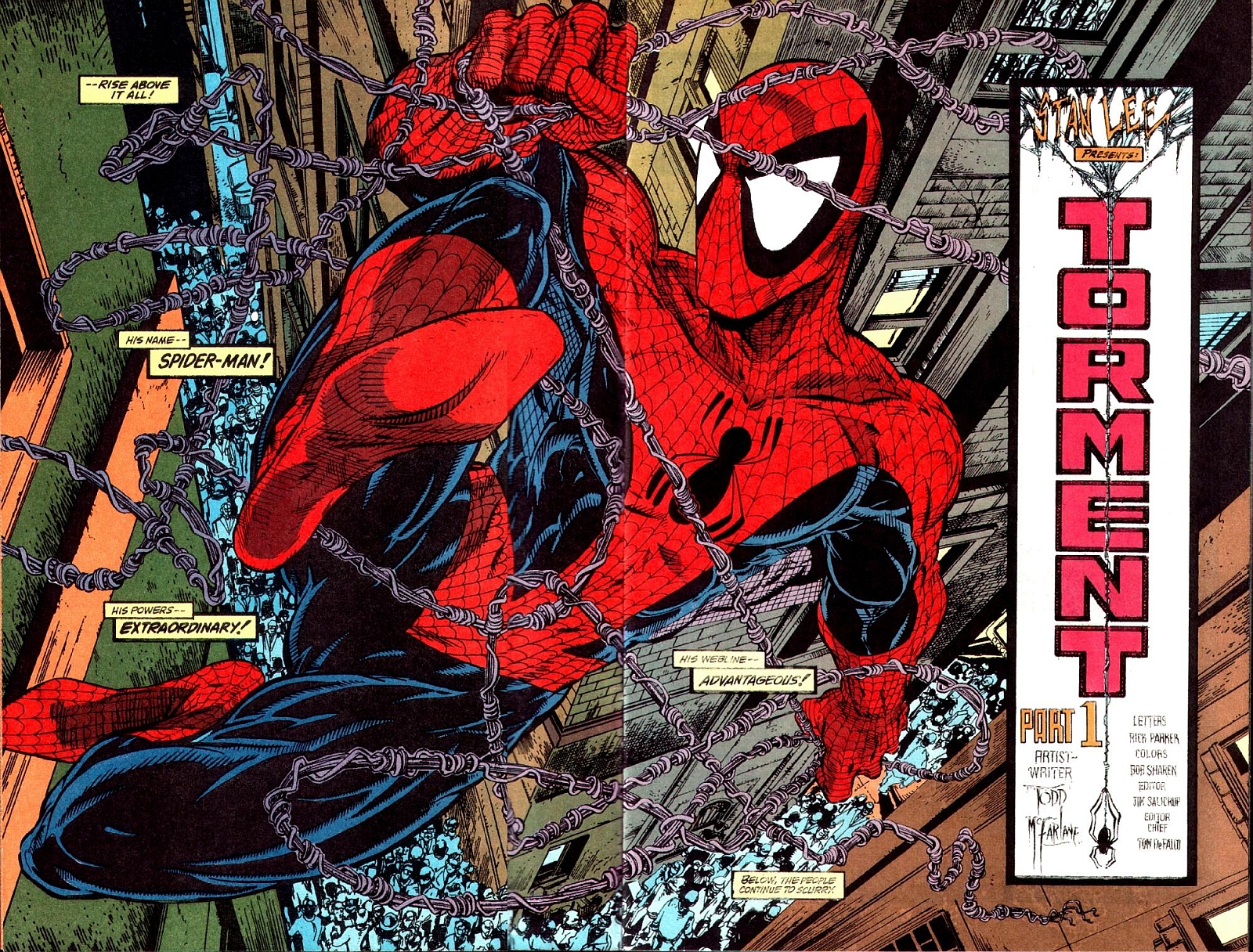
Today is the launch of Amazing Spider-Man #1 and The Amazing Spider-Man 2 comes out in theaters tomorrow. How fitting, then, that Wired gives us a great article about the physics behind Spidey’s most famous piece of paraphernalia, his webs. Being an engineer, I’m familiar with most of the equations used in the article, but I had never put much thought into what the physical requirements must be for the webs. To pull of some of Spidey’s more impressive feats, the webs would need to be five times stronger than a steel cable.
Nobody draws Spider-Man’s webs quite like Todd McFarlane.
I also really enjoyed the preemptive comment responses. This man has dealt with the internet before.
Observing un-contacted native tribes has always been a tough thing to do. Frequently contact eventually results the destruction of the very culture that is being observed. In an effort to prevent this from happening but still learn about the tribes, researchers are turning to Google Earth to monitor the behavior and activity of some tribes. This form of observation will also help set up buffer regions around the tribes to prevent inadvertent contact.
I see you…
While this is a pretty great use of technology, it’s also a high tech form of voyeurism. Just a little creepy.
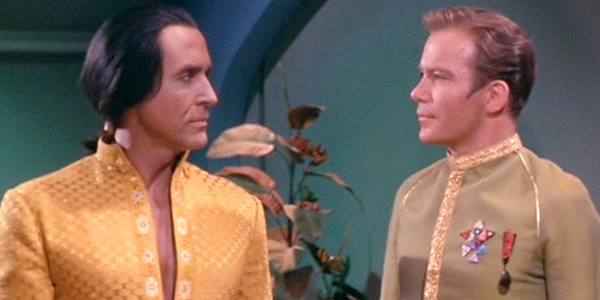
NASA has chosen to honor none other than William Shatner with their highest award, the Distinguished Public Service medal. This is a real no brainer. I’d bet considerable amounts of money that you couldn’t walk twenty feet in a NASA building without finding someone who has been inspired by the adventures of Captain James T. Kirk and his successors. Shatner has also been a vocal supporter of the NASA and of space exploration in general.
William Shatner with Ricardo Montalban in the episode “Space Seed”.
I had no idea he was Canadian. Guess I’m not quite the trekkie I thought I was. 😦
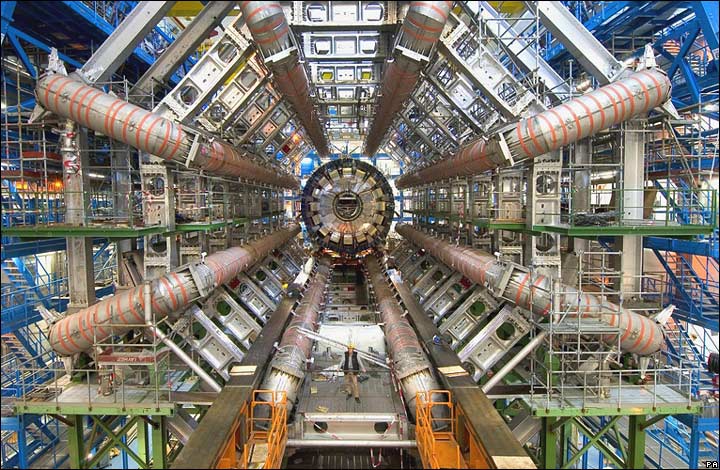
Today CERN announcedthat they have unambiguous proof of a new exotic hadron. Hadrons are subatomic particles that aid in creating the strong nuclear force that binds atoms together. These new hadrons do not fit in to the current quark model, however, which means that scientists will need to revisit the existing model in order to account for these particles. It’s always really awesome when scientists find out that the universe doesn’t quite work the way they thought it did, because every time it happens humans improve their understand of how things really work.
CERN’s Large Hadron Collider
I’d also like to take a moment to point out that–as has happened with other things–I thought baryons were fictitious Star Trek inventions. Once again, foiled by Gene Roddenberry
Back in the day, a navy’s fighting power was measured by the strength of its battleships. With the emergence of the aircraft carrier during WWII, the battleship took a back seat and they have since all been decommissioned. Still, without the battleships’ big guns, there is something missing in the Navy’s arsenal–the ability to “put steel on target” as I have heard it put. Now the US Navy is getting ready to implement the use of rail guns. These weapons can put a non-explosive round on a target up to 100 miles away and the projectile travels in excess of mach 7. (By the way, mach 7 is just over 5,300 mph, which is eighty-eight times faster than the average car on the highway.)
Not only is this weapon super cool, but it can be operated by one sailor and is extremely cost efficient as well. Each round costs $25,000 compared to missiles which range in price from $0.5 million to $1.5 million a piece.
As it turns out, there is a link between use of antibacterial soaps and increased bacterial growth. Persons who have an increased level of triclosan have also shown increased levels of Staphylococcus aureus. When the bacteria are exposed to non-lethal doses of antibiotics they tend to latch on to crevices and hide in biofilms. This leads to a corresponding increase in the amount of bacteria present and can cause an increased risk of infection if that person is undergoing surgery.
Staphylococcus aureus
This seems like a particularly appropriate story right now, given that I’ve got some bacteria that are laying me low at the moment.
“Then said they unto him, Say now Shibboleth: and he said Sibboleth: for he could not frame to pronounce it right.” Judges 12:6 KJB
The ancient Israelites used the word shibboleth as a passcode to prevent enemies from entering into their midst. In much the same way, modern geeks use various phrases and inside jokes to determine those who are one of them, and those who are “outsiders”.
The concept of the geek shibboleth isn’t mine. While accidentally sitting in a discussion panel for The Princess Bride at MarsCon, one of the audience members said that “Inconceivable!” was the geek shibboleth. When one geek says “Inconceivable!” and his companion responds, “You keep using that word. I do not think it means what you think it means” the geek knows that not only has his erstwhile companion, now dare I say friend, has seen The Princess Bride, but that he knows it well enough to have learned the lines and feel comfortable in repeating them in public. In short, he is one of us. It’s likely these two have other favorite movies, books, and shows in common. It won’t be hard for them to start building a friendship. This got me thinking (and as we all know, that is a dangerous thing). Sure, I agree that “Inconceivable!” is a password that grants access into world of geeks, but I believe that there are plenty of other examples that could also be considered a shibboleth.
The best example I can think of is also one of the most classic: “May the force be with you.” In the documentary Galaxy of Dreams they describe the phrase as being used in the 1970s by those who had seen Star Wars to identify other people who had seen the movie. It’s simple yet effective. For those in the know, nothing else needs to be said, and for those who don’t know, the phrase passes without notice. It was one of the earliest phrases that had wide spread usage in the geek community, and was often seen on bumper stickers and t-shirts. Unfortunately at this point, everyone knows “May the Force be with you,” so its function as a password is probably not useful as it once was. In its current form it serves as more of a legend to denote to the rest of the world that here be geeks.
“Hodor”
So what’s the difference between a shibboleth and just another great one-liner? While one-liners are lots of fun to quote, they don’t quite have the same meaning behind them. They don’t open the door to the universe like a shibboleth does. Game of Thrones has hundreds of great lines, but only a few of them are so readily identified with the show that they will immediately bring to mind the world these lines occupy. Among those are “Winter is coming,” “John Snow knows nothing,” and “Hodor”.
“John Snow knows nothing” is perhaps the best one, if for no other reason than it’s not actually a quote. Nobody in the series actually says that line, but it’s something that has become associated with the show. The second I say it to someone who has seen the show, they are instantly in the mind set of Game of Thrones, whether they agree with the sentiment or not. Another great example of the not-quite-a-quote is “Beam me up Scotty.” Captain Kirk never actually said that in The Original Series—though he does say several variations on that theme. Still, to millions of Trekkies and other geeks, it is a code word.
Apparently, this man knows nothing.
There is no one single password that will get you admitted into the halls of geekdom. This is due in large part to the sheer size of what is considered geeky. Maybe back in the 1950’s this would have been easier because the geek canon was so much smaller, but nowadays it’s not so simple. Some of us choose to be jacks of all trades and know something about everything, and therefore know most of the major phrases that let us into the societies of many fandoms. Others choose to be masters of their chosen genre and know every little detail and every quotable phrase.
Oddly enough, geeks have never been the most approachable people, which is probably why we have embraced this idea of a “passcode” to determine if people are already in the know. If we are not careful however, we can exclude those who are genuinely interested. This kind of thing does us an injustice and perpetuates stereotypes. We must be careful to be welcoming while retaining that which makes us geeks, passwords included.
There is a curse on our society. It is a dangerous and insidious plague that works its way into the very heart of the most precious part of our lives: our entertainment. I am, of course, referring to DVD bonus features. While tempting and tantalizing, they have cursed us with the knowledge of what might have been. This extra content often reveals the director’s original vision, before things like budget and other physical constraints get in the way. Without this knowledge, fans are more than happy with the final product, but with the additional knowledge we begin to ask ourselves how much more would we have loved what might have been.
An artists vision of what Starship Trooper‘s power armor looks like.
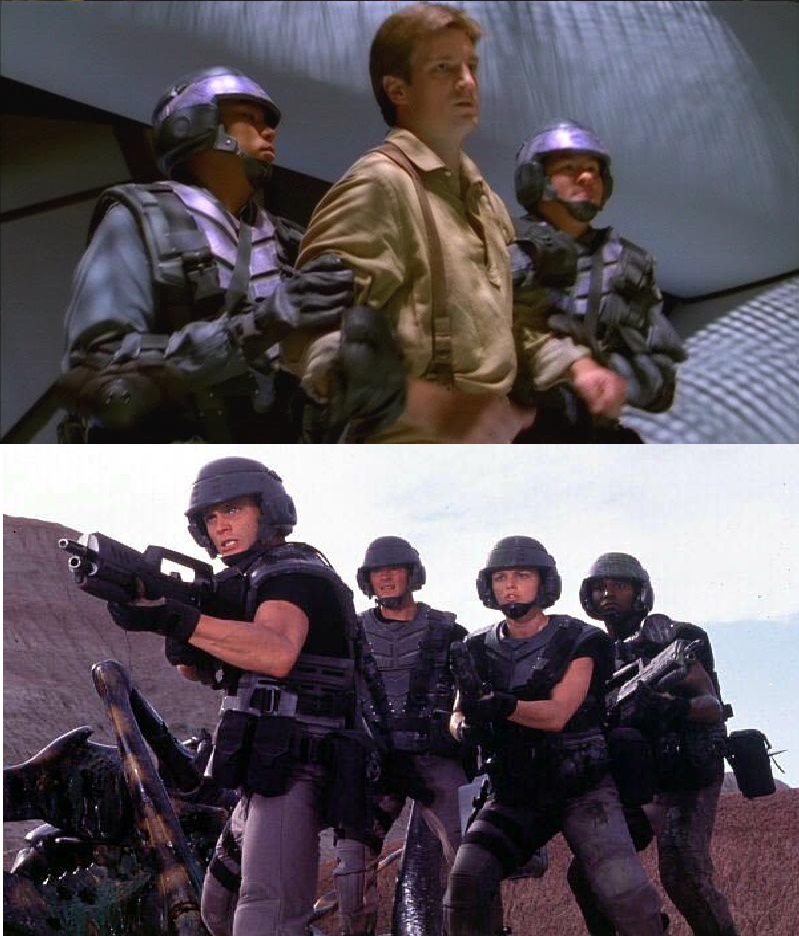
Starship Troopers is my favorite book, hands down. I’ve read it at least a half dozen times. Robert Heinlein crafted a fantastic science fiction universe, and the centerpiece of that universe is the Mobile Infantry, with their suits of powered armor. These suits protect the infantrymen and provide them with enhanced strength, sensory perception, communications, and weaponry. These suits are described in the book as looking like giant, armored gorillas. Of course, this is not what appeared in the film. Instead, it was a box office disaster that didn’t have powered armor at all. That being said, the movie has some redeeming qualities as a B movie and I was willing to accept the movie for what it is—that is, until I saw the special features. In them, director Paul Verhoeven spoke very excitedly about what he was planning to do with the suits. Special feature interviews with Verhoeven show various concepts of what the suits might have looked like and, while they were all very different, they were all really cool looking. Instead we got really crappy body armor (This same armor made an appearance in episode two of Firefly). Had I never seen Verhoeven’s original vision, I would have never expected anything other than the final movie version.
If you thought the armor looked familiar, you are not going crazy.
While Starship Troopers was an all-around disappointment, of which the armor was just one small part, J.J. Abrams’ Star Trek was an awesome film. Abrams was able to successfully reboot the franchise while still retaining the aesthetic, the positive vision of the future, the characterizations, etc. that made Star Trek so amazing in the first place.
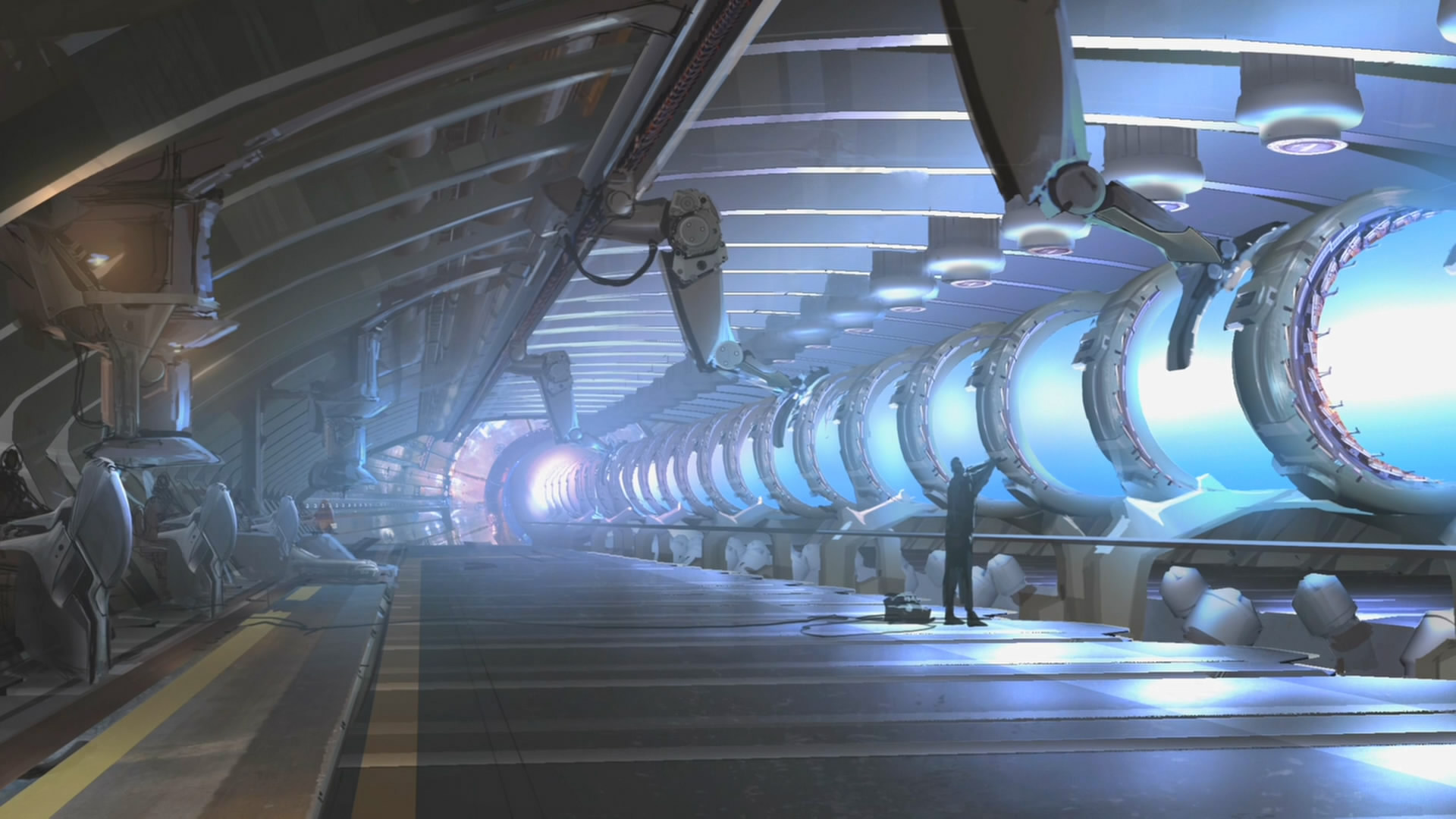
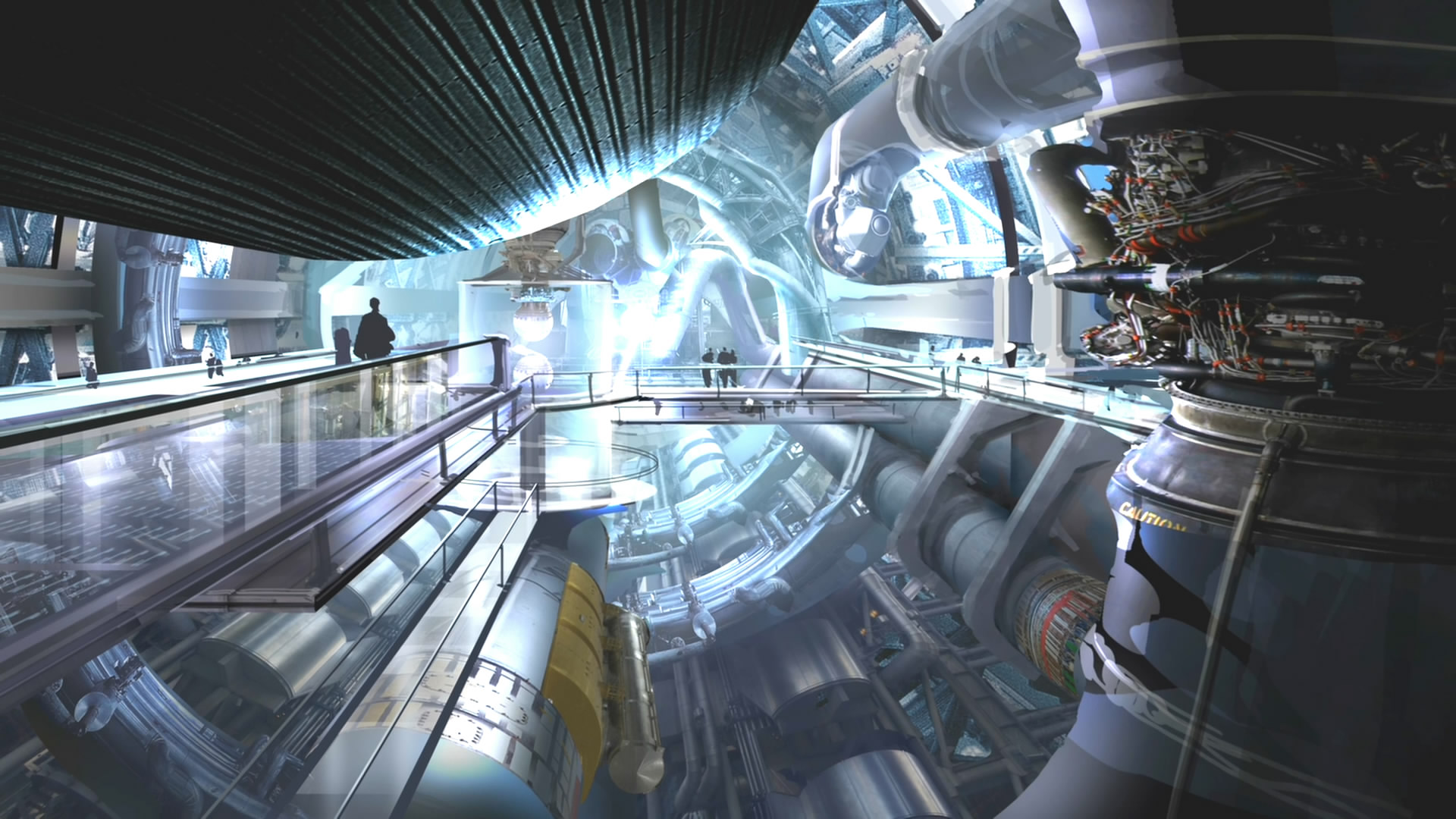
Accompanying the reboot is a refreshingly streamlined Enterprise. Everything looks so shiny and sleek. Well, almost everything. The engineering spaces are completely out of place with the new look. They have more in common with the engine room of a modern cargo ship than with any of the previous incarnations of Star Trek engineering spaces. I felt that this disconnect detracted from the film and for quite a while I was forced to wonder why J.J. Abrams made that particular choice. When my answer finally came, I was both pleased and disappointed. Again, thanks to DVD special features (ok, this time it was Blu Ray) I was shown the original designs for engineering. Everything I could have hoped for, it was streamlined, and meshed perfectly with the rest of the redesign. So what the hell happened? Turns out it was the almighty dollar sign. There just wasn’t enough money in the budget to make everything happen, and since it isn’t as integral to the film, engineering was forced to take one for the team. Unfortunately, now that I have seen the concept art, I can’t help but think about what the engine room could have looked like and how cool it would have been.
Of course DVDs are not the only place to get these kinds of behind the scenes secrets. Thanks to the internet there is a plethora of information and it usually doesn’t take more than thirty seconds of searching on Google to find it. In recent years studios have gone so far as to release concept art well in advance of the movie’s release in order to drum up as much excitement and anticipation as possible. I’ve always thought this was tremendously risky. What if the final product doesn’t live up to the expectations of the fans? If they didn’t already have this information, they would have never known and might have been satisfied with what they actually got.
DVD special features are great. They can be lots of fun, but they also carry with them the inherent danger of ruining the final product for the fans. One must be careful not to become too fixated on those things that might have been. Instead we should be content with what we have and leave the speculation for someone else.







 Therefore I Geek