Category Archives: Editorial

Editorial | What Makes a Strong, Female Character

Strong, female characters are one of my favorite topics on which to wax eloquent and passionate.  As Andrew and other friends can tell you, my “Strong, Female Character” rant makes me a huge hit at parties all the time.  All it requires is for one person to mention nonchalantly that George R. R. Martin is known for writing these strong female characters and the entire group is in for an evening full of fun entertainment.

It is best to start on the discussion of strong, female characters by determining what exactly that term means.  The easiest way to start defining the phrase is to list the females in books and other media that are commonly considered strong.  Catelyn Stark is fan favorite.  She is the wife of Eddard Stark, the lord of the northern section of A Song of Ice and Fire’s Seven Kingdoms.  She watches over the household while Eddard has been called away to be the king’s right hand man, and then leaves her family to warn him about a possible plot to kill him in the capital.

Eowyn, a daughter of Rohan from Tolkien’s Lord of the Rings, has been called strong as well.  She is the only person left at Meduseld who can keep things running at all, since her brother, Eomer is angrily riding across Rohan, her uncle the king has been possessed by Saruman, her cousin Theodred is lying on his deathbed after a fight with some Uruks, and Grima Wormtongue, the king’s steward, is an evil, lying bastard.

Last but not least, my foreshortened list of strong female characters would not be complete without Aerin, from Robin McKinley’s The Hero and the Crown.  Unhappy that she is not living up to her father’s expectations, Aerin sets out to fight the mighty dragon Maur.  She defeats him, but is very badly injured in the process.  She makes her way to a healer, who gets her set to rights just in time for her to lead an army of her people against the invading demons from the North.

Many authors create female characters that they believe to be strong.  The word that I hear most often is “complex.”  The author creates a girl or a woman who must be completely human, and especially heir to human fallibility.  The character must meet the challenge, fall before it, and then rise to the occasion, or at least, this is how the formula seems to have been constructed.

It is obvious through past blog posts and most brief conversations with me that I love Joss Whedon’s work.  His characters are multifaceted and lifelike, the worlds he builds are four dimensional, and the situations into which he throws his casts are complex, even when they are fantasy.  However, his women are rarely strong.  I love this quote from Bobby Roberts:

“Joss shoots his actresses most lovingly when they’re wet and crying and curled up in the fetal position, pressed up against a wall, broken, mascara running, bleeding, and reaching out. And what are they typically reaching out for? Some dude (or vampire or werewolf) and the dick he’s attached to.”

A truly strong woman, as history has shown us through the phenomenal examples of Eleanor of Aquitaine, Harriet Tubman, Golda Meir, and Margaret Thatcher, to name just a very few, is that to be a strong woman, one must do two things.  First, one must recognize one’s destiny.  It does not matter whether this destiny is to lead a country through a time of peril, or to raise one’s children to be productive members of society.  The second is that one must fulfill that destiny without turning aside.

It is this second half of what makes a strong woman truly strong that trips up many would-be strong women—both real and fictional.  If Catelyn Stark truly believed that her destiny was to help put her sons on the throne (and her actions say loudly that she did), then she made some incredibly foolish decisions.  She deliberately destroyed Robb Stark’s ability to negotiate with the Lannisters for the return of Jaime because she thought that releasing him would give her daughters that she believed were in Kings Landing a better chance at survival.  Not only did her scheme not happen as planned, but it led to massive losses that included her life, and that of her oldest son.

Eowyn would be considered strong, since she knew that her destiny was to be a Shieldmaiden of Rohan.  When the time came for her uncle, the King of Rohan, to lead his troops into battle, he asked her to take the throne and lead his people.  Instead of remaining in Rohan and realizing that she was the last in line for the throne and that her death would throw Rohan into chaos, Eowyn decided to disguise herself and ride into battle.  She would rather risk the complete destruction of her homeland to save herself emotional turmoil, than actually follow the orders that would allow her to fulfill her destiny.

On the other hand, Aerin, the protagonist of The Hero and the Crown, chose to sacrifice personal gain, love, and even her health to become the ruler of Damar.  She left her home and the man she loved to kill a dragon, and then to find the healer who could make her whole again.  She lost her mortality and her innocence along the way.  She fell deeply in love with an immortal, and chose to leave the life she clearly wanted to make with him and came back to lead her people and marry her consort to keep the land together and at peace.  Aerin is the embodiment of a truly strong female character.

To be truly strong, it isn’t enough to simply feel the pull of stressors.  It isn’t enough to continue to live during hardship.  It requires a bone-deep acceptance of destiny, and the sacrifice of ease and even of relationships to fulfill that fate.

Who are your favorite strong, female characters, and why do you consider them to be strong?  I’m always looking for new books to read and movies/TV shows to watch, so let me know in the comments!
11 Comments

Filed under Editorial, Tracy Gronewold

Editorial | When is a Spoiler a Spoiler?

The idea for a post on the topic of spoilers and what makes them so awful came up while I was waiting on line to purchase my weekend pass at Marscon.  The cute (and obviously new) couple in front of me was chatting about upcoming convention events with another man in a costume.

Mikey Mason is performing on Saturday night.  He does a funny song about Firefly” said Costume Guy.

“Oh, I haven’t seen Firefly yet, but I really want to,” the girl responded.

“Yes, I’m gonna fix that ASAP,” said her boyfriend.

“Well you HAVE TO LIKE IT,” Costume Guy intoned.  He paused for a second and then said, almost belligerently, “And you have to cry when Wash dies.”

“DUDE!!  Why did you do that??” cried the boyfriend.

Then Costume Guy actually smirked and said exactly what I knew he was going to say:  “It’s been ten years.  She should have seen it.”

So what exactly is a spoiler?  How long should fans wait to discuss major plot points of their favorite entertainment in public to avoid spoiling them for others who may not have seen, heard, or read them?  I have made it very clear on this blog how much I hate spoilers and why I hate them.  I think that most people think of spoilers in two ways.  Most people—especially fans—are very respectful and careful of spoilers in entertainment that has recently been released.  No one wants to ruin a new movie for their friends.  Those who don’t care personally if they ruin the ending for a someone else may just wish to avoid the condemnation they would receive from a group of people who had not yet enjoyed it.

costumeAt the same time, many people seem to think that any piece of entertainment older than an arbitrary amount of time is fair game to be spoiled for anyone.  Some even seem to want the attention, negative though it may be, that comes from the inevitable exclamations of protest.  As I was composing thoughts for this blog, right before class, the student next to me began discussing the movie we would be watching this week for History of Russia, Anna Karenina.  “Everyone dies!” he announced gleefully to the girl who had just explained that she was excited to see the movie since she hadn’t read the book, “Don’t even tell me, ‘How dare you spoil a 19th century novel.’”

On this subject geeks should beware falling into to the hipster trap.  What is annoying about hipsters is not that they enjoy media outside the mainstream, but their superior attitude and the fact that they sneer at and refuse to educate those who are ignorant of these so-called alternative works.  The feeling of superiority over the nouveau geek who hasn’t mourned the loss of everyone’s favorite firefly class pilot is alluring and addictive, but it can be an even more incredible feeling to watch someone else experience your favorite show or movie for the first time.

I believe that it is just as discourteous to deliberately ruin the plot of a piece of entertainment that is decades old to a person who has already expressed a wish to see or read it as it is to ruin the plot of something new.  In the case of my Marscon example, I really wanted to slap Costume Guy before he walked away.  (I probably would have, if I weren’t wearing my Therefore I Geek t-shirt to represent the blog.)  This also goes for readers of book series that have recently been made into movies or TV shows.  The readers of The Hunger Games should not spread spoilers about the plot on message boards designed for fans of the movies.  I find the A Song of Ice and Fire readers who deliberately campaigned to spoil the Red Wedding for people who only watch the HBO show particularly loathsome.

At the same time, geeks who have not yet seen the entirety of Dr. Who are responsible to avoid spoilers of old seasons that may be available on the internet.  It is just as ridiculous for someone who doesn’t know the name of the tenth doctor to complain that someone has spoiled Rose Tyler’s fate on a message board somewhere, as it is for Costume Guy to spitefully spoil the ending of Serenity for someone who has stated that she wants to see it.
My point here is that, just as it is common courtesy to avoid spoilers of new material, it is also polite to avoid spoiling (especially maliciously) the plots of things other geeks have yet to enjoy, if they are planning to.  When Andrew and I have conversations about A Song of Ice and Fire (Game of Thrones), I am very careful to avoid discussing the plot of the books beyond where he has read.  Likewise, he did not spoil Serenity for me before I had a chance to watch it.  Wash’s death would have done very little for me if I had known about it beforehand.  As it was, I identified and empathized with the character only to be punched in the gut (as was he).

Have you had a big moment in a movie, TV show, or book ruined?  Tell us about it in the comments.

7 Comments

Filed under Editorial, Tracy Gronewold

Editorial | Review: Clash of Clans

So today on my desk I have the screen shots from a game called Clash of Clans.  Supercell, the game’s developer, describes this as “an epic combat strategy game” and today I’ll tell you if this description is accurate.

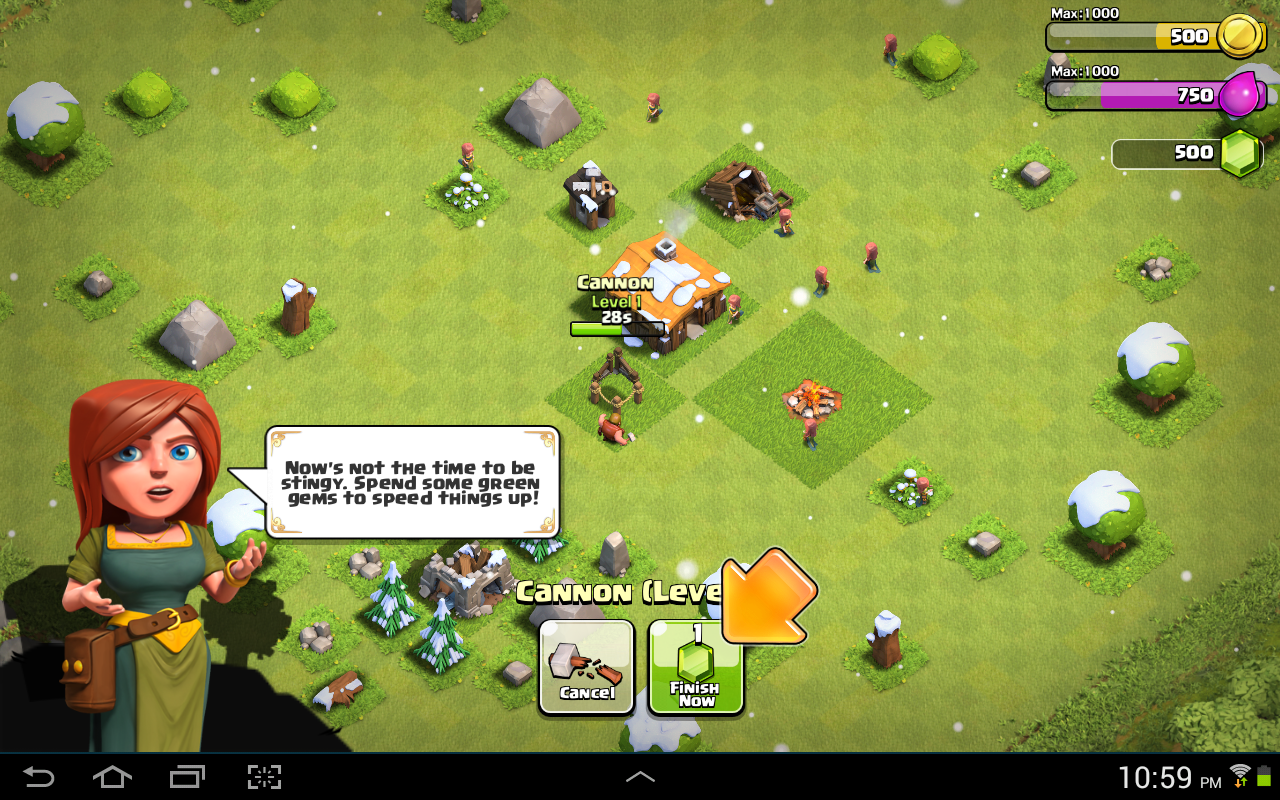
Stop trying to manipulate me, lady!

Stop trying to manipulate me, lady!

Upon downloading the game for the first time, I got the usual barrage of tutorials, which as in most games want the player to build the rudiments of their basic home-base structure, in this case a village.  The game will insist that the player use gems to speed up the process of building, but these will be hard to come by later in the game without making in app purchases with real money, so I advise against using gems, and just waiting out the thirty seconds it takes to create a Builder’s Hut.  Players do receive gems as a reward for completing the challenges in the Challenge Menu, but they are few and far between.

Initial setup is pretty fun.  It’s nice to learn what all the different buildings do.  The rules and gameplay are very generic.  Gold, which the player accumulates from mines, and Elixir, which accumulates from elixir pumps, are used to purchase and build structures, defensive weapons, and warriors.  Gems are used primarily to speed things up.

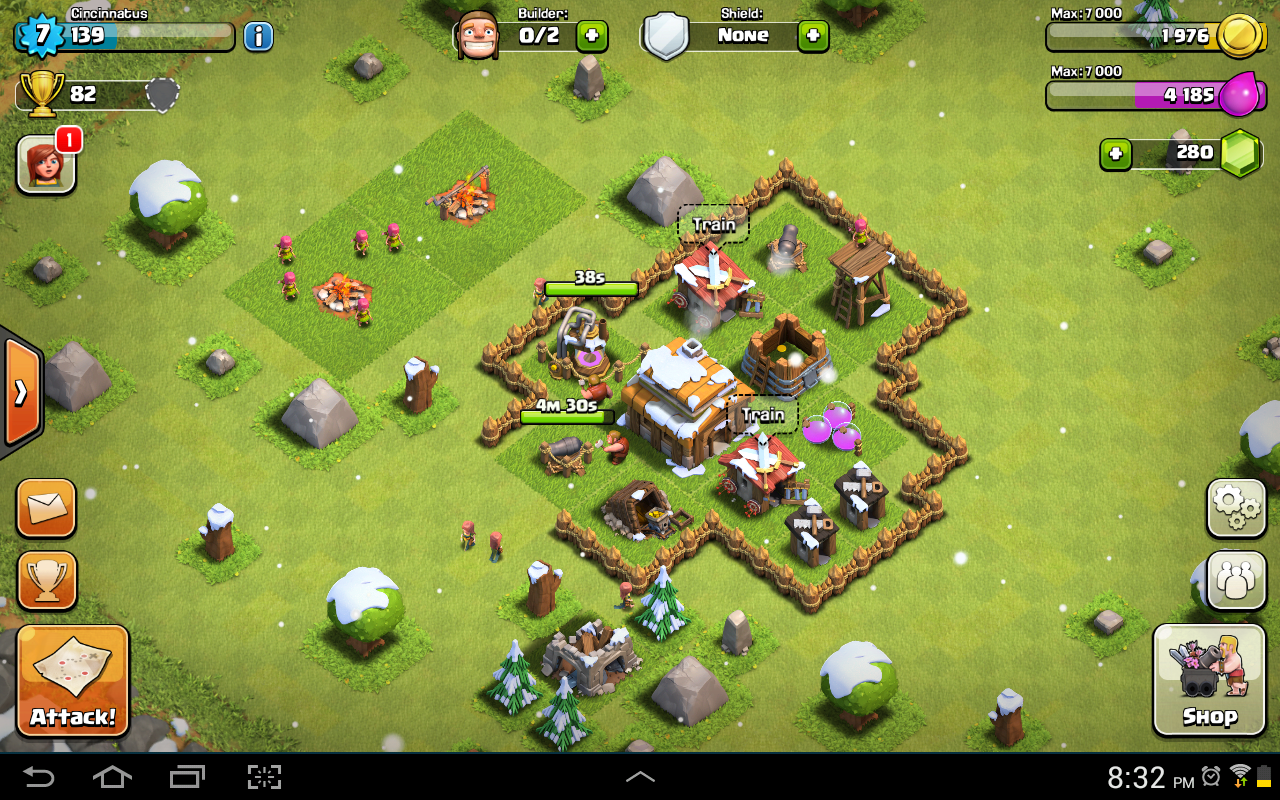
The first structure is the Builder’s Hut.  Each hut houses one builder, and each builder can work on one project at a time.  Builders are required for each new structure and to upgrade existing structures.  I currently have two Builder’s Huts so I can only build or upgrade two structures at a time.  (I should mention here that Builder’s Huts are the only structures that require gems for purchase—this can get annoying.)

Help! Not enough wall!

Help! Not enough wall!

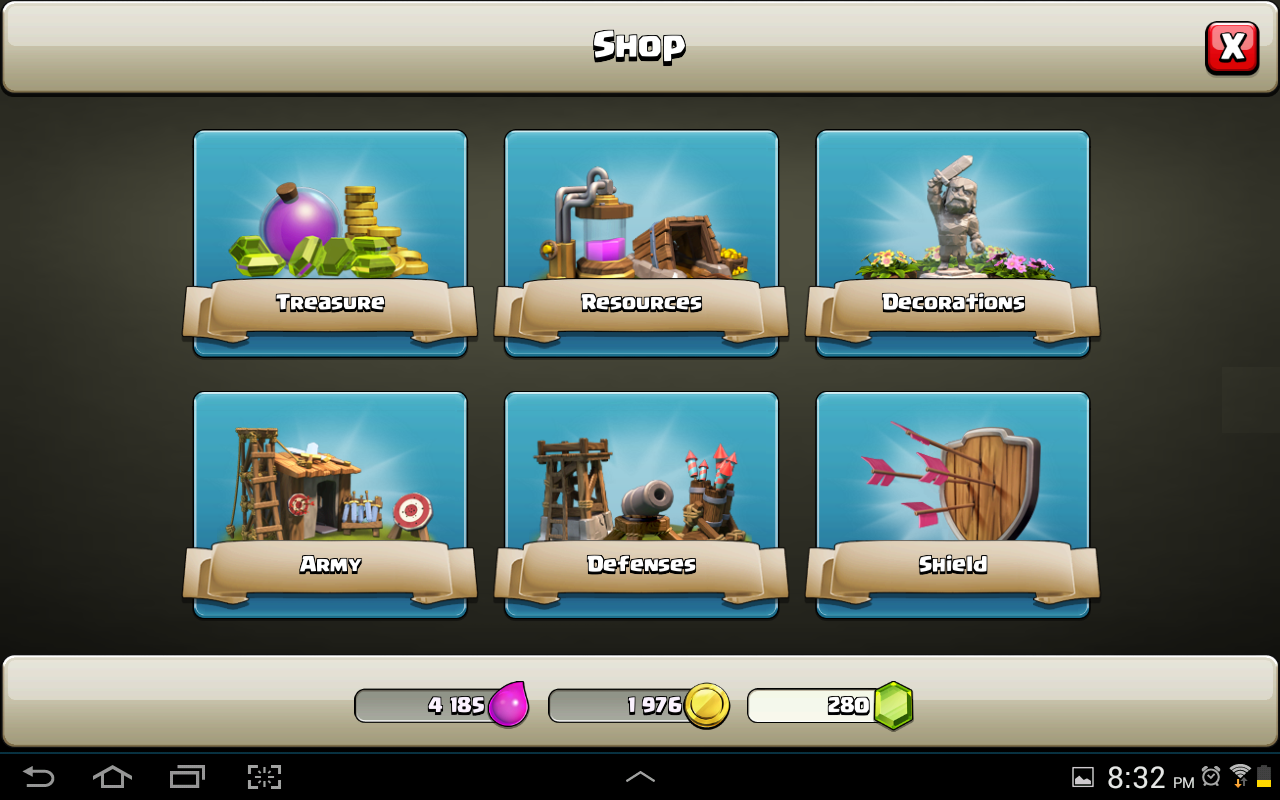
Defensive weapons can be purchased for gold.  At first, players only have access to a few defensive items:  an archer tower, a cannon, and a few units of wall.  As they level up and upgrade the Town Hall, they gain access to more types weapons and in greater numbers.

Offensive warriors are purchased with Elixir points.  In order to have warriors, the player must set up barracks to train them, and army camps to house them.  Leveling up the barracks unlocks new types of warriors, and leveling up the army camp allows the player to store more warriors at a time.  In later levels, players can purchase the laboratory which, for a fee, will allow them to upgrade their warriors’ abilities.

Players can attack other fortresses in either of two ways.  They can attack a goblin camp on the map, which results in a small gain of gold and elixir (provided their army wins).  Alternatively, they may attack another player’s fortress.  If I attack another player and destroy his village, he is automatically given a shield for a number of hours corresponding to the amount of damage I do to his village—up to sixteen hours for 100% destruction.  While the shield is in place, no one can attack him again.

Purchase menu

Purchase menu

After a few levels, players can save enough money to rebuild the Clan Castle, and then join a Clan or create their own.  Clans tend to be groups of similar ranking players.  I personally dislike the social aspect of games like this, so I don’t really like this feature.  One perk of joining a clan, however, is the donation of troops to players in need.

All in all this is a fun game at first.  I am playing on a tablet, and there is ample room to tap and move.  Unfortunately, after level fifteen or thereabouts, I became trapped in a cycle of being beaten up by larger clans, saving up money while I had a shield in place, and still being short of the amount needed to upgrade my defenses before the shield ran out and I was attacked and my gold and elixir stolen.

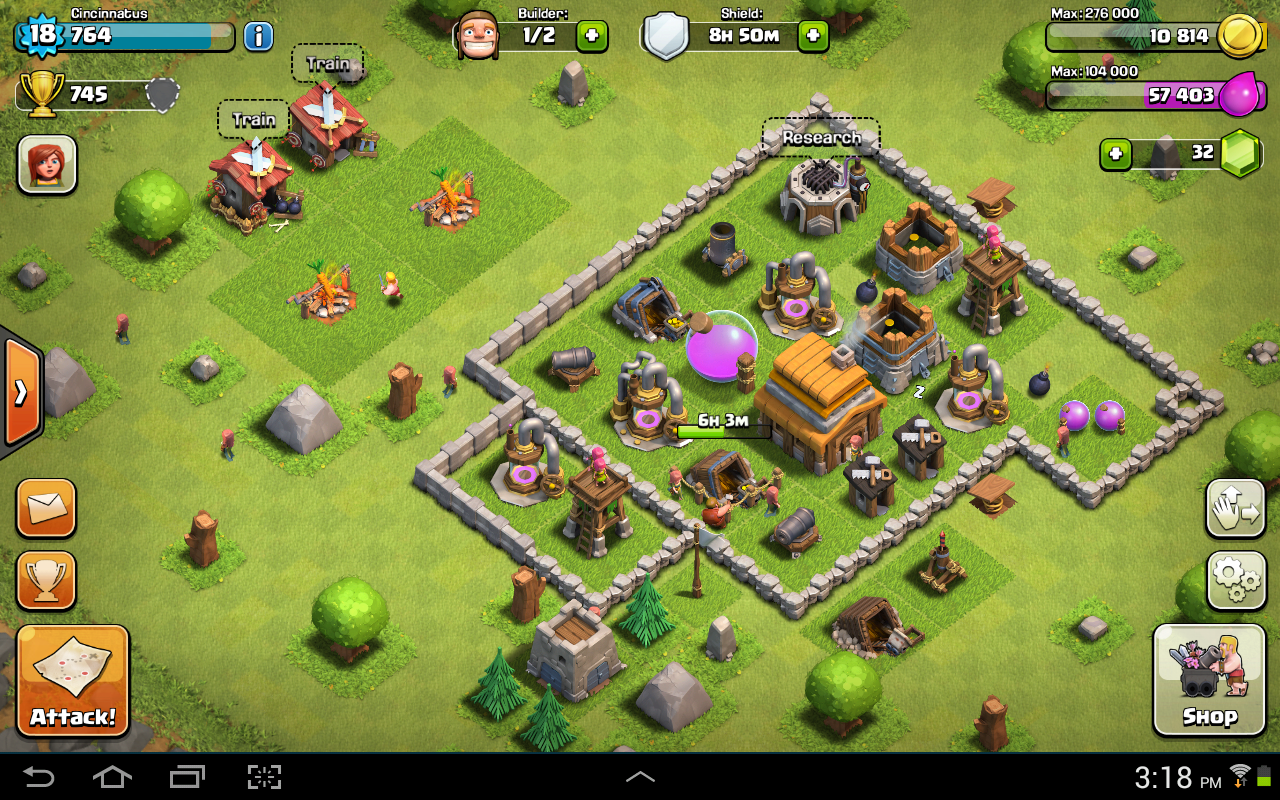
My current fortress

My current fortress

There are huge in-game rewards for continuing on past level nineteen, where I currently am, but I am getting bored with the game and may not continue to play at all.  This game is free on iOS and Android devices.  I give it three and a half Death Stars, because it couldn’t hold my attention for more than two weeks.3.5 Death Stars

2 Comments

Filed under Editorial, Game Reviews, Gaming, Tracy Gronewold

Editorial | Teen Paranormal Romance? Gag Me With a Spoon!

I’ve spent a lot of time recently reading, and occasionally reviewing, young adult fiction—mostly fantasy.  While doing so, I have lamented several times about the eroding quality of YA literature.  After all, I remember reading many fantastic books as a child and preteen.  Our local library was near enough that my siblings and I were allowed to bike there, once our mother deemed us responsible enough.  We would spend hours pouring over the shelves, and then bike back home with backpacks bursting at the seams.  Frequently, especially during the summer, the library system would flash a caution screen, “WARNING:  THIS PATRON IS OVER THEIR LIMIT.”  The librarians never said anything to us; they just quietly clicked OK, and let us take out as many books as we wanted.

The Hero and the Crown, Crown Duel & Court Duel, Half Magic, The Black Stallion, Redwall, Tom’s Midnight Garden—each of these had characters that seemed to leap off the page and into my imagination.  I fell in love with the male leads, or rewrote the story in my mind and superimposed my own characters on their worlds long before I was aware of fan fiction.  These were the pinnacle of young adult fiction.

In current YA fantasy, especially, tropes seem to be worn to the bone.  The most clichéd of these seems to be one of several variations on the idea that the protagonist is not what he/she appears to be.  He can be the “Chosen One,”—the answer to some prophecy, come to save everyone from some great evil—a prince in disguise, or sometimes the unwitting mixed child of a human and a non-human (normal animal, mystical beast, or god).  This seems to be considered most believable if he has been orphaned, split from his family by a catastrophe, or abandoned by his caretakers.  This becomes even more trite if he discovers his magical powers/super-secret heritage right before or immediately upon puberty.

I could probably have just put up this picture with no text at all and y'all would understand.

I could probably have just put up this picture with no text at all and y’all would understand.

Currently, the YA trend (thanks to Twilight and the plethora of vomit-inducing books that followed in its wake) seems to be that this protagonist is a human, but has some abnormal characteristic that renders him irresistible to some magical being, and they fall in love.  (This plot is actually legit.  If I had a nickel for every time a mind-reading vampire informed me that he had to have me then and there due to my opaque frontal lobe activities…)

However, to the young adult reader, many of the plot devices that an adult has seen ad nauseam are fresh and new.  Let’s face it, many of these have become so laughably worn out because they can be used with such beautiful effect when written well.  The first time I read a Xanthian novel, I laughed over it for days.  I recently reread one of Piers Anthony’s books and was horrified at the hackneyed phrases and the threadbare tropes.

CaptureWhat bothers me perhaps the most about cheap YA fiction is that it is no longer being read exclusively by young adults.  Grown adults now gush about the events of Breaking Dawn as though they happened to a best friend.  When grownups cannot tell the difference between beautifully written world building and fan fiction bound between paperback covers and slapped with a publisher’s logo, then who can?  Worse yet, with the advent of online review boards, such as Amazon, terrible books are being recommended willy-nilly.  I have learned that just because the majority of appear to be written by adults does not make them trustworthy.

It also bears remembering that for every wonderful YA book, there are literally hundreds of mediocre, or terrible works.  Twilight is the obvious example here, but there are many others.  For every Anne McCaffrey and Susan Cooper, there are dozens of K. A. Applegates and Suzanne Collinses.  Frank LeVoie talks about this in his article, “Is YA the Death of Epic Fantasy?”

“Our first love was what publishers label as Epic or High Fantasy… Despite the unusual nature of our desired reading, it came with a certain quality. The lexicon, the syntax, and the high-literary value of many of these works was something that most ‘kids’ didn’t quite get. To read and understand them was a challenge and an accomplishment…  One thing that I always appreciated about Epic Fantasy was its exclusivity. Not everyone could read it.”

YA Fantasy has made fantasy marketable, but it hasn’t improved the content of the genre.  My advice to fantasy readers who prefer a higher order of literature to avoid books recommended by obvious bottom feeder readers (on Amazon, these are usually the readers who write reviews full of grammar/spelling/syntax errors and who use too many capital letters and exclamation points), and to be willing to set a book aside if it lacks any pith by chapter three.

What makes you love or hate a YA fantasy book?  Do you have any authors you especially love or hate?  Let us know in the comments.

6 Comments

Filed under Books, Editorial, Tracy Gronewold