Category Archives: Books

Editorial |The Silent Character

In the course of writing a novel or a screenplay, authors carefully set up the scene they wish to play out.  In science fiction or fantasy—even more so than in other genres—they create a world, and then populate it with figures that are limited only by the author’s imagination.  However, I submit that in the very best sort of books there is one character that is not created by the author, but is temporarily bound in the world he creates:  the reader.

A book is something like the stage on which a play is performed.  The onlooker sees everything that is going on in the story spread out before him in his mind’s eye.  In a play, the characters can interact with themselves, but they arrange themselves to be visible to the audience as much as possible.  Their gestures are larger than life, their facial expressions more dramatic, and their voices pitched to carry to the unmentioned and usually silent viewers.  Although in most plays the actors never acknowledge the audience, they still consider its response in every action that takes place on stage.

In a good book, the kind that sucks the reader in and completely absorbs him, the same thing happens.  In most of these books, such as Tolkien’s The Hobbit (now a Major Motion Picture), the reader is never directly addressed.  Characters act, interact, and react with each other for the benefit of the audience.  Events are arranged for thrilling suspense.  Action sequences are highlighted, and periods in between them are foreshortened.

Sometimes, although more rarely, the author does directly speak to his readers.  This is usually an aside.  My favorite example of this is from C. S. Lewis in The Lion, the Witch, and the Wardrobe, “”Wherever is this?” said Peter’s voice, sounding tired and pale in the darkness. (I hope you know what I mean by a voice sounding pale.)”  I think I was six years old the first time I read this, and it was a completely novel idea to me (pun entirely intended) to be addressed by an author I already loved and trusted by this point in the book.  However, this style of writing does not happen very often.

Down the beaver hole

Some authors spend more time crafting the story to their audience, such as Piers Anthony.  His world of Xanth is escapist fantasy taken to extremes.  Nearly everything in this fictional universe is designed to be a pun or an inside joke.  The reader is fully engaged as a silent character in his world.  More serious authors tend to make the role of the reader much smaller.  However, even these authors expect the audience to be fully engaged in the story.

In some cases, the author starts off with a good sense of his audience as a silent participant in his world, but then seems to forget their presence, further into the story.  A great example of this is George R. R. Martin’s Song of Ice and Fire series.  The first couple of books read like smooth and beautiful stage productions.  The level of description sets the stage for the reader, without becoming so boring that he skips over large sections.  The action flows at a fluctuating pace:  slowing down during the moments of action and speeding up to skip over slow, boring chains of events, such as Catelyn Stark’s journey to King’s Landing in A Game of Thrones.  In later books, such as A Dance With Dragons, Martin seems to prefer spelling out each and every tiny event, even if it has very little to do with the story.  In cases such as this, I personally feel that extra time in the editing stage of the process is necessary.  (Of course, he doesn’t really have the time for extended editing sessions, but I digress.)

If GRRM doesn’t get the next book out sometime next year… grrmmph mumble mumble…

It seems obvious, then, that the audience to any good story is a silent, third party character which interacts with the world and the characters in it.  When the reader is so enthralled with a book that he or she spends hours or even days after it is closed reliving the events in his imagination, or creating new stories set on the same stage, the author has done his job.

Have you read a book that kept you focused for days, and even made you unwilling to read something else for a little while after you finished it?  Let us know in the comments.  I may even add it to my Reading List of Doom!

1 Comment

Filed under Books, Editorial, Tracy Gronewold

The Reading List of Doom

I scream sometimes in the shower.  “So many good books, so little time to read them!” I cry out, with nothing to hear my pain but the falling water. I bang my head against the hard tiles in an attempt to stop the pain, but it fails.  It doesn’t help that I’m a slow reader. The ever expanding pile of books that I want to read absolutely drives me crazy, and doesn’t even count magazines, graphic novels, and my weekly comics.  On one hand, it’s a blessing to have so many good books that are worth my time, and on the other it’s a curse that I’m certain is designed by some evil being to drive me completely insane.  The Reading List of Doom as I like to call it has presented me with a particularly stubborn challenge to overcome.

bibleinjail21

Not exactly the best idea.

My indecision can sometimes lead to another option:  reading multiple books at once. There are times where this system does work; however, it usually ends up meaning that I make less progress on each book than I otherwise would.  My typical method in this case is to read one book at work during lunch and then read the other at night in bed.  While in theory this would allow me to make progress on both, it rarely works out that way.  The only time that reading more than one book at a time is a good idea is when I get fatigued with one, but don’t just want to abandon it half way through.  For instance, right now I’m working my way through Game of Thrones but since I’ve seen the show and know what happens, I’m a little tired of it.  George R. R. Martin’s writing is wonderful and reading the book has added quite a bit to my love of the world he has created, but it’s 800 pages of story I already know, after all. I’m over 500 pages in and I don’t want to give up, especially since there are four more books for me to read. So instead I’ve put down Game of Thrones and picked up The Seven Pillars of Wisdom: A Triumph by T.E. Lawrence.  It’s a nice change of pace and it relieves my fatigue. Best of all it moves the list forward.

In my family there is no such thing as too many books. In fact such a statement is tantamount to heresy.  My father collects military history books and has several thousand volumes, so I grew up with stack and piles all around the house that formed as we ran out of bookshelf space.  Sadly, in my case, there are few books I actually collect simply for the sake of having a library available on a particular subject.  Most of my reading is whatever strikes my fancy and is usually not worth anything. I use this fact to justify not buying books to add to my stash, since the content isn’t particularly valuable, but I also hate it.

As a kid this was all much less of a problem as I was a much faster reader. Somewhere along the way I lost that talent and I sorely miss it. One summer I plowed through Airframe in 5 hours. I was averaging just over 100 pages an hour! Now I’m lucky to get through 30 in the same time. I wish I had the skill to push through my reading list at a rate such that I have to buy new books to keep up. One of my good friends has that ability and I am so jealous. He has to look hard to find new books he wants to read, while the Reading List of Doom is rapidly approaching the height of a 12 year old.

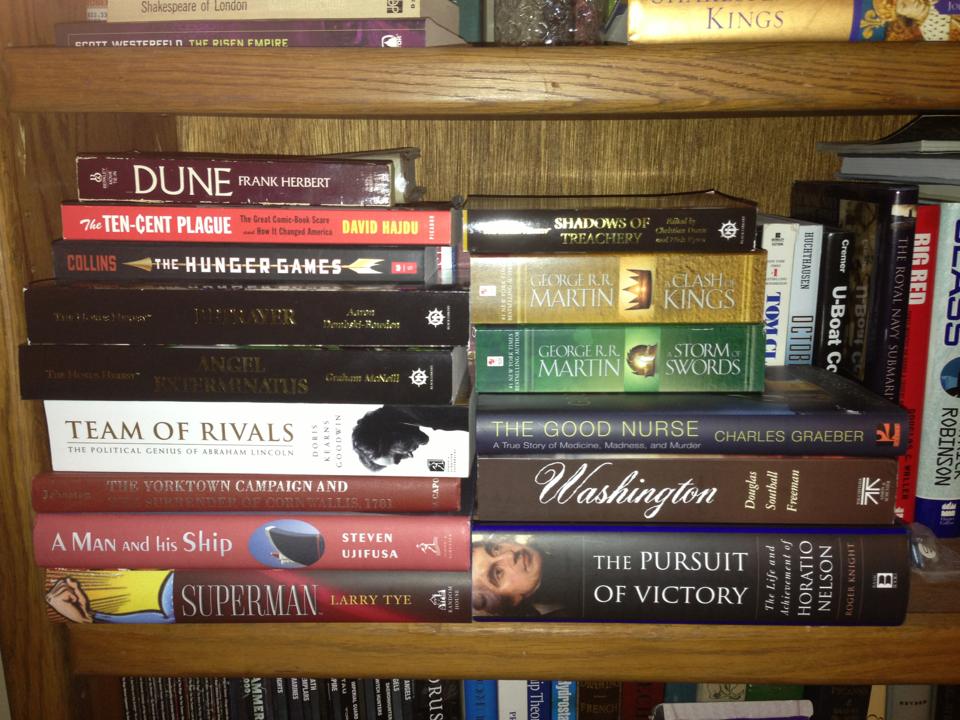
Reading List of Doom. And this is only the prioritized stuff.

Reading List of Doom.
And this is only the prioritized stuff.

In the end, I know that the Reading List of Doom is not the worst thing that can happen to me.  I am fortunate that I enjoy reading and that I live in a place that embraces free speech and allows me to read whatever I please. Reading provides nourishment for my hunger for knowledge.  I have a wide variety of interests and it’s always nice to find a book that helps to increase my level of knowledge regarding a particular topic, even if that book may be stuck at the bottom of the reading list for a while.  Fear not, book-on-the-bottom-of-the-pile, soon enough you will have new brethren to join you while you wait to share your wonderful content with me.

1 Comment

Filed under Andrew Hales, Books

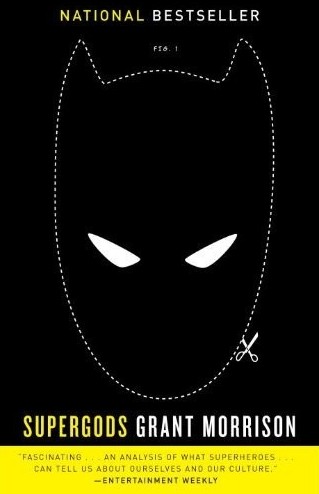
Review: Grant Morrison’s Supergods

Image

Last year’s New York Comic Con got me much more interested in the history of comics.  The second book I’ve read in my pursuit of comic book knowledge is Grant Morrison’s Supergods.  I was already interested knowing that Grant Morrison had written it but when a friend of mine recommended it, I decided to take the plunge.  I don’t always enjoy a Morrison book, but there is no arguing that he is one of the biggest and most influential names in comics right now.  I expected an insightful discussion of comic characters with some of his personal experiences interspersed throughout the book.  What I got was far weirder, far more personal information than I had bargained for.

The book starts off with several chapters dedicated to Golden Age superheroes.  Morrison’s analysis of the beginnings of classic heroes like Superman and Batman was both insightful and enlightening.  He presented these well-known characters in ways I had never thought of them before and made me reevaluate how I saw them.  My favorite of these early chapters dealt mostly with Superman though the 1950’s, after the establishment of the draconian censorship rules of the Comic Code when the plot limitations made writers come up with some very whacky stuff.  Morrison’s description of the off-the-wall adventures of the Man of Steel is quite a bit of fun.  Personally, I’ve never been much of a Superman fan, but this made me want to read some of those old stories.  I was so captivated by these opening chapters I could hardly put the book down.

As Morrison got to the comics of the 60’s and 70’s, he began to incorporate his personal experiences in comics and explain how he got his start in the industry.  This was all pretty interesting and it fit well with the general theme of the book (on occasion he begins to drift off topic, but even then it’s still interesting and at least tangentially related).  In these chapters, Morrison begins talk about some of his favorite of the more esoteric, less well known comics.  The comics he experienced are not the same ones that I enjoyed, although to be fair, I’m an American who grew up in the 90’s and he is a Scot and about 25 years my senior.  I am certain, however, that some of his references would be lost even on many of his Scottish peers.

For me, the wheels really started coming off this ride when Morrison began to talk about his exploration into magic.  That’s right, magic.  While I honestly have no issue with whatever the man chooses to believe, and I was aware that the book was partly an autobiography, I was not prepared for this level of weird.  I felt that it really detracted from the comic history in the book and that both subjects would have been better served by being separated into freestanding volumes.  If Morrison had written an autobiography and included every odd thing from Supergods and anything else he felt like covering, I would still probably have read it.  Grant Morrison is a fascinating man with a real gift for his chosen craft and I would be interested to see what insights could be gleaned from his life experiences, but I would prefer it in a book dedicated to his own personal stories.

This book is filled with comic book history and explores the use of archetypes within our society. It is not, however, a book I would recommend to someone with only a passing interest in comic history or even the average comic fan. Morrison delivers an insightful look at our modern culture through popular art and an interesting depiction of his own person journey to comic book legend, but the mixture of these two often disparate themes tends to dilute the impact of both.

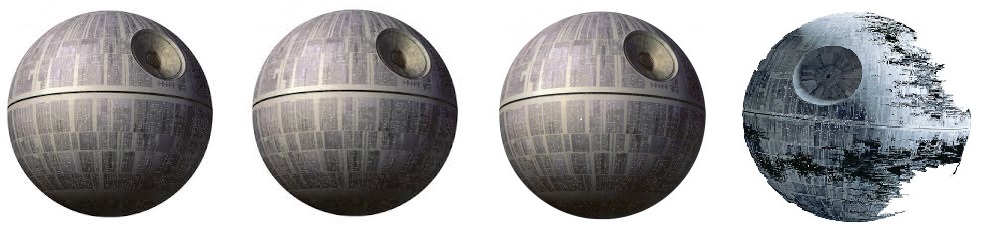
Rating: 3.5 / 5 Death Stars

Image

Leave a comment

Filed under Andrew Hales, Book Reviews, Books