As a fairly prolific reader, I often get asked for recommendations from people looking to expand their reading list of doom. Over the summer and into the first few weeks of fall, I’ve been catching up on a lot of the books I’ve been meaning to read, and here is my list of the books you should add to your pile right away, as well as a couple that I would recommend avoiding. Continue reading
Tag Archives: Books
Editorial | Fantasy Books You Should be Reading RIGHT NOW (and some that you shouldn’t)
Filed under Books, Editorial, Tracy Gronewold
Confessions of a Geek: Literary Influences, Part 2
I lived a very sheltered childhood, and so books have been the staple influence in my life. My mom read to me when I was very small (we started the Little House on the Prairie series with her reading to me, and ended them with me reading to her). I was off and running into the wild world of books that ended up taking me all over the world and beyond it. Some of the authors and books that have influenced me (and this is only a partial list) are below.
- As a girl, I was obsessed with horses, and thoroughly enjoyed Marguerite Henry’s White Stallion of Lipizza and of course, Misty of Chincoteague, as well as Cinnabar, the One O’clock Fox (although this one was more about the fox than the horses). I preferred the less well-known books. White Stallion of Lipizza had me sitting backward on kitchen chairs for months, because that was how the Lipizzaner trainers would stretch the inside of their thighs to fit over the extra wide barrel of those gorgeous horses.
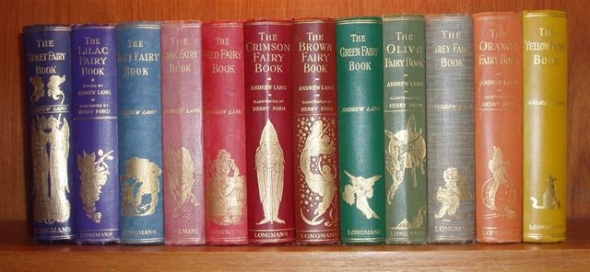
- The Colored Fairy Books were another huge influence on me. Andrew Lang took me all over the world, from the snowy, troll infested forests of Germany to the oyster beds off the coast of Polynesia. I can’t wait to introduce my nephews to this series.
- C.S. Lewis was a huge influence on me very early on in my life. I read The Lion, the Witch, and the Wardrobe so early that I cannot remember reading it for the first time. I lost count of my rereads at number nineteen. I also read and enjoyed the space trilogy. Perelandra was a beautiful picture of an idyllic world that made me ache for a place I had never been. That Hideous Strength was a book that I read long before I was ready. It was terrifying, but beautifully written. Till We Have Faces was amazing and profound.
- I was also really interested in all of the classic authors; Dickens, Austen, and the Bronte sisters were high on my list. Unfortunately, thanks to the Great Illustrated Classics, abridged books for children, many of these books were ruined for me. I couldn’t even get through David Copperfield until I was in my late teens. That abridged series taught me to loathe spoilers. I guess the children’s versions had some influence on me as well as the original versions.
- I continued to read books that I could technically comprehend, but was not old enough to properly digest. I read Jane Eyre when I was fourteen, and I was not particularly impressed. I felt that Charlotte Bronte got lost on her way to the conclusion. On the other hand, after I read Wuthering Heights, I wandered around the house in a funk for a couple of days.
- One of the greatest influences on my life was a series called The Young Underground, by Robert Elmer. These books were about a young brother and sister, Peter and Elise Anderson, who smuggle underground newspapers, and later humans, in Nazi occupied Denmark. These books influenced me, not because of their content, but because my mom used to read them to my siblings and me to keep us close as a family after she had to go back to work.
This can only be a partial list (it’s not even CLOSE to a full one), because there were so very many books that influenced me growing up. I am happy to say that I continue to find books that change the way I see the world, so the list continues to grow. -t
Filed under Books, Editorial, Geek Life, Tracy Gronewold
Confessions of a Geek: Literary Influences, Part 1
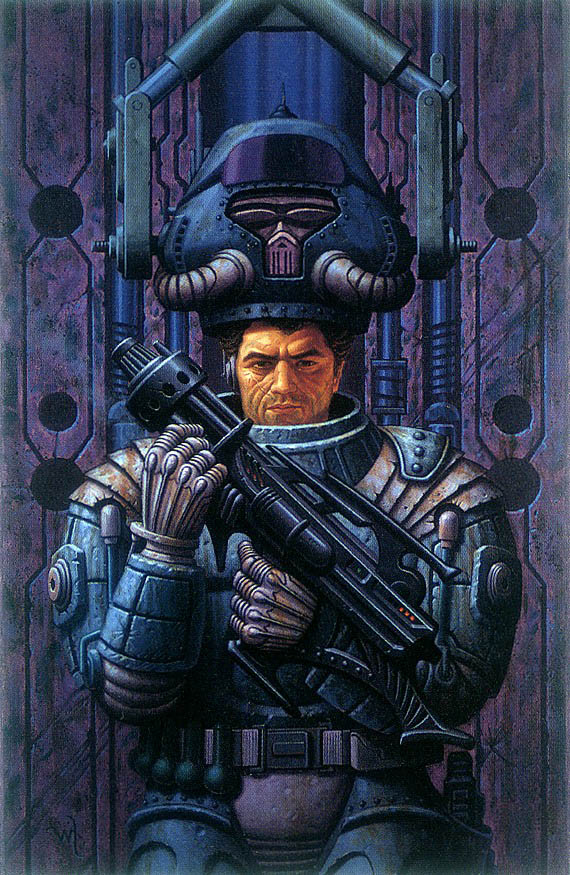
An artists vision of what Starship Trooper’s power armor looks like.
A few weeks ago I was looking over a friend’s Facebook page and noticed they had posted a list of movies and/or books that had influenced them. It was a nicely mixed list and I soon found myself considering the books that had influenced me. I have decided to share with you three separate lists of books, movies and comics that have influenced me and a little of the reasoning behind why. Today we’re going to start with books, in no particular order (well, they’re in the order in which I thought of them).
- Starship Troopers – This is one of my all-time favorite books. Robert Heinlein masterfully combines a science fiction, war story with Libertarian political views, without ever making it seem preachy. While I don’t agree with all of the political things that Heinlein has to say, they do make for interesting thoughts and debates.
- The Hobbit – Honestly, this almost goes without saying. Like many of my generation (and my parent’s generation) this was my first introduction to the fantasy genre. The Hobbit really is just that, an introduction. Tolkien gives just enough of all the various pieces to make readers want more without feeling as though they’ve been cheated. It’s also a pretty light read, which cannot be said of The Lord of the Rings.
- The Lion, The Witch, and The Wardrobe – Keeping with fantasy for a moment, this is the C.S Lewis classic. I first came across this book sometime around third or fourth grade (maybe earlier) and was so immediately enthralled that I read the entire thing in a single night. This was the first time that I have been so in love with a book that I physically could not put it down.
- Fear and Loathing in Las Vegas – Anyone who has read Hunter S. Thompson knows exactly how bizarre his work can be. Underneath the layers of drug use and general weirdness in his books There is a surprisingly accurate and thoughtful look at America. I certainly don’t share Mr. Thompson’s political views, but from time to time there are things in his work that I find myself agreeing with.
- Marvel Comics: The Untold Story – There are two things that have fueled my interest in comics history: a panel about the history of censorship in comics at the 2012 NYCC and Marvel Comics: The Untold Story, which I also got at NYCC. This book was so good that despite being in the middle of two other books, I dropped everything else I was reading and read this as much as possible. It reads more like a novel than a history and makes the reader feel like they know all the people personally. It has also had the effect of driving me to get more books on the history of comics.
- Horus Heresy: Horus Rising – I picked this book up on a whim in college and then spent every moment of the next three days that I was not in class (and probably somewhere I should have been in class) reading. This series isn’t always very good, but it has reminded me that I can enjoy purely indulgent fiction. And I’ve read TWENTY-TWO of the books, so they’ve had to have some influence.
- Complete Works of Shakespeare – This is cheating a little, I know. Shakespeare is not only one of the greatest works of literature in the world, but it has also had a considerable impact on my life. I started reading Shakespeare in fourth grade and it opened up a whole new world of ideas to me. Back in high school I was vice-president of school’s Shakespeare Society. Some of my favorite books and movies even now are adaptations of Shakespearean works.
To Be Continued…
Filed under Andrew Hales, Books, Geek Life
Editorial |The Silent Character
In the course of writing a novel or a screenplay, authors carefully set up the scene they wish to play out. In science fiction or fantasy—even more so than in other genres—they create a world, and then populate it with figures that are limited only by the author’s imagination. However, I submit that in the very best sort of books there is one character that is not created by the author, but is temporarily bound in the world he creates: the reader.
A book is something like the stage on which a play is performed. The onlooker sees everything that is going on in the story spread out before him in his mind’s eye. In a play, the characters can interact with themselves, but they arrange themselves to be visible to the audience as much as possible. Their gestures are larger than life, their facial expressions more dramatic, and their voices pitched to carry to the unmentioned and usually silent viewers. Although in most plays the actors never acknowledge the audience, they still consider its response in every action that takes place on stage.
 In a good book, the kind that sucks the reader in and completely absorbs him, the same thing happens. In most of these books, such as Tolkien’s The Hobbit (now a Major Motion Picture), the reader is never directly addressed. Characters act, interact, and react with each other for the benefit of the audience. Events are arranged for thrilling suspense. Action sequences are highlighted, and periods in between them are foreshortened.
Sometimes, although more rarely, the author does directly speak to his readers. This is usually an aside. My favorite example of this is from C. S. Lewis in The Lion, the Witch, and the Wardrobe, “”Wherever is this?” said Peter’s voice, sounding tired and pale in the darkness. (I hope you know what I mean by a voice sounding pale.)” I think I was six years old the first time I read this, and it was a completely novel idea to me (pun entirely intended) to be addressed by an author I already loved and trusted by this point in the book. However, this style of writing does not happen very often.

Down the beaver hole
Some authors spend more time crafting the story to their audience, such as Piers Anthony. His world of Xanth is escapist fantasy taken to extremes. Nearly everything in this fictional universe is designed to be a pun or an inside joke. The reader is fully engaged as a silent character in his world. More serious authors tend to make the role of the reader much smaller. However, even these authors expect the audience to be fully engaged in the story.
In some cases, the author starts off with a good sense of his audience as a silent participant in his world, but then seems to forget their presence, further into the story. A great example of this is George R. R. Martin’s Song of Ice and Fire series. The first couple of books read like smooth and beautiful stage productions. The level of description sets the stage for the reader, without becoming so boring that he skips over large sections. The action flows at a fluctuating pace: slowing down during the moments of action and speeding up to skip over slow, boring chains of events, such as Catelyn Stark’s journey to King’s Landing in A Game of Thrones. In later books, such as A Dance With Dragons, Martin seems to prefer spelling out each and every tiny event, even if it has very little to do with the story. In cases such as this, I personally feel that extra time in the editing stage of the process is necessary. (Of course, he doesn’t really have the time for extended editing sessions, but I digress.)

If GRRM doesn’t get the next book out sometime next year… grrmmph mumble mumble…
It seems obvious, then, that the audience to any good story is a silent, third party character which interacts with the world and the characters in it. When the reader is so enthralled with a book that he or she spends hours or even days after it is closed reliving the events in his imagination, or creating new stories set on the same stage, the author has done his job.
Have you read a book that kept you focused for days, and even made you unwilling to read something else for a little while after you finished it? Let us know in the comments. I may even add it to my Reading List of Doom!
Filed under Books, Editorial, Tracy Gronewold


 Therefore I Geek