
Geeks You Should Know: Rene Descartes

With that long hair and facial hair, Descartes is already half way to a hipster.

With that long hair and facial hair, Descartes is already halfway to a hipster.

Rene Descartes was born March 31, 1596 in France. In 1606 he began attending Jesuit College in La Fleche and studied there until 1614. His curriculum included a study of the classics, as well as current understandings of physics, metaphysics and math. From 1616 to 1618 he studied law at Poitiers, but he never made use of his law education. Shortly after graduating he became a gentleman soldier and continued to serve until 1622. Descartes started to develop his theories during his time as a soldier but didn’t given them his full attention until after his return to France. In 1637 Descartes published Discourse on the Method of Rightly Conducting the Reason and Seeking Truth in the Sciences, the work he is most well known for. Descartes died in 1650 in Sweden, where he was the personal philosophy tutor for Queen Christina.

Why we care:

Descartes is most famous for his statement “Cogito ergo sum” meaning “I think, therefore I am”. This frequently gets misunderstood to be, “I exist because I think.” This is an obvious problem given how many people that we all know who don’t think and yet still exist. What Rene was actually getting at is the idea that we exist because we believe we exist.  He brought a more scientific approach to philosophy.  The idea of leaving all accepted notions and preconceptions behind and starting from a clean slate was revolutionary. This approach earned Descartes a place as the father of modern philosophy.

What Descartes is less known for, though it may be far more important, is his introduction of analytical geometry. Anyone who has taken a high school algebra course is more than familiar with the standard x-y coordinate system. Here in the U.S. we refer to this as a Cartesian coordinate system, but it is in fact an invention of Descartes (Cartesian comes from the Latin name Descartes used, Cartesuis). This is one of the most fundamental pieces of modern mathematics and it exists thanks to Descartes.

In addition to the x-y axis, he also gave us laws of refraction, explanations for rainbows, and an account of the formation of the solar system, though he suppressed much of this theory due to the pope’s attacks on Galileo. Descartes even developed laws of motion which were a precursor to Newton’s Laws, although they failed to incorporate vector forces. Descartes managed to impact multiple branches of thought and science and his work has had a lasting impact on the world, making him a Geek to Know.

2 Comments

Filed under Geek Life, Geeks You Should Know

Happy New Year 2014

Welcome to a brand new year full of potential and wonderful new things. 2013 was a good year for us, and we can’t wait to see what 2014 has in store. Personally, I can’t wait to see where 2014 leads us. If you had told me a year ago that I would be writing a blog, I’d have looked at you funny (well funnier than usual), but it’s been great so far.  Now if only I can remember to write the correct year in the date, that will be a small miracle. -a
This new year is about to get very busy and very exciting for me personally and for Therefore I Geek.  I am really excited for multiple conventions, a chance to go abroad for the very first time, FOUR amazing Marvel movies (and the Scarlet Witch onscreen for the first time!), and graduation next fall.  I hope 2013 was a good year for all of our readers, but I really hope that 2014 treats you right! -t

Leave a comment

Filed under Geek Life

Andrew & Tracy’s New Year’s Resolutions

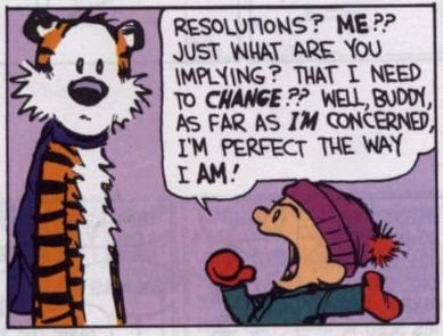
new_year_cartoon2

Hey, everyone!  Like many of you, we here at Therefore I Geek each have a list of New Year’s resolutions, some geeky, and some not.  We thought that we would share them with you as a way of saying farewell to 2013, and looking ahead to 2014.

Andrew

Read More – I haven’t been reading as much as I would like and it’s my own fault. I tend to put the TV on for noise and do other things at times when I could be reading. It’s time to take on the Reading List of Doom and hopefully make it a little smaller.

Catch up on select TV shows – While I want to watch less TV, I would also like to focus that TV watching so I can catch up on several shows that I have never seen. This includes, but is not limited to Doctor Who, Breaking Bad, Lost and maybe (a very tentative maybe) Battlestar Galactica.

Lose more weight – Some of you may remember my Fit 4 Con posts and my attempts to lose weight before NYCC this past year. While not a resounding success, I did lose some weight and I’d like to keep going. Now that the holidays and their endless supply of treats are coming to an end, I’m in a pretty good place to keep going. I now have a rowing machine with which to torture myself, so I think I’m set.

Be more social – We are constantly advocating for geeks to be more social and while I have gotten much better about this than I use to be, there is still plenty of room for improvement. It does me no good to tell you guys to do something that I don’t do myself.

Tracy

My first resolution is to learn to swim properly.  I’ve tried some beginner classes, but instructors want to focus on treading water, which I cannot seem to grasp.  I can float and doggy paddle, so I won’t drown, but there is entirely too much splashing and it takes too long to get anywhere.  This year I want to take on the pool and learn to swim correctly.

Secondly, I want to spend some time researching and reading Cloak & Dagger.  This fun comic duo has always interested me, but I’ve been more enthralled with Beast and the Scarlet Witch in the last couple of years.  It is time to branch out to a series that I don’t know much about.

Like Andrew, I also need to up my book count this year.  It’s a big undertaking, but my goal is to read fifty two books in fifty two weeks.  I remember reading far more than this as a child, but I have gotten out of the habit, and become involved in reading more online or for school.  Books that qualify can be anything other than comic books (although I am willing to include full graphic novels).

Lastly, and perhaps my most difficult and most important resolution, I want to graduate in 2014.  I’ve been working on my degree for almost three years.  Because of careful planning, hard work, and some blind luck, I may be able to graduate a semester early, and I really want to do this.  It will take focus and even more hard work, but I believe I’m up to the task.

So those are our lists.  We cannot wait to see what 2014 holds both for us and the blog.  Are you making resolutions?  Share them with us in the comments.

1 Comment

Filed under Andrew Hales, Geek Life, Tracy Gronewold

Editorial |The Silent Character

In the course of writing a novel or a screenplay, authors carefully set up the scene they wish to play out.  In science fiction or fantasy—even more so than in other genres—they create a world, and then populate it with figures that are limited only by the author’s imagination.  However, I submit that in the very best sort of books there is one character that is not created by the author, but is temporarily bound in the world he creates:  the reader.

A book is something like the stage on which a play is performed.  The onlooker sees everything that is going on in the story spread out before him in his mind’s eye.  In a play, the characters can interact with themselves, but they arrange themselves to be visible to the audience as much as possible.  Their gestures are larger than life, their facial expressions more dramatic, and their voices pitched to carry to the unmentioned and usually silent viewers.  Although in most plays the actors never acknowledge the audience, they still consider its response in every action that takes place on stage.

In a good book, the kind that sucks the reader in and completely absorbs him, the same thing happens.  In most of these books, such as Tolkien’s The Hobbit (now a Major Motion Picture), the reader is never directly addressed.  Characters act, interact, and react with each other for the benefit of the audience.  Events are arranged for thrilling suspense.  Action sequences are highlighted, and periods in between them are foreshortened.

Sometimes, although more rarely, the author does directly speak to his readers.  This is usually an aside.  My favorite example of this is from C. S. Lewis in The Lion, the Witch, and the Wardrobe, “”Wherever is this?” said Peter’s voice, sounding tired and pale in the darkness. (I hope you know what I mean by a voice sounding pale.)”  I think I was six years old the first time I read this, and it was a completely novel idea to me (pun entirely intended) to be addressed by an author I already loved and trusted by this point in the book.  However, this style of writing does not happen very often.

Down the beaver hole

Some authors spend more time crafting the story to their audience, such as Piers Anthony.  His world of Xanth is escapist fantasy taken to extremes.  Nearly everything in this fictional universe is designed to be a pun or an inside joke.  The reader is fully engaged as a silent character in his world.  More serious authors tend to make the role of the reader much smaller.  However, even these authors expect the audience to be fully engaged in the story.

In some cases, the author starts off with a good sense of his audience as a silent participant in his world, but then seems to forget their presence, further into the story.  A great example of this is George R. R. Martin’s Song of Ice and Fire series.  The first couple of books read like smooth and beautiful stage productions.  The level of description sets the stage for the reader, without becoming so boring that he skips over large sections.  The action flows at a fluctuating pace:  slowing down during the moments of action and speeding up to skip over slow, boring chains of events, such as Catelyn Stark’s journey to King’s Landing in A Game of Thrones.  In later books, such as A Dance With Dragons, Martin seems to prefer spelling out each and every tiny event, even if it has very little to do with the story.  In cases such as this, I personally feel that extra time in the editing stage of the process is necessary.  (Of course, he doesn’t really have the time for extended editing sessions, but I digress.)

If GRRM doesn’t get the next book out sometime next year… grrmmph mumble mumble…

It seems obvious, then, that the audience to any good story is a silent, third party character which interacts with the world and the characters in it.  When the reader is so enthralled with a book that he or she spends hours or even days after it is closed reliving the events in his imagination, or creating new stories set on the same stage, the author has done his job.

Have you read a book that kept you focused for days, and even made you unwilling to read something else for a little while after you finished it?  Let us know in the comments.  I may even add it to my Reading List of Doom!

1 Comment

Filed under Books, Editorial, Tracy Gronewold