Category Archives: Book Reviews

Editorial | Review: Fates

While I was at New York ComicCon, I was fortunate enough to be able to snag several advance copies of some really interesting books.  I am really pleased to be able to review these books before they are available for sale.  Today’s review is Fates, which will go on sale next month.

The cover image and tagline for Lanie Bross’s book were definitely not encouraging.  “There will be no miracles today,” the front cover proclaims.  I opened the book thinking that I was going to read another fairly trite piece of young adult fantasy.  (This is called foreshadowing, and in this case it indicates that the content of the book changed my mind.)

The first couple of chapters were told mostly from the point of view of typical, modern, high school students.  The dialogue is atrocious, and my heart sank.  I was prepared to put the book down.  Then the story seemed to come into its own, and I really started to enjoy it.

Corinthe, the main character, was a Fate, once upon a time.  She made a mistake while doing her job one day, and her punishment was to leave her Eden-esque home in Pyralis (in an alternate dimension) and walk the earth.  She is now an Executor, tasked with carrying out assignments to make sure that humans’ fates proceed according to plan.

The other protagonist, Lucas Kaller, is a human who has been forced to grow up too soon.  His home life fell apart after his mother left the family, and his dad retreated inside himself.  His sister turned to drugs, and Luc was left to keep the pair of them alive, if not functional.

In opposition to the orderliness of the Fates and the current system, a group that call themselves Free Radicals roam between worlds and attempt to bring chaos to all dimensions.

The plotline of Fates is fairly straightforward, with few surprises for the experienced reader.  The heroes go on a quest, feel a strange attraction for one another, and fall in love.  However, the quest itself has some unique twists—Corinthe seeks redemption, while Lucas seeks something else entirely—and the final act of this book is not at all what I expected from fluffy YA fiction.

The setting of this world was well created.  Most of the scenes set on Earth feel like a depiction of a yuppy, California city.  The secondary characters aren’t quite as fleshed out as I would like, but the primary characters are very bright and lifelike.  It is easy to empathize with them.  The prose is simple; the vocabulary is light and pleasing.  I appreciated that the dialogue matured quite a bit once I got through the first few scenes of high schoolers interacting.

Fates caught me by surprise and made me change my initial judgment.  I liked Corinthe a lot by the end.  It certainly is not a classic piece of fiction, but it is very enjoyable, light reading.

This book goes on sale on February 11, and will be available in hardback and e-book form.  I would say that it is worth buying at the e-book price.  Therefore I Geek’s rating is three and a half out of five Death Stars.3.5 Death Stars
Leave a comment

Filed under Book Reviews, Books, Editorial, Tracy Gronewold

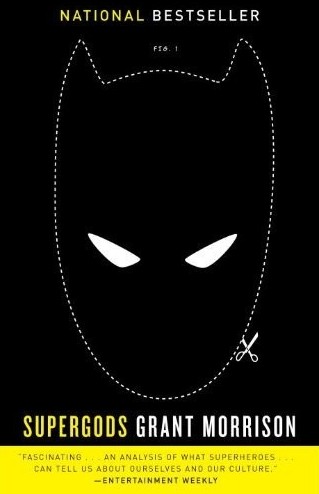
Review: Grant Morrison’s Supergods

Image

Last year’s New York Comic Con got me much more interested in the history of comics.  The second book I’ve read in my pursuit of comic book knowledge is Grant Morrison’s Supergods.  I was already interested knowing that Grant Morrison had written it but when a friend of mine recommended it, I decided to take the plunge.  I don’t always enjoy a Morrison book, but there is no arguing that he is one of the biggest and most influential names in comics right now.  I expected an insightful discussion of comic characters with some of his personal experiences interspersed throughout the book.  What I got was far weirder, far more personal information than I had bargained for.

The book starts off with several chapters dedicated to Golden Age superheroes.  Morrison’s analysis of the beginnings of classic heroes like Superman and Batman was both insightful and enlightening.  He presented these well-known characters in ways I had never thought of them before and made me reevaluate how I saw them.  My favorite of these early chapters dealt mostly with Superman though the 1950’s, after the establishment of the draconian censorship rules of the Comic Code when the plot limitations made writers come up with some very whacky stuff.  Morrison’s description of the off-the-wall adventures of the Man of Steel is quite a bit of fun.  Personally, I’ve never been much of a Superman fan, but this made me want to read some of those old stories.  I was so captivated by these opening chapters I could hardly put the book down.

As Morrison got to the comics of the 60’s and 70’s, he began to incorporate his personal experiences in comics and explain how he got his start in the industry.  This was all pretty interesting and it fit well with the general theme of the book (on occasion he begins to drift off topic, but even then it’s still interesting and at least tangentially related).  In these chapters, Morrison begins talk about some of his favorite of the more esoteric, less well known comics.  The comics he experienced are not the same ones that I enjoyed, although to be fair, I’m an American who grew up in the 90’s and he is a Scot and about 25 years my senior.  I am certain, however, that some of his references would be lost even on many of his Scottish peers.

For me, the wheels really started coming off this ride when Morrison began to talk about his exploration into magic.  That’s right, magic.  While I honestly have no issue with whatever the man chooses to believe, and I was aware that the book was partly an autobiography, I was not prepared for this level of weird.  I felt that it really detracted from the comic history in the book and that both subjects would have been better served by being separated into freestanding volumes.  If Morrison had written an autobiography and included every odd thing from Supergods and anything else he felt like covering, I would still probably have read it.  Grant Morrison is a fascinating man with a real gift for his chosen craft and I would be interested to see what insights could be gleaned from his life experiences, but I would prefer it in a book dedicated to his own personal stories.

This book is filled with comic book history and explores the use of archetypes within our society. It is not, however, a book I would recommend to someone with only a passing interest in comic history or even the average comic fan. Morrison delivers an insightful look at our modern culture through popular art and an interesting depiction of his own person journey to comic book legend, but the mixture of these two often disparate themes tends to dilute the impact of both.

Rating: 3.5 / 5 Death Stars

Image

Leave a comment

Filed under Andrew Hales, Book Reviews, Books