Category Archives: Editorial

Editorial | Editing 101: “How to… Avoid Pissing off the Writer”

As an editor, one of the scariest things I have to do is… edit someone else’s work.  It may sound odd, because it is my job, but it is the truth.  As an editor, I’m responsible for taking the brain child of another human being, and making just enough changes so that readers can understand it, while making sure the author’s voice is never lost.

A large part of the fear comes from the fact that telling another person that their work needs improvement is never easy for either party.  It is important that I as an editor point out the flaws in writing as gently as possible.  At the same time, it is always hard for anyone to accept criticism without taking it too personally.

First of all, it is important that an editor and a writer have a good working relationship.  It is a bonus if they have a solid friendship.  Often when two stubborn people bump heads over the correct word to use in a sentence—and believe me, both writers and editors are inherently stubborn; it’s in their genetics—only a healthy relationship will allow them to back away from the situation.  This relationship also allows them to see each other as humans, and not just the faceless creator or modifier of words on a page.  Often, this relationship (and sometimes a significant distance between them) is all that will keep an editor from killing her blog writer.  Not that I speak from personal experience, of course.

Secondly, as an editor, it is important to have respect for the person whose work is being edited.  I have found that when I personally respect the person whose writing I am editing, I am much more likely to be cautious in how I approach changes.

I never tell a writer that their ideas are stupid.  As far as I am concerned, every idea is excellent—it is sometimes merely a diamond in the rough.  It may require a little cut and polish to truly shine.  Instead I find ways to point out how their ideas can be improved, or that their particular audience may not be the most appreciative of a piece of writing.

I keep my words respectful as well.  Sometimes just the choice of language in discussing someone’s work is the difference between making them angry, and actually getting a fantastic final piece of writing.

Lastly, and I have mentioned this before, it is incredibly important to retain the author’s voice in his piece.  If I think that a sentence or paragraph is awkward or unclear, I usually will just say as much to the author, and allow him or her to rewrite it in the way that seems best.  If they prefer that I give them suggestions, then I do so, but in a style as close to theirs as I can write.  This is much easier if I do have a good working relationship or a friendship with the person.

Being a good editor comes down to the attitude with which I handle the person writing the piece.  To make sure that I don’t piss off the writer, I try to establish a good relationship with him, hold him and his work in regard, and I do my best to preserve his voice within his work.

Have you ever worked with someone that you pissed off too badly to continue working together?  Let us know in the comments.

Leave a comment

Filed under Editing 101, Editorial, Tracy Gronewold

Editorial | When Geek Life Interferes with Real Life

Sooo it is finals week for me, as well as most university students in the United States.  While this is a delightful time for most adults, involving frolicking in virgin snowfall and rushing about in scarves and knit caps, carrying armfuls of packages wrapped in brown paper, for me it mostly involves rushing from one group study meeting to another, and dozing off over study guides.

However, there is one glitch to this idyllic vision of the devoted college student:  I’m a geek.  Sometimes, being a geek interferes with my real life.  For instance, this afternoon I was happily typing away at a bullet-point riddled evaluation of Walzer’s application of just war theory to modern obliteration bombing, when suddenly without my consent, my mouse directed my browser to open a new tab to find out when the new season of Sherlock would air in the US.  (It is January 19th on PBS, if anyone is interested.)  Twenty minutes later, I realized that not only was my study guide not finished, but I was late to a group study meeting. ARGH!!

I feel that Sherlock might have had some excellent insight into the Melian’s dilemma…

Then there was the moment while I, engrossed in determining whether climate change or nuclear weapons in terrorist hands were the greater threat to international security, was interrupted by a message from one of my friends who wished to debate the merits of Fox Mulder as an FBI agent.  I have some very strong opinions on this subject, so of course, there was another hour down the drain.

In order to combat the tendency to lose time in this way, I recently decided to create an incentive system for focusing on schoolwork. I spent an hour writing outlines, and then decided to reward myself with an episode of Supernatural.  Four episodes later, I suddenly realized it was two o’clock in the morning and that I was going to be exhausted in class.

My evening hours seem especially prone to such distractions.  I’ve lost countless hours to A Song of Ice and Fire, or Atomic Robo.  About the only thing that doesn’t waste much of my time is video games—mostly because my lack of coordination causes me to get frustrated and give up long before time becomes an issue.

He’s a TERRIBLE criminal investigator… and I can prove it!!

Geek life spills over into my real life in other ways, too, and it doesn’t translate well either.  My meme references seem to always elicit strange, uncomprehending looks from those around me.  (Currently my favorite is Doge—because the final “wow” always, always makes me laugh out loud.)  Random references to my father, Mr. Maximoff, go unnoticed.  It is a sad, hard life.

Still, I manage to find a balance between surviving in the real world and enjoying my own geekiness.  First of all, I find other geeks who are available to hang out IRL.  Andrew, who writes most of this blog, is always down for a cup of coffee and a trip to one of the local comic book shops.  I have other geeky friends on campus who share my love of crime dramas, comic books, and fantasy.  Some even understand my meme references!!  At the same time, I’ve learned exactly how far I can push the procrastination button.  Sure I can binge on Grimm, X-Files, or Dr. Who sometimes,  but if there is a fifteen page paper due in two days, or it’s 3:00 a.m. and I have class in three hours, I have learned to put my entertainment aside and make sure I take care of my real life responsibilities.

Does your geek life ever spill over into your real life?  How does it happen for you?

1 Comment

Filed under Editorial, Geek Life, Tracy Gronewold

Editorial | 5 Reasons Supernatural is a Terrible TV Show

When I’m reading, I definitely prefer fantasy as a genre over science fiction.  Sci-fi has so many descriptions of strange species and technology, that I often feel that the story has been engulfed and overwhelmed.  However, when it comes to the screen—big or silver—sci-fi is much preferred to fantasy.  Still, not all sci-fi shows are created equal.  Let’s be honest, there are good sci-fi shows, and there are bad sci-fi shows, just as with any genre.  In fact, I think the following ratio sums it up nicely:

Supernatural/Grimm = Psych/NCIS

Without further ado, here are five reasons that Supernatural is a terrible show:

Is that a stack of credit card applications, or are you just happy to see me?

1.)         For people who commit credit card fraud for daily expenditures, Dean and Sam appear to never fill out credit card application forms.  Considering the heightened awareness of credit card fraud in the past decade or so, it seems as though they should be going through these things pretty quickly.  What address are they putting down for these cards?  How has no one noticed what has to be thousands of dollars in gas being fraudulently purchased?  In fact, my bank calls me to confirm that I actually am on a trip, if my card is used outside the state of the address I have given them.  Something seems fishy in the state of Denmark, Hamlet.

2.)         The demons that the Winchesters fight seem pretty impotent… until they’re not.  Simply repeating over and over how big and bad a character is doesn’t make that character actually big and bad. (The Yellow-Eyed Demon, Lilith, Eve…)

Just a little too pretty to be very scary.

3.)         There are no actual consequences to any of the brothers’ actions.  Somehow these boys have (allegedly) perpetrated every felony in the book, and yet no one seems to be able to catch and hold them to pay for these crimes.

4.)         Let’s not forget the multiple deals with multiple demons that they’ve made for one life or another.  Sam was revived by a covenant that traded Dean’s soul to the Cross-Roads Demon, which was later revoked.  Bobby almost lost everything to a card shark who played for time instead of money.  Dean was saved multiple times, including from the same card shark.  The only person who has actually paid the price for one of these deals seems to be the boys’ father.

5.)         There are no good and bad guys.  Sam and Dean eventually turn out to be selfish and petty enough to warrant plenty of head-slapping.  Demons turn out to sometime have good motives, and angels often have bad ones.  In a show about good versus evil, there seem to be no actually good or actually evil characters.

Are these actually good guys?

I’m a fan of Supernatural and I’ll support pretty much any sci-fi show on television, but the truth is that Supernatural is sci-fi “trash TV.”  I’ll keep watching my favorite guilty pleasure, but don’t expect me not to complain about it.

**This article has been UPDATED and a newer version can be found here.

1 Comment

Filed under Editorial, Tracy Gronewold

Editorial | Review: League of Heroes

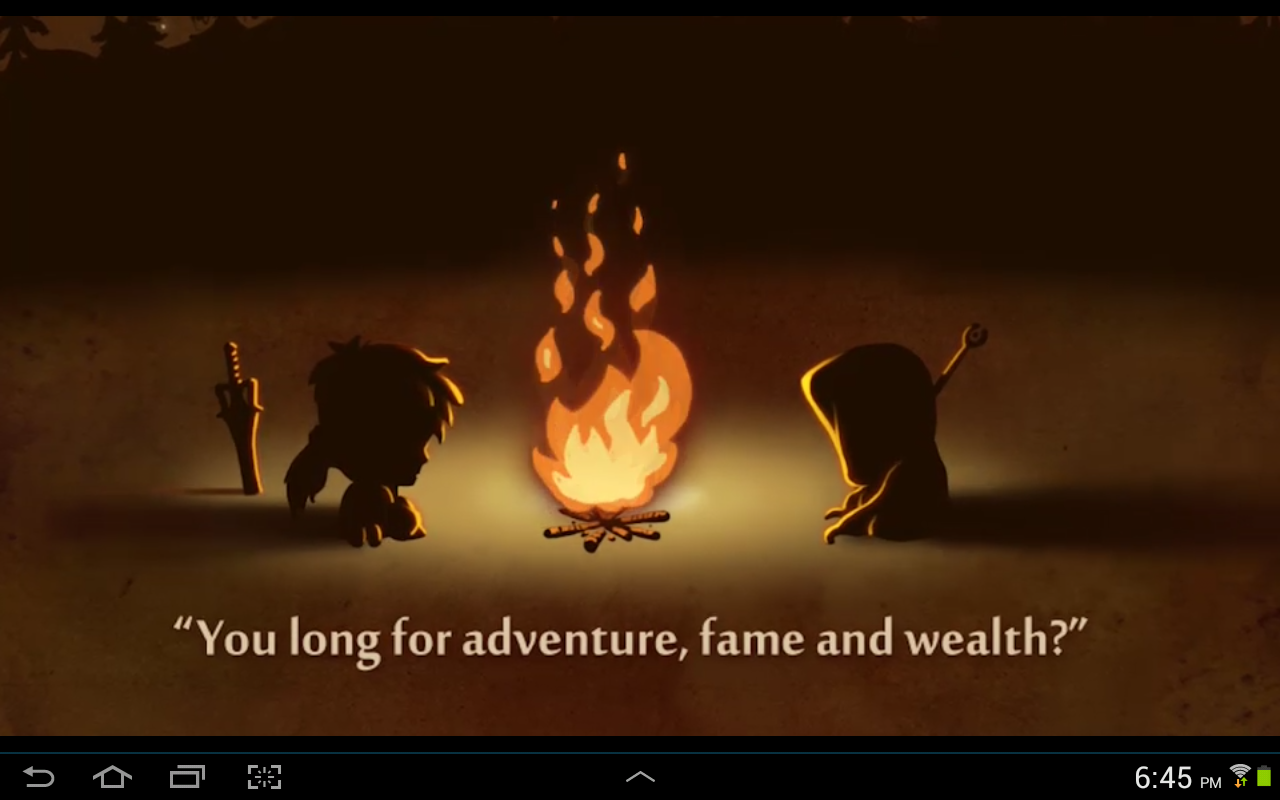
The “League of Heroes” is a simple RPG available both in the Android Play store and Apple App Store.  I really enjoyed the bright, playful graphics and the smooth game play, but there were some drawbacks to this game.

Welcome to the village of Froggnest

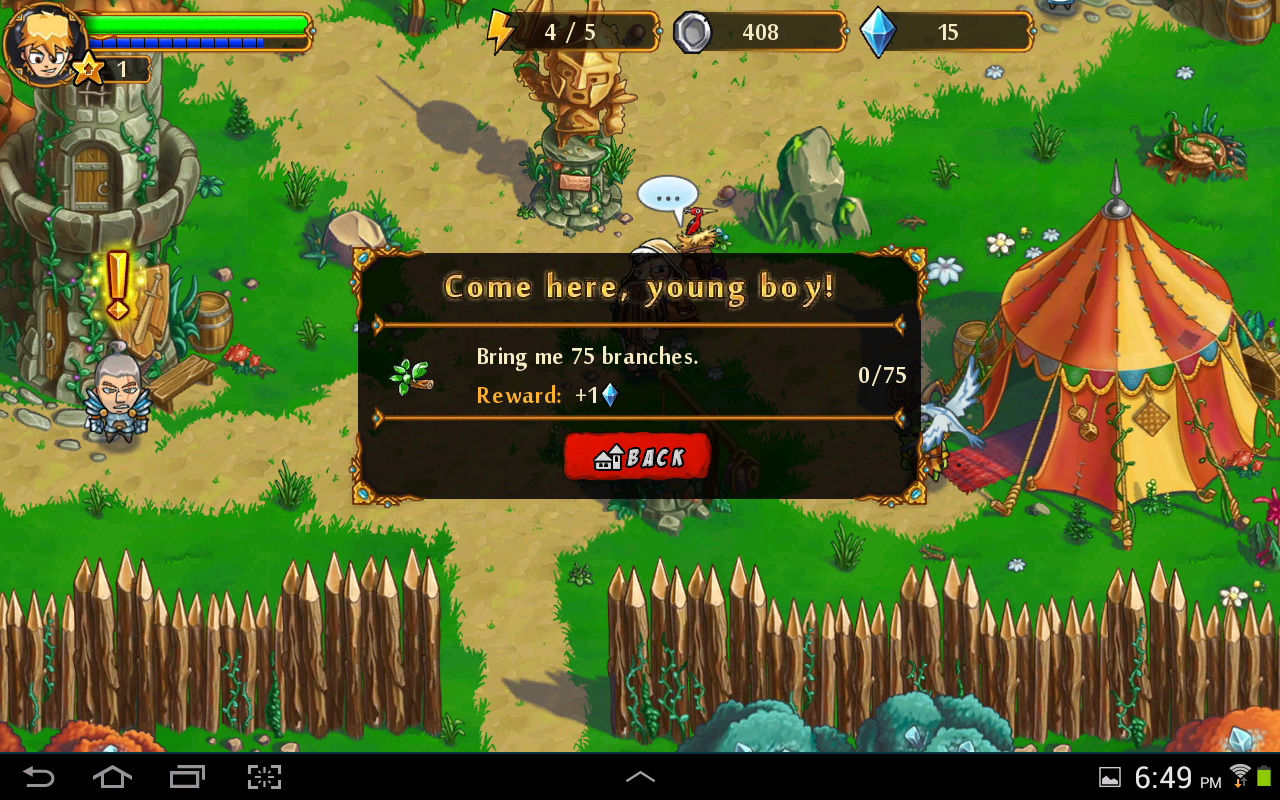
The hero of the game is asked to undertake a quest to rid the small village of Froggnest of the scourge of evil creatures that presumably want to destroy the inhabitants.  These inhabitants seem to consist of a Captain, an armorer, potion mistress, town troll, a trainer, and an elderly grandmother.  Most of these have obvious functions, such as the armorer and potion mistress, who both sell valuable items that are useful for completing quests.  The Captain gives the player missions and individual quests, and the trainer provides certain capabilities for a price—such as increased hardiness or stamina.  The town troll is the social feature of the village, and the grandmother provides small side quests for a reward, such as gathering sticks for her while the hero is on other larger quests.

The Grandmother's Quest

The Grandmother’s Quest

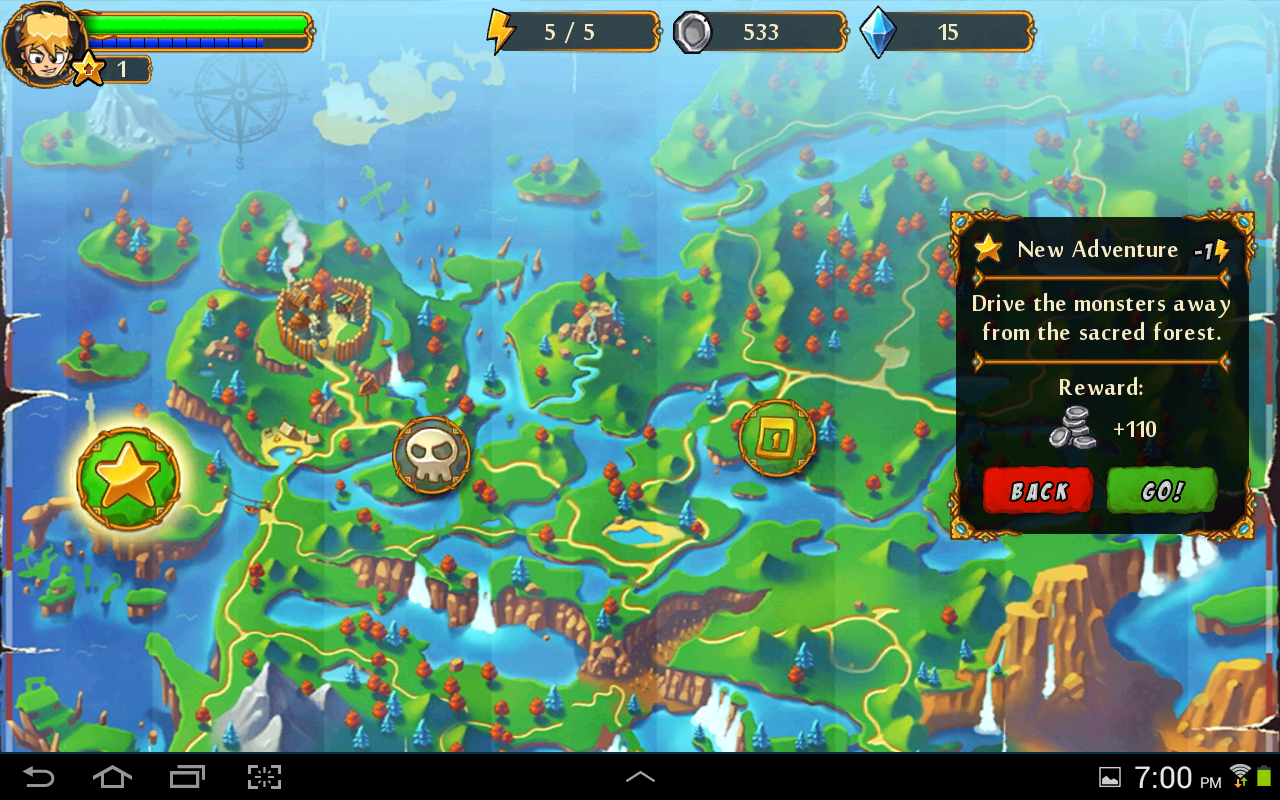
Each time the hero leaves the village, he is given a choice for his quest.  There is exploration, which allows him to continue to defeat ordinary monsters, the daily quest, which is pretty self explanatory, and the boss level.  I like this layout because the player can choose when to face the boss level.  If the hero has gone too long without facing a boss, the game will alert him that he can continue to accumulate coins and jewels, but that his XP will not increase until he has finished the boss level.

Choose your own adventure...

Choose your own adventure…

I like the smoothness of this little game and the ease with which the player can become immersed in the world.  The graphics are bright and pretty.  Quests are simple enough to be played in roughly three or four minutes—which is perfect for the adult player who just wants to take a brief break from work or homework.

There is a nice variety of monsters, and while most of the terrain looks similar, it is not exactly the same.  This helps keep it from being boring.  Also there are lots of little barrels and jugs scattered throughout each level that can be smashed to reveal the contents—coins, usually, but occasionally nothing.  Once a level has been cleared of monsters, the hero is given the option to go straight home to the village, or stick around and search for more treasure.

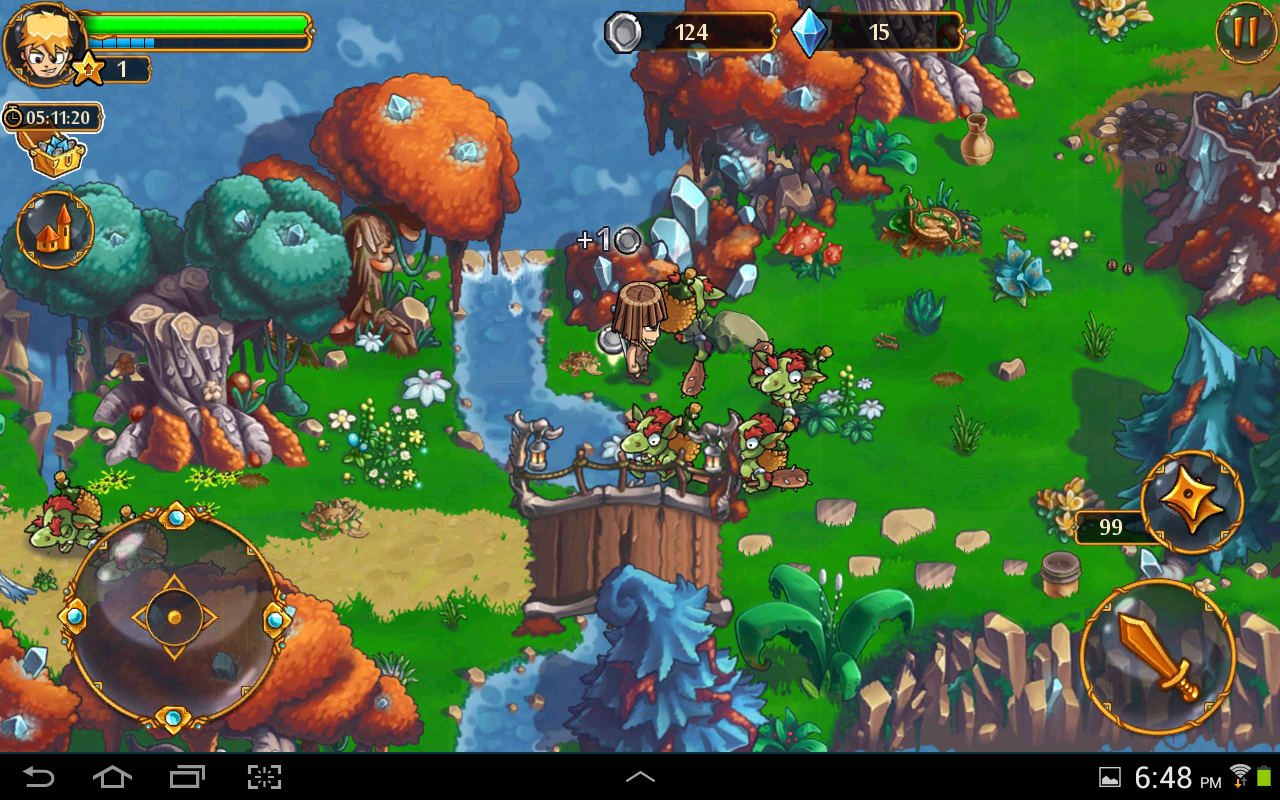
Where the game falls short is the controls.  The main character is controlled with a touch compass in the bottom left corner of the screen.  Moving the compass determines which way he goes.  The bottom right corner is the action button.  While the player is exploring, this is a sword.  At other times it can be used to interact (or “talk”) with other characters, or perform other actions.

I realize that the game has to work with the soft, onscreen buttons on most tablets and smart phones, but it makes the player work very hard to keep his character headed in the right direction.  I’ve been defeated during several levels because I was swinging my sword away from the monsters that were attacking me, and couldn’t get turned back around in time.

Here there be monsters

Here there be monsters

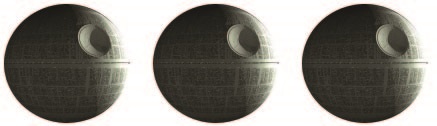
Overall, this is a bright, cute, fun game to idle away some hours, but it is easy to get frustrated over the difficulty of control due to a lack of physical buttons.  I give the game three out of four Death Stars.

3 Death Stars

Leave a comment

Filed under Editorial, Game Reviews, Gaming, Tracy Gronewold