Author Archives: Andrew Hales

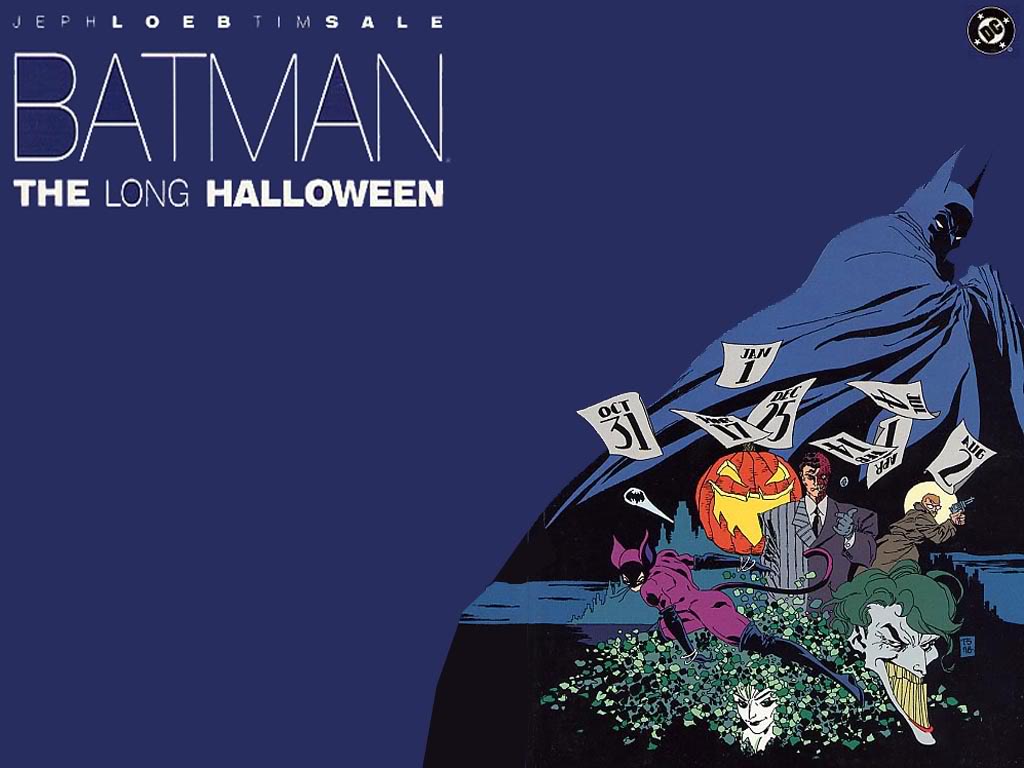
Batman: The Long Halloween Giveaway Winner

We are pleased to announce that the winner of our Batman: The Long Halloween is username Kai. We are so pleased to see how many of you entered our contest and I’m completely blown away at the great comments you all had. Stay tuned to Therefore I Geek for future giveaways and other great content. Once again thanks to everyone who entered and congratulations to our winner, Kai.

wednesdaysheroes.com

Leave a comment

Filed under Comics, Giveaway

Review: Godzilla (1954)

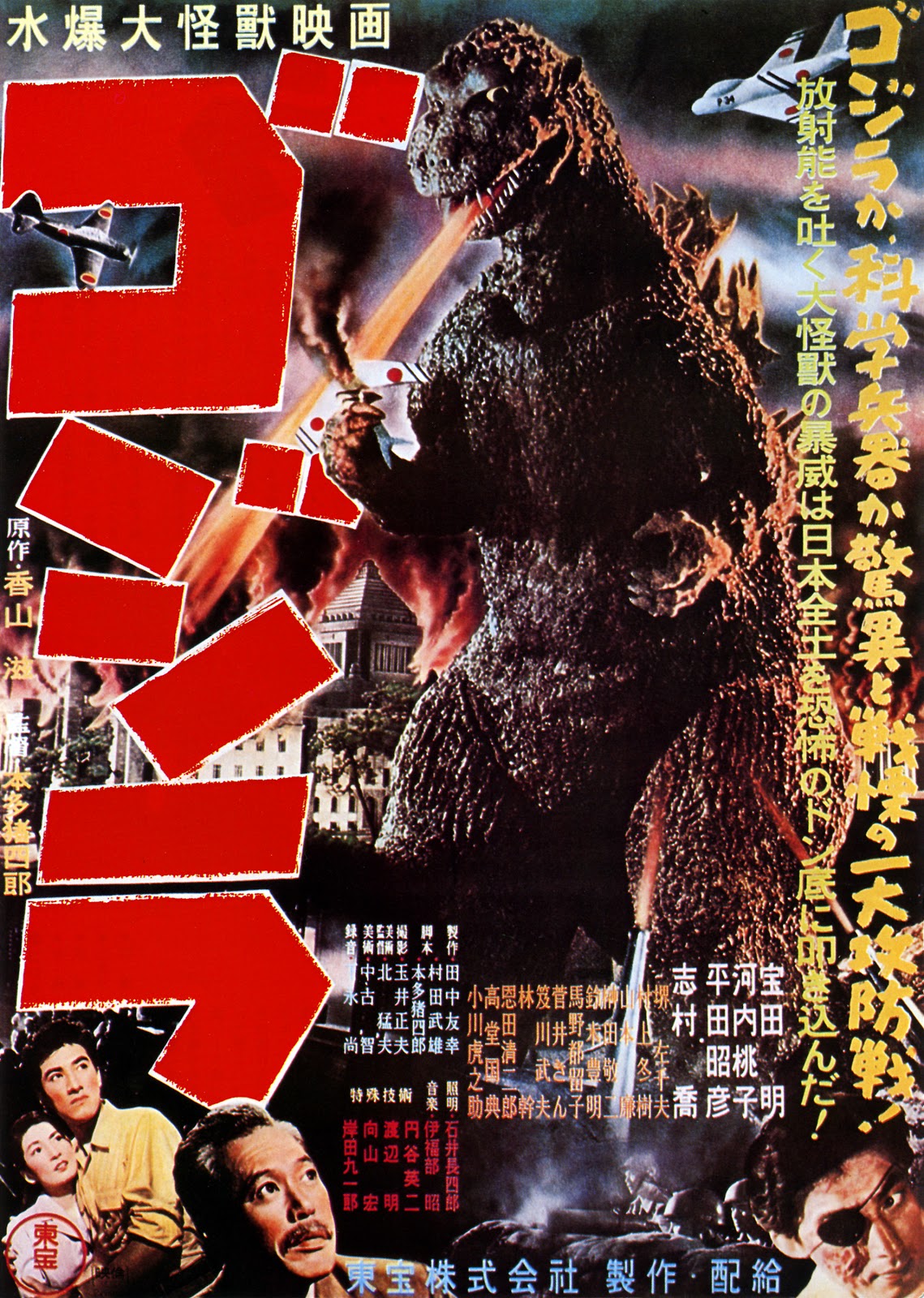
Gojira_1954_Japanese_poster

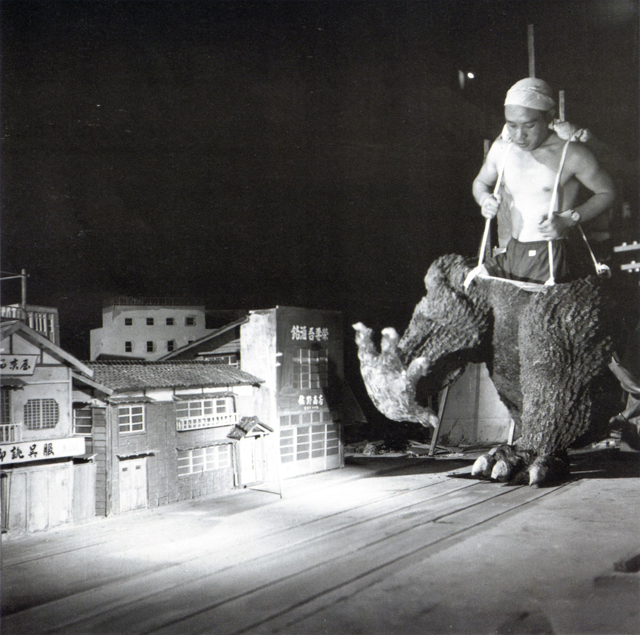
Man in foam rubber suit.

Man in foam rubber suit.

1954’s Gojira is a piece of film history.  For those of you scratching your heads, Gojira is more commonly known in the United States as Godzilla—everyone’s favorite foam rubber monster. When most people think of Godzilla, they think of men in sketchy looking, foam rubber suits fighting each other in a model town, crushing everything in their process (poor Tokyo). This stereotype might be true for some of the later movies, but the original Godzilla is much more complex than that. Not only is it a classic B movie, but it also provides us with some valuable insight into post war Japanese culture.

The most important thing to realize about Godzilla is that there is a plot, despite popular belief to the contrary. In fact, not only is there a plot, but it’s a pretty good one. The film starts off with the mysterious sinking of a fishing vessel; a flash of light from under the water and the ship is engulfed in flames and sinking. Shortly thereafter another boat shows up to investigate the scene of the first sinking and it too is destroyed in spectacular fashion. While the Japanese Coast Guard investigates, a fishing village on the island of Odo is ravaged by what is first thought to be a storm, though there are reports of a giant monster that caused the damage. The Japanese government sends a scientific team to investigate, and they discover enormous, radioactive footprints throughout the village. Between the radiation and the discovery of a trilobite (a small creature thought to be extinct millions of years ago), the scientific team concludes that the creature must be from the Jurassic period.  Soon after Godzilla himself is sighted on the island.

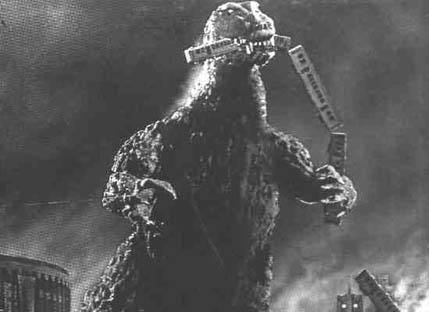
Mmmmm, train...nom nom nom.

Mmmmm, train…nom nom nom.

The Japanese Coast Guard decides that Godzilla is too much of a threat and must be destroyed and attempts to do so with depth charges.  Of course this goes poorly for them and only drives Godzilla to attack Tokyo harbor.  Eventually Godzilla is driven off, but not before turning Tokyo into a flaming ruin.  In a final act of desperation, Japanese scientists release the Oxygen Destroyer into the water of Tokyo harbor, killing all living things in the harbor, including Godzilla.

To begin, the incidents involving the fishing vessels mirror a real life incident in which the crew of a Japanese fishing vessel were exposed to extreme radiation from an American underwater Hydrogen bomb test. While film makers caught considerable flack from critics and the public for this parallel, it tapped into the Japanese cultural mindset. Godzilla was released only nine years after the end of WWII and the horrors of the nuclear bombs were still fresh in everyone’s minds. In the 1950’s, there was still a lot that was unknown about the effects of radiation, but the fear of radiation is still a very real concern for the Japanese even today.

When the senior scientist presents his results to the Japanese government he immediately blames the H-bomb tests not only for disturbing Godzilla, but also for causing his mutation in the first place.  The Japanese government wants to destroy Godzilla, but the scientists want to study him, especially his resistance to high level radiation, in an implicit effort to better treat those who’d been exposed to radiation.

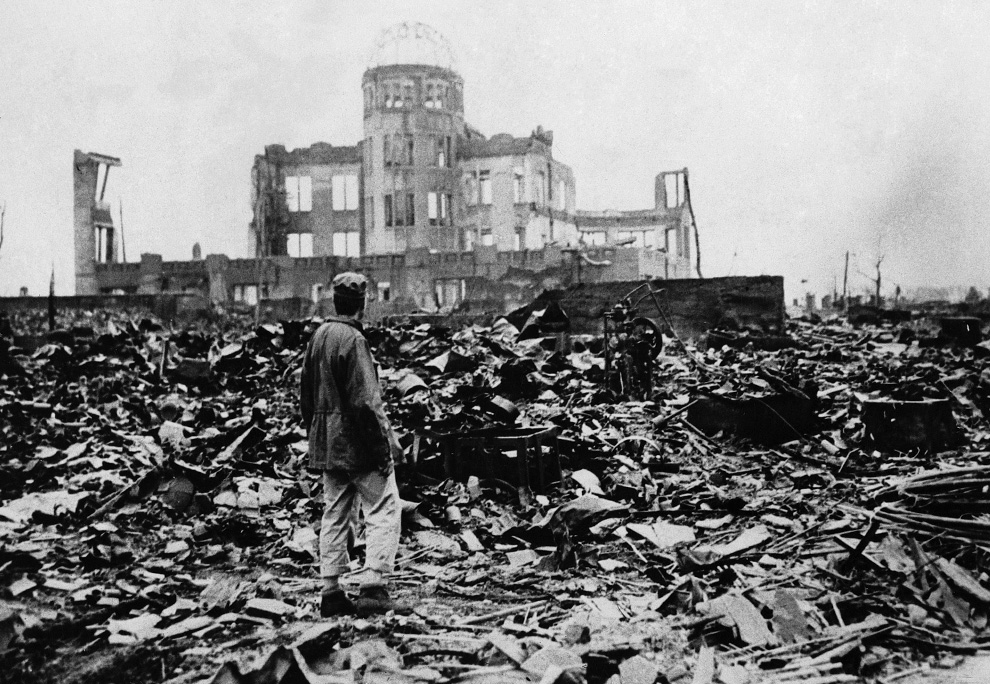
Godzilla’s attack of Tokyo harbor leaves the entire city in ruins, between his crushing things under foot and breathing fire all over the city. The scenes of a devastated city, filled with rubble and flames must have also hit home with Japanese audiences who remembered living through the firebombing of their cities. The fact that a monster movie like this can so directly tap into the pulse of Japanese society speaks volumes about its quality.

Aftermath of Hiroshima, an image still fresh in the mind of Japanese movie goers.

Aftermath of Hiroshima, an image still fresh in the mind of Japanese movie goers.

There are many things I love about Godzilla; chief among these is the miniature work. Well before the advent of computer generated special effects, the only options available to film makers were to film full-sized events (like Buster Keaton in The General) or use miniatures. Full sized effects are often one shot attempts, expensive and very limited in scope. Miniatures, on the other hand, allow for a world of options, can be repeated if the shot isn’t to the directors liking and are reasonably inexpensive. The real trouble with miniature work is that, done wrong, they can look terrible. Thankfully, the work in Godzilla is surprisingly good. Most of the work was masterfully done, with incredible attention to detail. There were also several occasions where the film makers blended miniature work with live actors.  Several scenes of destruction showed live actors on a set which was then destroyed (in miniature) after a quick cut.  It is almost impossible to tell the difference between several of these sets and their miniature counterparts.  There is only one time the miniature work disappoints me and that is when jets finally chase off Godzilla. The jets themselves look like cheap models made from balsa wood and the wires attached to them and the rockets they fire are very visible.

I also thoroughly enjoyed the science aspects of the film. From the use of actual Geiger-Muller Counters, to the discovery of the trilobite in the foot print, there is factually accurate science all over the film. My favorite reference was to the discovery of Strontium-90 in the footprint, which—after a few minutes of Google searches—I discovered is actually an isotope found several weeks after the detonation of an atomic weapon.

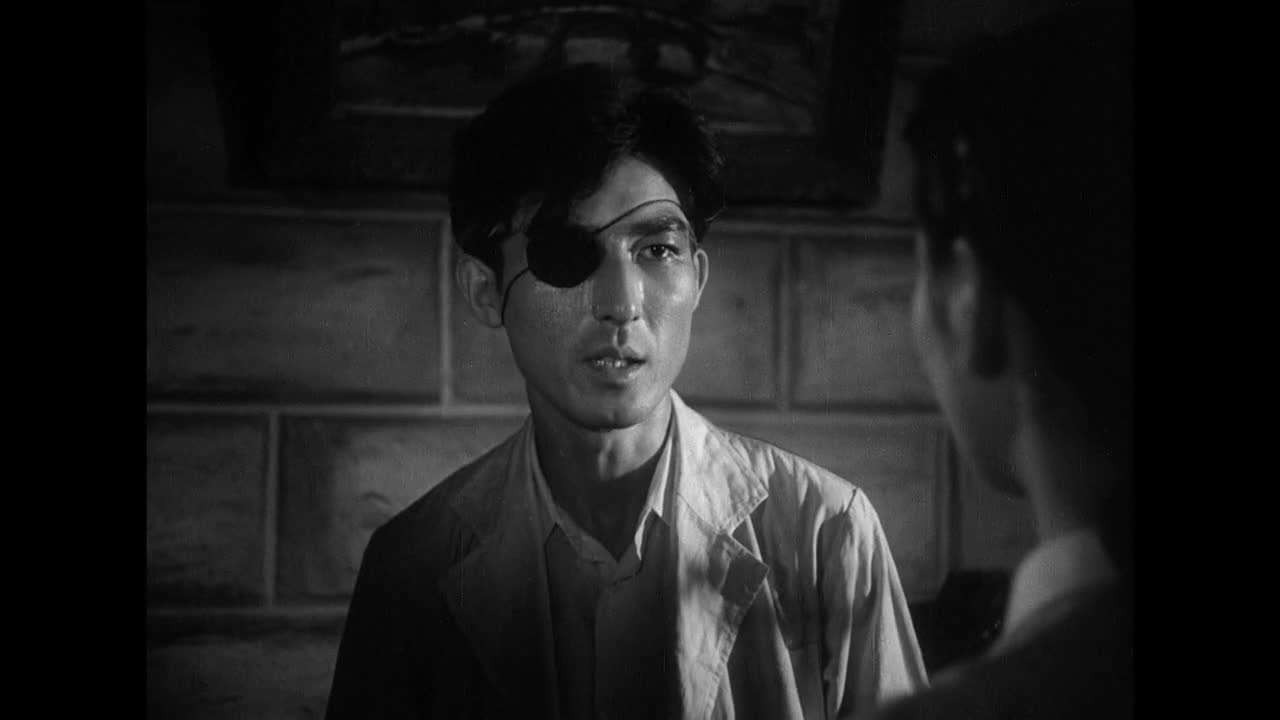
Even the ending of the movie is dependent on science, although that science is unfortunately utter garbage. The idea of an Oxygen Destroyer is completely ridiculous though it does serve a purpose, aside from ridding th0e world of Godzilla. The Oxygen Destroyer is a weapon that is even more dangerous than the atomic bomb and it isn’t used until there are no other options left and even then the creator dies with his creation to ensure that it can never be used again. Given what they experienced as a culture, it’s no surprise that the Japanese have this feeling towards a weapon of mass destruction and the willingness of a scientist to sacrifice himself in order to prevent it from being used by anyone ever again.

This man was willing to die to prevent another Hiroshima.

This man was willing to die to prevent another Hiroshima.

Even though it is a monster movie, Godzilla is definitely worth checking out. If you need more proof of this movie’s excellence, just look to the fact that the year it was released if won the Japanese Movie Association award for Best Special Effects and was nominated for Best Picture, losing to Kurasawa’s Seven Samurai. Without a doubt this film warrants five Death Stars.

1 Comment

Filed under Andrew Hales, Movie Reviews, Movies

Review: Batman: The Long Halloween plus Special Giveaway

wednesdaysheroes.com

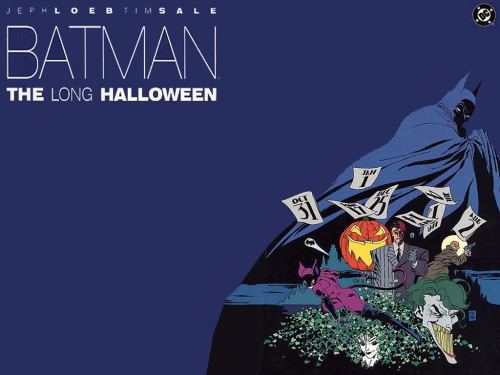
With Halloween just a few days away, I thought it’d be a good time to take a look back at Batman: The Long Halloween.  Written by Jeph Loeb with art by Tim Sale, this is a classic Batman story with film noir feel.  Loeb crafts a masterful mix of hardboiled crime, mystery, and superheroes without making any of these elements feel like they are out of place. Yet despite this expert craftsmanship, there are things in this book that could do with some improvement.

Batman: The Long Halloween was originally printed in thirteen monthly issues, starting in October 1996, and wrapping up the following October.  The story follows Batman as he attempts to discover the identity of Holiday, a murderer who is killing members of Gotham’s crime families on holidays, starting with the murder of Johnny Viti, nephew of mafioso Carmine Falcone, on Halloween.  Thus begins a yearlong hunt by Batman, Captain Jim Gordon, and District Attorney Harvey Dent.  The story takes some wonderful twists and turns as the year progresses, which leads to its eventual conclusion. The final twist is good enough that I won’t spoil it for you, but rest assured that it is one of the better ones I’ve seen in quite a while.

www.comic-con.org

Archie Goodwin

By far the best part of this book was Jeph Loeb’s story telling.  In the forward to the edition I own, Loeb says that much of the credit for the book goes to Archie Goodwin, former editor of DC, for pushing Loeb to tell a noir story about the Gotham crime families set in the Batman: Year One time period.  If this is true, and I have no reason to doubt that it is, Loeb took a good idea and ran with it as hard and fast as he could.

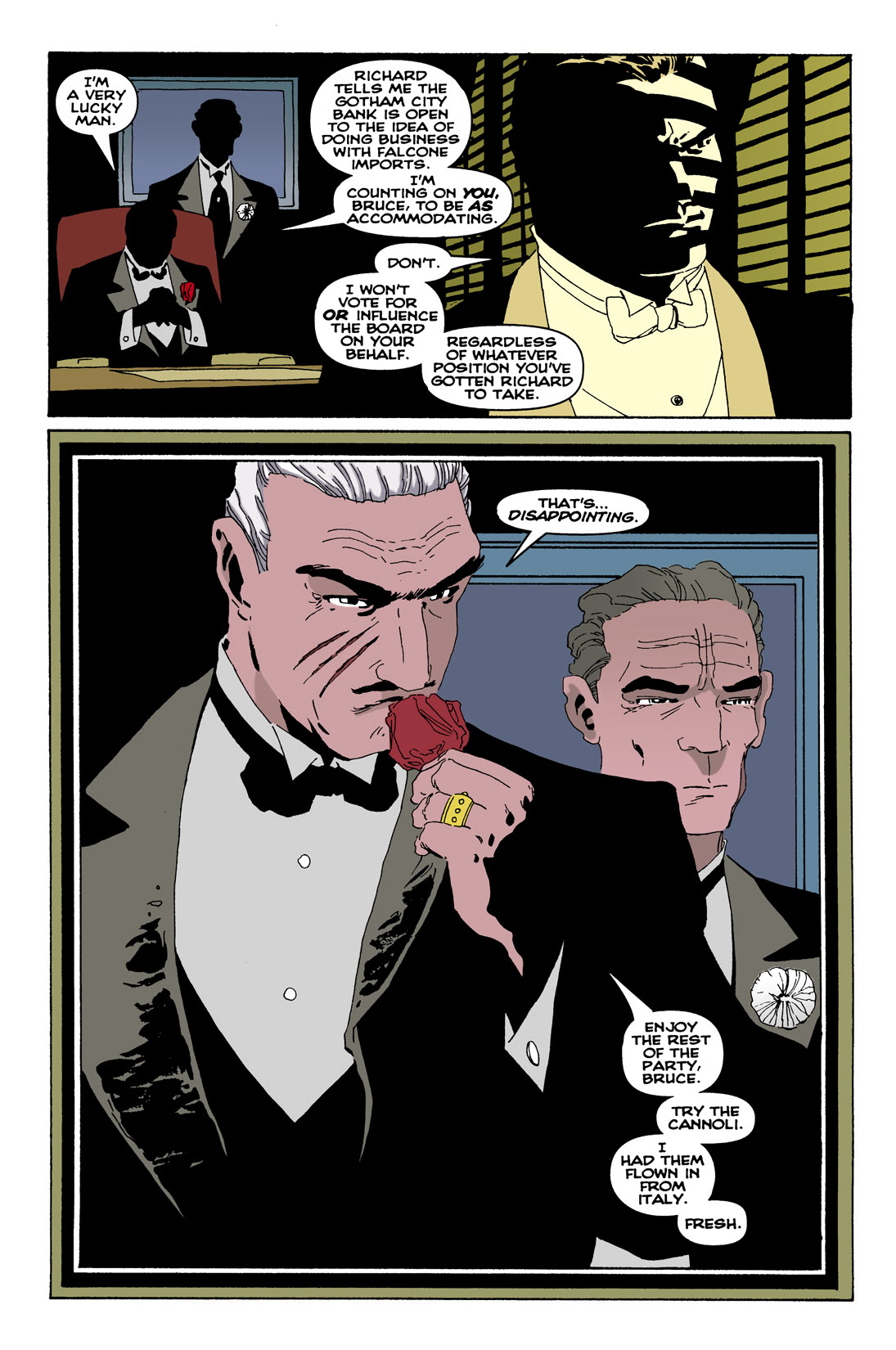
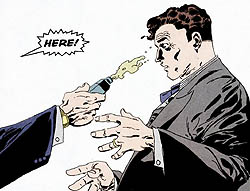
The characterizations of rival gangsters Carmine Falcone and Sal Maroni is fantastic. Both men see themselves as legitimate business men and try to conduct themselves as such when in public. They often attend events together and quietly trade barbs even as they rage and plot against each other behind closed doors.  Not only are these characters fully fleshed out, but so are the secondary characters that surround them. The only real issue with this is that at times it feels like a few plot points are being taken right from The Godfather.  For instance, the opening scene at a wedding and the inclusion of a son who is not involved in the family “business”.  While these points take different turns in Long Halloween than they do in The Godfather, I do wish that Loeb had taken the opportunity to write new, fresh material, instead of borrowing from the most well-known Mafia story that exists.

More than a little borrowing from The Godfather.

More than a little borrowing from The Godfather.

Not only is The Long Halloween a good noir crime story, it is also a solid Batman story. Long Halloween has my two favorite elements of a Batman comic:  plenty of costumed villains and Batman showing off his investigative abilities.  Batman has always been known as “the detective,”—which is fitting given the fact that he first appeared in Detective Comics—and he is always at his best when he is fulfilling that role.  The mystery portion of Long Halloween provides a great opportunity for Batman to test his skills as a detective.  While the story doesn’t focus much on this aspect, it is still constantly there, most often expressed through Bruce’s inner monologue.

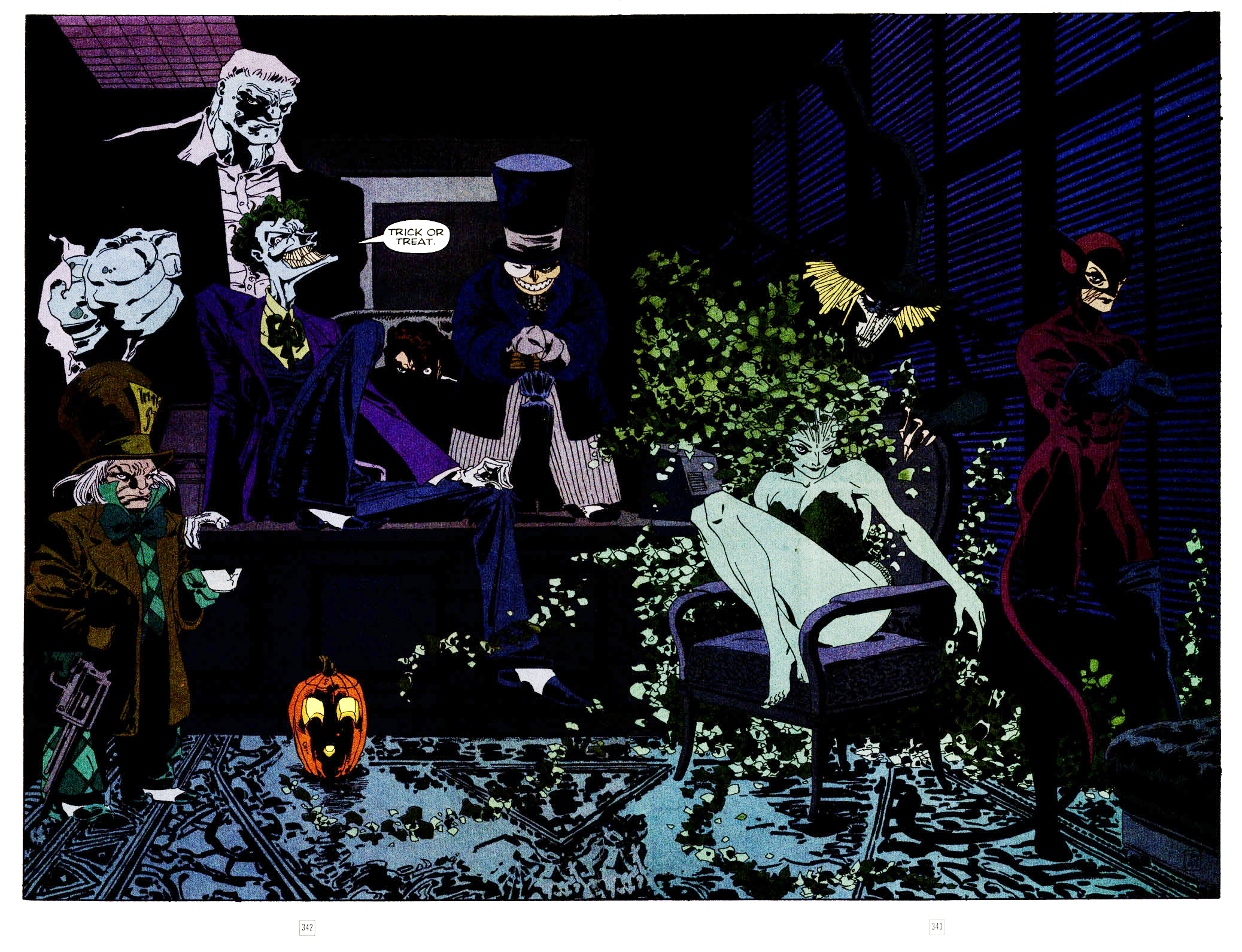
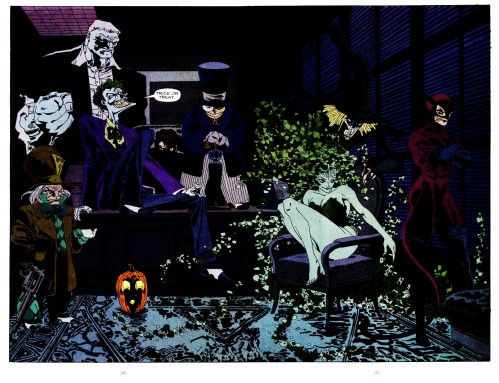
Of course, what would a Batman story be without his usual cast of costumed adversaries? For my money, no one beats out Batman for the best rogues gallery (That includes Flash.  Deal with it.), and Long Halloween has no shortage of them. Almost every major Batman villain gets at least a cameo at some point and others play a much more leading role.
batman-the-long-halloween-rogues1

Batman’s Rogues

As always, the Joker is present and is more a force of chaos than anything else. He is as clueless about the identity of Holiday as everyone else is, but figures that by killing everyone at a New Year’s Eve celebration in Gotham Square he stands a pretty good chance to taking Holiday out. Joker isn’t too fond of the competition for Gotham’s craziest citizen.

By far the most interesting of the villains is Catwoman. Loeb takes full advantage of the Year One setting and really takes the time to explore the beginnings of this complex relationship.  While Bruce is obviously involved with Selina Kyle, Batman has a back and forth with Catwoman which frequently mirrors the interactions between Bruce and Selina. We know that eventually Batman figures out that Catwoman and Selina are the same person, but at least for now it’s really quite interesting watching these two interact, completely unaware of who the other is.
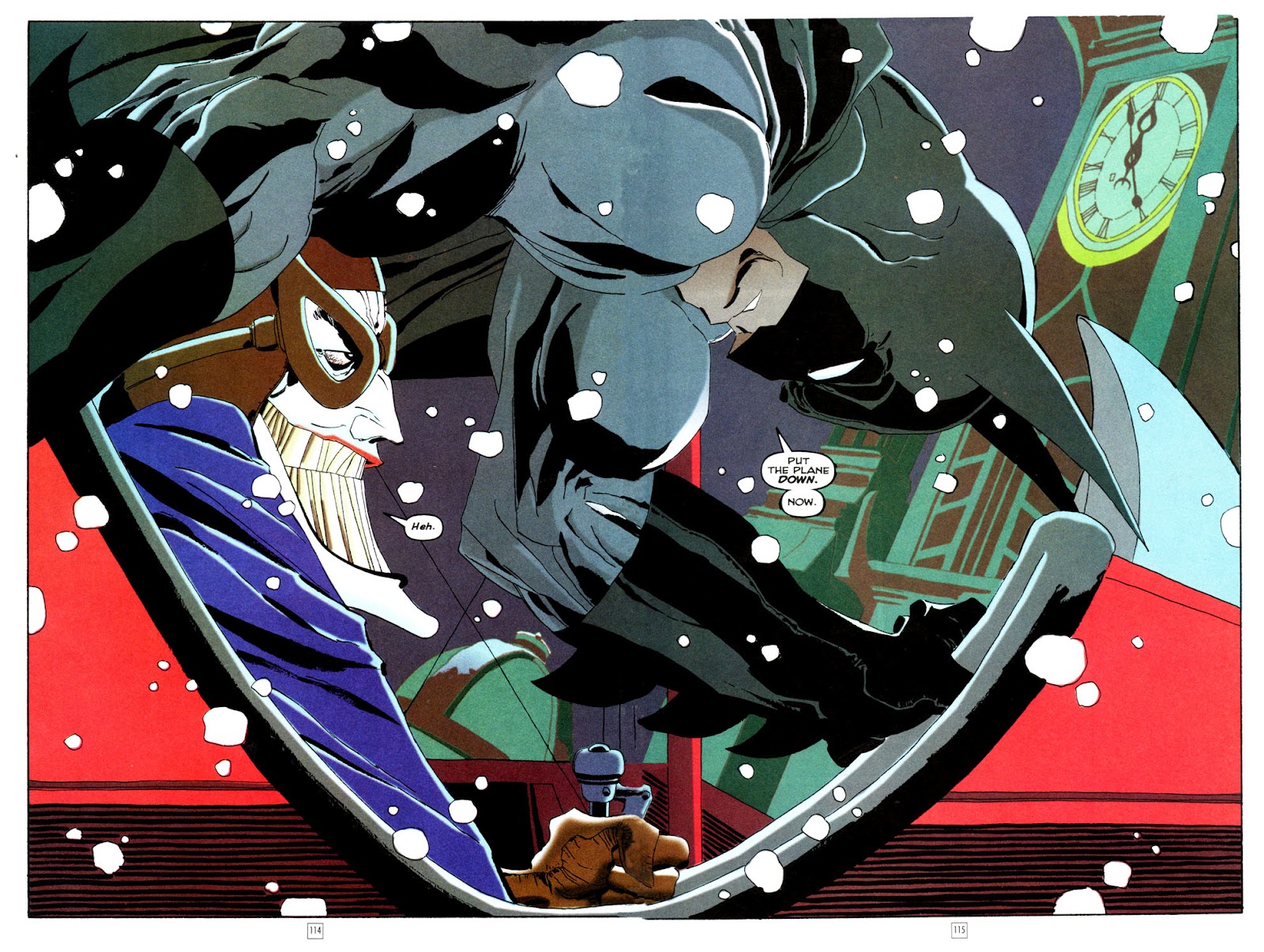
A great example of Tim Sale's two page spreads.

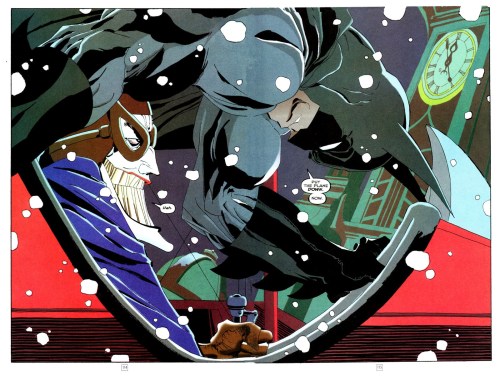
A great example of Tim Sale’s two page spreads.

We all knew this was coming.

We all knew this was coming.

My biggest complaint when it comes to the story involves Harvey Dent. The origin of Two-Face is one of the most over told origin stories in the Batman franchise and at this point, I can really do without another retelling.  Admittedly this was written in 1996 and at the time it might not have been so over used, but unfortunately it is now 2013 and the story is played out. Yes, it would have required some things to be done differently, but I feel that showing the darkness in Harvey and using it to foreshadow what we all know to be inevitable would have been far more powerful.  It is also odd to me that they always seem to shoehorn his transformation in very near the end of a story.  In Christopher Nolan’s The Dark Knight we also see the transformation of Dent, and like Long Halloween it is very near the end of the story.  Creators do this otherwise well written origin a disservice by rushing through and not allowing it to fully develop.

When it comes to Tim Sale’s art, I find it to be hit and miss.  Sale is a very talented artist, and this story provides several opportunities for him to show off.  There are plenty of spectacular double page spreads that really enhance the story.  I’m also quite fond of the murder scenes which are done in black and grey, except for the blood and the holiday themed trinket that is left behind (not always in color, but it looks better when they are).  While I’m not overly thrilled with the choice of color palette, I freely admit it works with the story and doesn’t take anything away.
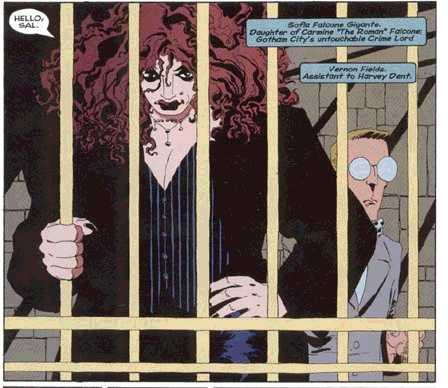
Sofia Falcone

Sofia Falcone

There are two areas where I find the art falling short. First is some of Sale’s women. When Sale wants to make a woman look beautiful, like Selina Kyle, then he succeeds with flying colors, making them truly appealing. On the other hand, when Sale attempts to make a woman look ugly or unattractive they just look poorly drawn. Sofia Falcone, daughter of Carmine, more often looks like a poorly depicted drag queen than a woman.  I found it distracting and it removed me from the story several times.

My second issue is the inking. Since there is no separate artist listed as inker, one can only assume that Sale was inking his own work.  I think that Sale was attempting to use ink to convey a noir feeling, but there are many examples where he takes it too far and the panel becomes confusing.  Several times it took far too long for me to figure out what was going on panel to panel when there was no dialogue to help guide the story.  Really great art should be able to tell the story easily, without dialogue or narration.

Even with its shortcomings, I would highly recommend Batman: The Long Halloween. It’s a great noir story with superheroes mixed in. While Loeb and Sale have teamed up on other Batman works, this is still the strongest of their partnerships.  With this in mind, I’m pleased to announce that we will be giving away an Absolute Edition of Batman: The Long Halloween. The contest begins, rather fittingly, on Halloween (October 31) 2013 and ends at 11:59 pm EDT on Sunday November 3, 2013. See below for entry rules and good luck.
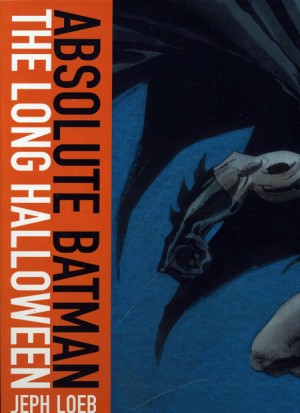
absolute-batman-the-long-halloween-hc

That’s right, we’re giving this away!

RULES: Please read the rules for entry carefully.

1)      Entry is easy:  simply comment on this post! Comments must be of some substance. This means no one word posts or gibberish.

2)      Unfortunately, entries can only be accepted from persons living in the United States.

3)      The winner will be chosen at random from all eligible entries and announced on November 4, 2013. Every effort will be made to contact the winning party before the public announcement. The winner will need to provide an address where the prize can be shipped. (However, this should not be included in the comment.)

4)      If it is determined that the winner is ineligible (not living in the United States, etc) then a new winner will be chosen at random, and contacted.

5)      Failure to comply with the rules listed will result in an ineligible entry.

6)      Final determination of eligibility will be done solely by the staff of Therefore I Geek.

7)      Seriously, get out there and enter! This is an awesome prize.

41 Comments

Filed under Andrew Hales, Comic Reviews, Comics, Giveaway

Winning Science October 29, 2013

Ever wonder why it always seems that your awesome smartphone or computer starts to fall apart right about the same time that the manufacturer announces a brand new model? If the answer is yes, then you are not alone. The New York Times’ Technology section attempts to tackle this mystery. It turns out there is a very fine line between making a quality product that everyone loves and “planned obsolescence”. Stray a bit too far either way and your bottom line will be taking a considerable hit.

apple-logoIt’s reassuring to know that I’m not losing my mind when I notice these things.

The US Navy’s newest destroyer, the USS Zumwalt, has made its way into the water finally. The Zumwalt, named for former Chief of Naval Operations Admiral Elmo R. Zumwalt Jr., is significantly larger than its predecessor but requires a much smaller crew. While technologically advanced, the design program met with considerable problems and cost a lot more than the original budget, much in the way the earlier Seawolf Class Fast Attack Submarines did. Also like Seawolf,  the program was cut down to just three ships.

www.sinodefenceforum.comThe Zumwalt boasts advanced radar systems, a new 155mm gun, an electric propulsion system, significant computer automation, and a stealth hull.

Popular Science finally answers a question I’ve always had about the Apollo missions. What happened to Apollo 2 and 3? We all know about the tragic fire on Apollo 1 and the investigation that followed, but what happened to the next two missions? As it turns out, they never happened. Each of the Saturn rockets to be used was assigned to a mission, and so Apollo 2 and 3’s rockets were never used, due to the massive redesigns following the fire. With the introduction of the new and improved Saturn rockets, the mission number was maintained and the next unmanned Apollo flight became Apollo 4.

en.wikipedia.orgApollo 4, 5, and 6 were all unmanned test missions that were conducted prior to resuming manned missions with Apollo 7.

Leave a comment

Filed under Winning Science