I have a cool job working at a NASA Visitor Center, and occasionally, that means that I get to do some really cool things—some of which are creating or helping design and build exhibits to share exciting information with the public in engaging ways. The other day, I had the opportunity to experience a demonstration on how the Oculus Rift goggles could be used as a learning adventure and I must say, the hype surrounding the technology is well deserved.
For those who have not heard, Oculus Rift is a virtual reality hardware that is completely immersive and allows the user to look and move around in a virtual world. Since the earliest hints of this technology, gamers have been giddy at the possibilities. The ability to “get into the game” in a more visceral way has been a gamer fantasy for a long time. Imagine sitting in an X-Wing and having a space dogfight with a squadron of TIE Fighters. You will have complete control of the craft with the controller, but also the ability to look around the cockpit with a full, 3D, 360 degree view by actually turning your head. It is an amazing and exciting concept!

Oculus Rift headset
Practical people may prefer a more pragmatic application. They can get excited about a full, room simulation that has been created to train teams on bomb disposal. One man puts on the Oculus and is able to walk around in a virtual room, find a bomb, and then relay what he sees to teammates so that they, in turn, can give him step-by-step instructions to diffuse the situation.
What is amazing about the Oculus is how seamless the world is, as the user moves around in it. I was able to walk through a couple of demonstrations of informational simulations that placed me in space, using the headset. The first simulation was called 6000 Moons and described the different uses of satellites, explained how different orbits help facilitate different functions, and gave a very cool visual of what all of the satellites look like as they circle the earth all at once. If each satellite were part of an alien invasion force, we’d be screwed! It looked like a swarming mass of insects around their queen.
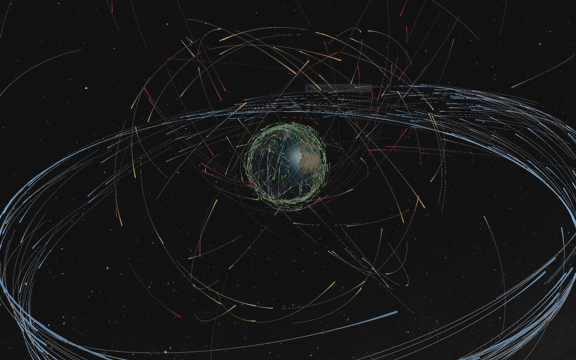
Promotional image of 6000 Moons from binsoftware.com
The informational clips were all automated, and propelled the viewer through space at certain times while a narrator explains what the viewer is seeing. Because the technology works through motion detection, a three-dimensional tour can be designed and the world can be viewed at any angle. The immersive effect comes in from the ability to look above and below, and even turn completely around in your chair and still be in space. There are no hard stops to keep you inside a proscribed area. There are no graphical seams or lines depicting programming limits. It’s just you in space. After watching 6000 Moons, my first thought was, “What about a tour of the Solar System!?” So I asked the question and, even though it wasn’t the purpose of the visit, I was shown a beta version of a tour called Titans of Space.
This simulation starts with a view of Earth with the Moon circling it and the Sun ominously close. As the narration went on about the various particulars of our home planet, I was busy looking around. I looked back over my shoulder and was startled when I saw… my shoulder! Of course, it wasn’t really my shoulder. This program had a simulated body to act as an anchor for the experience. I must say that it was a good choice that added to the natural feel. Some trade-off is made for loss of view, but for those like me who suffer from motion sickness, the reference point allows for a much more comfortable tour.

Titans of Space, photo from blog.dcxn.com
After the smaller planets were described, the next planet was Jupiter and here was where the name of the program, Titans of Space, started to make sense. The background music turned ominous and the planet filled the space in front of me. It was imposing and intimidating—feelings I don’t normally associate with a description of the Solar System. I felt compelled to look away to get my bearings and I was rewarded with a view of the Sun behind me and a silhouette of all of the planets I had passed in front of it. I was actually in space! This was not a frame by frame look at a world, in which only the part being focused on is rendered. I was actually being moved through a digital world around objects programmed in relative scale and distance. It was awesome and amazing and by the end of the tour, which went on to describe the largest known stars, I felt very, very small.
The Oculus Rift is coming for mass consumption very soon—right now it is scheduled for release in the first quarter of next year. I’m not sure yet how the gaming world will react. There are a lot of interesting possibilities, but it will take some experimentation to figure out which are good ideas and which are just impractical because of movement limitations. Either way, if this sort of tech is up your alley, it’s coming, and it’s coming fast. If you’re lucky enough to live in the Hampton Roads area of Virginia, it’s coming to a museum near you and possibly within the next two months. You’ll definitely want to see this.
A big thanks to binsoftware and the folks at The Virtual Reality Learning Experience for their efforts in utilizing this new technology for public education and use.
– by Kurt Klein



 Therefore I Geek