A couple of months ago, I gave a detailed and involved description of film noir, discussing its history and the key points that make a noir story. Here I just want to name a few of what I think are the key films for this era that not only embody key characteristics of the genre but also turned out to be great entries in American film making.
The Big Sleep (1946): If I had to guess, I think when most people equate noir with private eye movies, and for good reason. Many films that combined these two tropes were made and were very popular and endlessly spoofed. I think the most famous example would have to be The Maltese Falcon (1941). However, for my money The Big Sleep is the best.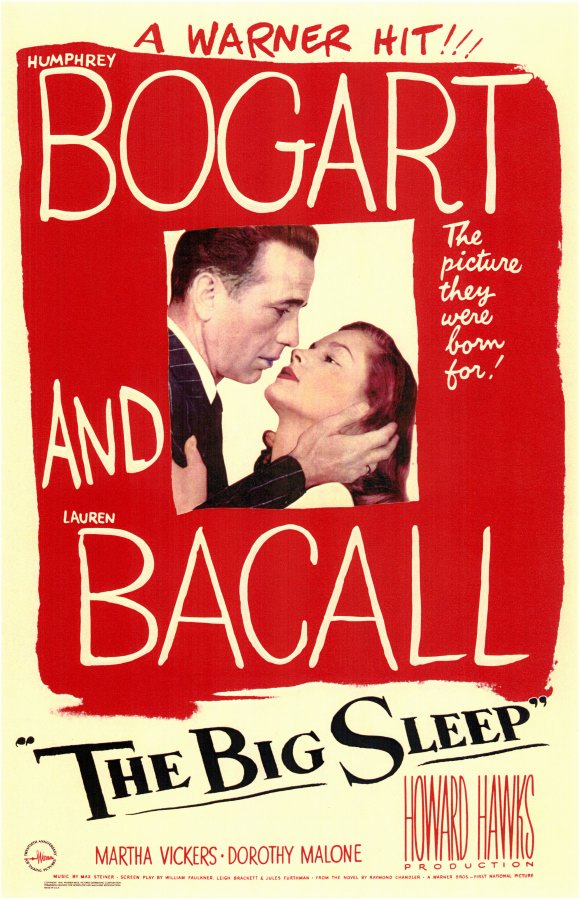
Based on the book of the same name by Raymond Chandler, the film was directed by Hollywood’s “Grey Fox,” Howard Hawkes. Humphrey Bogart plays Philip Marlowe, the main character. Marlowe is the closest thing to a James Bond style character that noir has. The character is played by four different actors in as many films in the 40’s, and reappears in five movies from ‘69 to ’78, twice being played by Robert Mitchum. It also stars the stunning beautiful Lauren Bacall as the woman Marlowe helps and with whom he battles wits.
The plot of the film is famously convoluted and just trying to follow and understand it is a game in itself. The acting is superb and the pacing keeps the viewer locked in. The dialoged is sharp and witty without the actors hamming it up. This is a classic of the genre that is a must see.
(Similar films are the famous The Maltese Falcon (1941) also starring Bogart, Murder, My Sweet (1944) with Dick Powell as Marlowe, and Out of the Past (1947).
The Asphalt Jungle (1950): Now this is a great film. Not only is it one of the best noir films ever made, it is easily in my top five movies ever. Directed by John Huston, the same man who created The Maltese Falcon, and starring Sterling Hayden (Dr. Strangelove) as a hired thug, the movie centers on a team put together to pull off one last great heist of a jewelry store. The heist is the brain child of Doc Erwin, played by Sam Jaffe (The Day the Earth Stood Still) who puts in motion the planning to rob a jewelry store after being out of prison less than a day.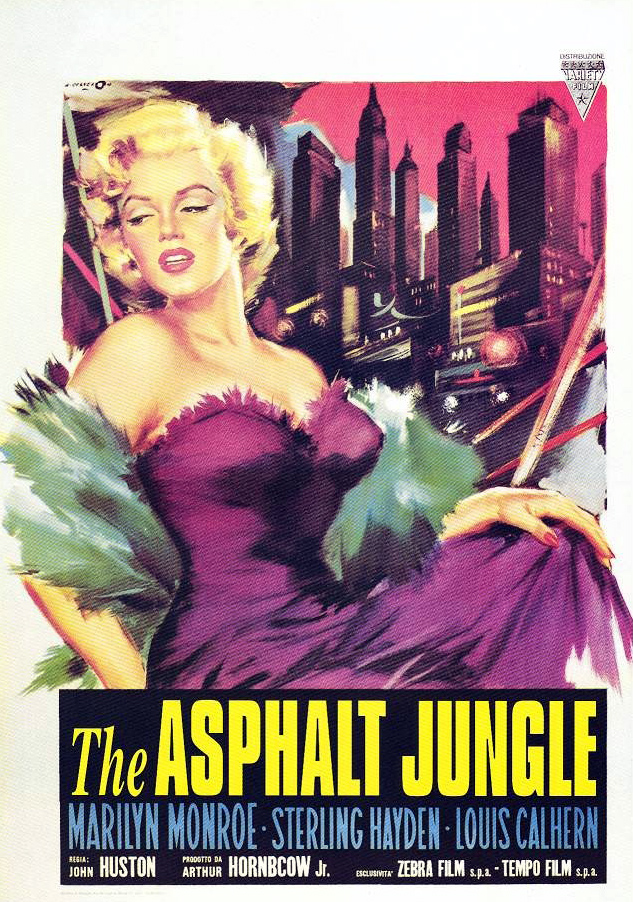
Pretty much everything about this film works. The pacing is even and steady: first the team is put together, then the plan is hatched, next the dry run, finally the heist itself when all hell breaks loose. Houston is also far more stylish in this film than he is in some of his other noir films, such as Key Largo (1947) or even The Maltese Falcon.
The cast is fantastic with strong performances not only by the leading roles of Hayden and Jaffe, but also the supporting cast that includes Jean Hagen as Hayden’s dim, yet loving girlfriend, and Louise Calhern, the money backer of the heist. The smaller roles really leave their mark as well. They include Marc Lawrence, a long time Hollywood character actor, and James Whitemore (Gus from The Shawshank Redemption). This film is also one of the first movies in which Marilyn Monroe appears.
Anyone who likes heist movies should take a moment and watch this great film. Other similar movies are the fantastic Stanley Kubrick heist noir The Killing (1956), also starting Sterling Hayden; Odds Against Tomorrow (1959); The Narrow Margin (1952); and the French heist noir by American ex-patriot director Jules Dassin called Rififi (1955).
The Big Heat (1953): Chances are any movie involving a rogue cop seeking his own brand of justice owes something to this Fritz Lang film. Starring Glenn Ford (who might be best known to blog readers as Pa Kent from the Donner Superman) as cop Dave Bannion, who just couldn’t stop asking questions. A plot against his life fails to kill him and instead kills his wife. After that the gloves come off and wholesome Bannion dives into the underworld of corrupt cops and organized crime.
Also starring Gloria Graham as a mobster’s girlfriend, Debbie Marsh, The Big Heat is an almost nonstop revenge film that tackles very dark subjects and has some very disturbing moments. Lee Marvin nearly steals the movies as the thuggish mob heavy in this film. The scene in which Marvin’s character beats Graham’s and pours boiling coffee on her face for getting close too to Dave Bannion is disturbing even by today’s standards.
Gloria Graham’s performance shouldn’t be underappreciated. She is brilliant in this film and her character is the archetype of the proactive female characters found in many noir films. However, I think Graham’s Debbie Marsh really stands out above other similar roles. Many femme fatales are often the villains in noir films, suckering hapless men in to doing their bidding. In The Big Heat, Marsh is a character that knows Bannion will fail without her help, and sets out to make sure he doesn’t.
Double Indemnity (1944): This is it—what I think could be the most noir-ish of all noir films on this list. The plot seems so typical in today’s cinema: a wife buys accident insurance without her husband knowing and seduces the insurance salesman in to helping her pull off his murder. A classic plot, but without Double Indemnity it wouldn’t be.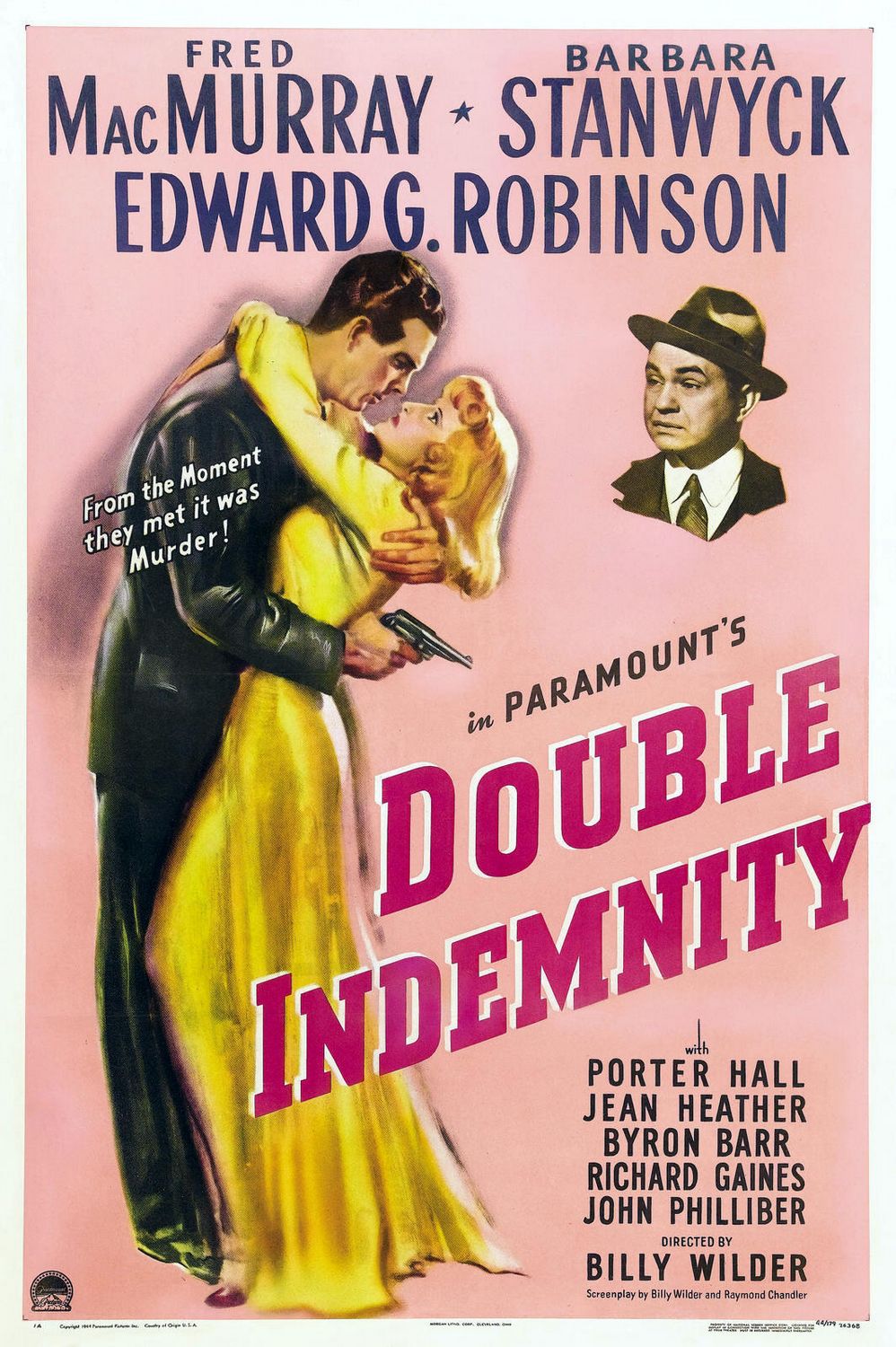
Some critics I’ve read say that film noir began with this movie. Starring Fred MacMurray, Barbra Stanwyck, and Edward G. Robinson, and directed by Billy Wilder this film is often one of the first films talked about when analyzing the femme fatale character.
Barbra Stanwyck’s Phyllis Diettrichon is not as one dimensional as some might think the femme fatale traditionally is. On the one hand, she is controlling, conniving, and manipulative, yet on the other hand it is clear that on some level, her feelings for MacMurray’s Walter Neff are very real. Stanwyck is utterly compelling and steals pretty much every scene she is in.
There an interesting suspense element to Double Indemnity, as the viewer is just waiting for the moment when the well laid plans of Walter and Phyllis all go wrong. Similar films would be The Postman Always Rings Twice (1946), and the landmark Sunset Blvd. (1950). Also, look for the little know B-noir Detour (1945).
The Set-Up (1949): Noir was also a genre that engendered some experimentation on the part of filmmakers at that time. It might have had to do with the B movie status assigned to noirs without a star like Bogart, or maybe these type of films just flew under the radar enough that pushing the limit of narrative devices was just accepted. I’m not sure. The Set-Up was one of these experimental films.
Of the many tropes in film noir, one more ignored one is the sport of boxing. However, it makes perfect sense that boxing is very noir. Boxing invariably goes along with gambling and fight fixing. This is noir turf for sure. Underneath the bright lights and cheers of the crowd is the seedy underworld of uncaring managers, crooked promoters, and corrupt commissioners. The fighters are just props ready to be used up and thrown away in favor of the next big thing that will make people money.
Robert Ryan’s Stoker is just one of these fighters, an old war horse still fighting. He is well past his prime but can’t seem to give up the sport. The movie’s open scene is Stoker getting laid out. For his next fight Stoker’s trainer and corner-man arrange for Stoker to take a dive while fighting the mob’s guy. All Stoker has to do is carry the new fighter to the third round, then drop to the mat. The trainer and corner-man agree, but the catch is that they don’t tell Stoker. They assume he’ll just get beaten like he always does and they won’t have to split their take with him.
Unfortunately, Stoker’s opponent sucks and he’s going in to this fight lazy, not knowing that Stoker doesn’t know he is supposed to throw the fight. It becomes clear the Stoker might win this fight and results could be bad for everyone involved.
What is unique about The Set-Up is that director Robert Wise (who might be better known for films like The Sound OF Music and Star Trek the Motion Picture) cut the film so that the event happens in real time. There is no passage of time like in other movies, ninety minutes is really ninety minutes, and there is even a shot of a clock at the beginning and end of the film to prove it. Only a few movies have tried this—High Noon is the other famous example.
Another great boxing noir worth checking out is The Harder They Fall (1956) with Humphrey Bogart and Rob Steiger. It is Bogart’s last film before his death and is a very dark trip through the seedy underworld of boxing. Also while on the topic of interesting narrative forms, two other films come to mind. One is Lady in the Lake (1947) with Robert Montgomery as Philip Marlowe. This movie is shot entirely from the first person perspective of Marlowe. Another interesting plot is D.O.A (1950), starring Edmond O’Brian as a man who is poisoned and must find the man who killed him before he dies!
Honorable Mentions: There are a few other films that I think do warrant a brief mention are well worth a look. To start, the rather ambiguous and stunningly dark romance noir In a Lonely Place (1950) starring Gloria Graham and Humphrey Bogart. In this film, Bogart plays an ill tempered screen writer accused of murder, and Graham, a woman from across his apartment complex, plays his alibi. However, viewers are left with some troubling questions by the end of the film that are left totally unanswered. Another is the socially conscience Crossfire (1947) with the three Roberts: Young, Mitchum and Ryan as well as Gloria Graham. This film studied the effect of violence driven by anti-Semitic hatred.
Also, I would be remiss if I didn’t mention two entries in the genre by the Master of Suspense himself, Alfred Hitchcock. One is Strangers on a Train (1957) and the other is the amazingly under-rated master piece Shadow of a Doubt (1943).
I think I’ll close with three lesser know works that deserve attention. One by Sam Fuller is called Pickup on South Street (1953), in which Richard Widmark plays a pickpocket that makes the unfortunate error of picking the pocket of a spy who has stolen secrets from the American government. The other are two by Ex-patriot Jules Dassin. I mention Rififi above but I think Night and the City (1950), also with Richard Widmark, and Thieves’ Highway (1949) are well worth watching.
**Here also I think it is worth mentioning some films from the time that aren’t quite noir but are close. On the Waterfront (1954) has all the elements of a film noir: boxing, crime, murder, and union corruption, but for some it doesn’t quit have the noir feel. Another is the vaunted Citizen Kane (1941) by Orson Welles. Welles has some great entries in the genre like The Lady From Shanghai (1947), The Third Man (1949), and Touch of Evil (1958), but even though Citizen Kane might not be a noir in plot or even premise, Wells and cinematographer Gregg Toland definitely evolved a style that influence many, including film makers of film noir.
As an Honorable mention to the above paragraph I think the Akira Kurosawa film Yojimbo (1961) bears mention, as it was likely an adaptation of the Dashiell Hammett story Red Harvest. Hammett is also the author of The Maltese Falcon and The Thin Man.
Lastly, I think I want to talk about some modern films that clearly have their roots in the noir family tree. I’m not going to talk about remakes of true noirs like The Postman Always Rings Twice but more like films that have the feel of noir. Watching The Big Sleep and then watching The Big Lebowski (1998) creates a totally different take on that film. Also the small indie film Brick (2005) is basically a world in which a SoCal high school is in a noir universe. The plot, characters, even the 40’s style dialogue is there but in the 21st century. Just for the hell of it, I also recommend checking out the black and white indie French thriller 13 Tzameti (2005). Here a young man enters a dark world of high stakes “professional” Russian roulette.
I could go on and on. Suffice to say I hope the above list of five films you will find to your liking and good viewing. They should prove to be a good start for anyone wanting to check out the genre but isn’t sure where to start. My hope here was to get you to take a look at some films that have a powerful mark in American film history that you may not have seen yet and to open up to you a series of films whose writers, directors, and actors work are well worth the time to study and enjoy.
– by Joseph De Paul


 Therefore I Geek