
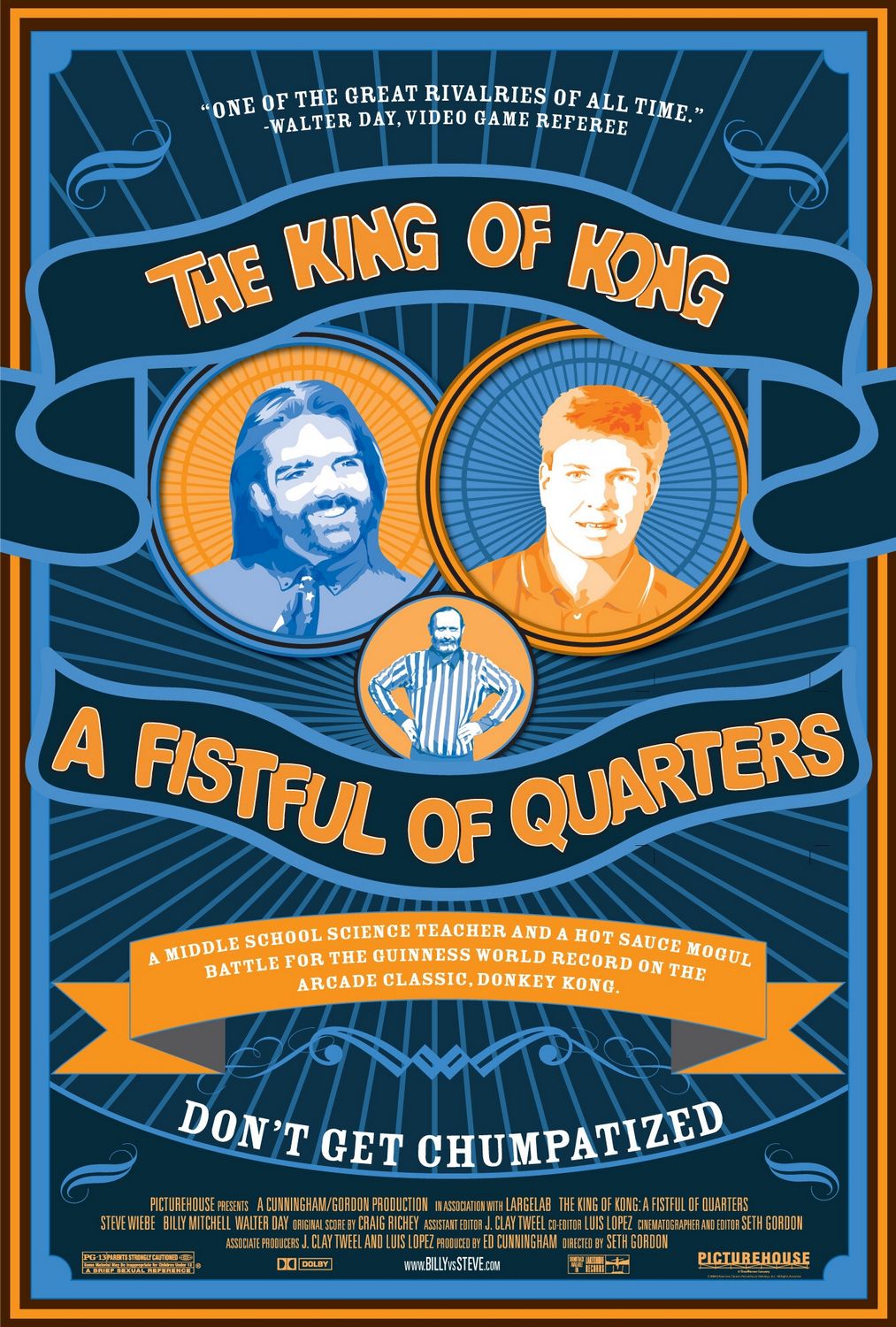
I was born only eight months before the Nintendo Entertainment System (NES) was released in the U.S. While my life was filled with various other activities, video games have been a part of it since I was five. I feel that I and others of my age group have a unique perspective, since we are young enough that we do not remember a time before video games, but old enough to remember much of the progress of the industry. One of the most curious things to come out of video games is the competitive gamer. Unlike most people who play games for fun or for relaxation, these individuals take this form of entertainment very seriously. The 2007 documentary King of Kong: A Fistful of Quarters follows two such gamers as they battle back and forth for the Donkey Kong high score world record.
At the time that the documentary opens (in 2006), the record is held by Billy Mitchell, who set the record back in 1982 at the age of seventeen. Until this point, the closest score submitted to Twin Galaxies, the arcade that manages the official records for Guinness, was nearly 300,000 points less than Mitchell’s score. Enter Steve Wiebe. After he was laid off by Boeing, Wiebe began playing Donkey Kong to give himself something to do, and immediately began to excel at the game. After some practice Wiebe submitted a taped score to Twin Galaxies for consideration. Unfortunately, his tape was ultimately rejected, which set off a race between Mitchell and Wiebe to set a new world record.

Walter Day watching one of Steve Wiebe’s attempts to break the record.
While fascinating, King of Kong is a bit disturbing for several reasons. First and foremost is the people who are involved. Wiebe is by far the most normal, though that is stretching the definition of normal quite a bit. Brian Kuh, who is Mitchell’s sycophantic toadie, tries to play things off as though he is just another player interested in what is going on. Instead he is obviously part of Billy’s scheming and plays an active role in subverting Wiebe. Also joining in the Billy fan club is Steve Sanders, a lawyer. Steve’s initial contact with Mitchell was based on the fact that Sanders lied about holding the Donkey Kong record back in 1982. This story serves to define the audience’s opinions of Sanders early on, and his further actions do nothing to change them. Sanders spends most of his screen time defending Billy’s questionable actions.
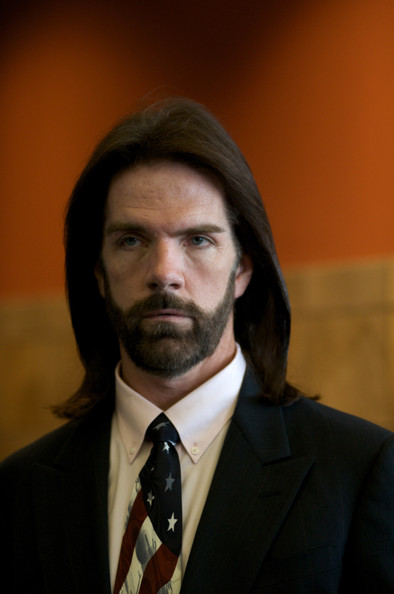
Billy Mitchell
Billy Mitchell himself is a piece of work. A self-proclaimed self-made man, Mitchell makes for the most perfect villain imaginable, given the situation. While Mitchell is obviously intelligent, he maintains an overly inflated opinion of himself that those around him help perpetuate. Billy attempts to manipulate the situation and take advantage of Steve Wiebe, and although he is successful, it is more because he takes advantage of other people’s enamor of him than his own actual cunning.
Even the film makers give Billy considerable time to opine about the gaming world and his own accomplishments. Much of what he has to say is rambling and make sense only in Billy’s mind, but it is all self-aggrandizing and nearly nonsensical. At one point Mitchell insists that breaking a record in public is the only way to properly break it, only to dash Wiebe’s attempt at a record with a video tape himself. Adding insult to injury, he then refused to play against Wiebe, even at a live event in Mitchell’s home town. Mitchell goes so far as to not speak to Wiebe, when all the man does is offer a polite hello. Even Mitchell’s plastic looking wife is perplexed by this particular snub.
The third major player in this whole story is Twin Galaxies, mostly frequently represented by founder and head referee Walter Day. I have a hard time vilifying Day because he is a genuinely nice guy. Being a nice person, while admirable in a regular situation, has no place in officiating a competition. Day is frequently steam rolled by other persons with more powerful personalities. For instance, Twin Galaxies refuses to recognize a record score in Missile Command from Roy Shildt mostly because he is Billy’s nemesis. Sure Shildt is a shady character at best, but to refuse a potentially legit record simply because Billy takes issue with that person is a questionable decision at best. After all, Billy is only ever looking out for Billy.
Additionally, Twin Galaxies as a whole is far too close to Mitchell to maintain proper objectivity. The fact that Mitchell is a member of the Twin Galaxies refereeing staff that is evaluating Wiebe’s initial record breaking performance only serves to prove that point. Chief referee Robert Mruczek goes so far as to say that Wiebe’s attempt, just the ATTEMPT, to beat Mitchell’s record is a slap in the face. This kind of obvious favoritism and patronage screams unprofessionalism.
In spite of all of this, Day is excited by the prospect of a Donkey Kong rivalry, going so far as to say “Out of the entire global classic gaming hobby, there is one significant rivalry that is the equivalent to the big rivalries in history–Yankees and Red Sox, Maris and Mantle, Heckle and Jeckle, all the big rivalries–this is up there on that level.” While I disagree with Day’s characterization of the rivalry, it’s hard not appreciate his enthusiasm. Day is a man who honestly loves what he does and wants to do the best he can—even if he is oblivious to the fact that he often misses the mark.
King of Kong isn’t perfect by any means. It was obviously shot with a fairly small budget and that is obvious at times. There are several bits of film inserted during interviews that seem like they were put in because the desired shots turned out to be a little short. The beginning of the film also lacks direction and it takes nearly twenty-five minutes to really grab the audience’s full attention. There is also a fair amount of old VHS footage that is difficult to see. On more than one occasion I misread a score due to a lack of clarity. For the sake of those who were submitting scores, I hope that was just an issue with the documentary and not the actual record submission tapes.
If this story were fiction, it would be awful, but it’s not and so it is instead bizarrely compelling. The interactions between these very strange people provides for some unique moments. I honestly wanted to see Wiebe break the world record just to shut Billy up for a while. King of Kong provides a fascinating look into a world that rarely sees the light of day. I give it 4 Death Stars.



 Therefore I Geek
I really enjoyed this movie.
Pingback: Editorial | Geek Subculture: parallels in the paranormal | Therefore I Geek