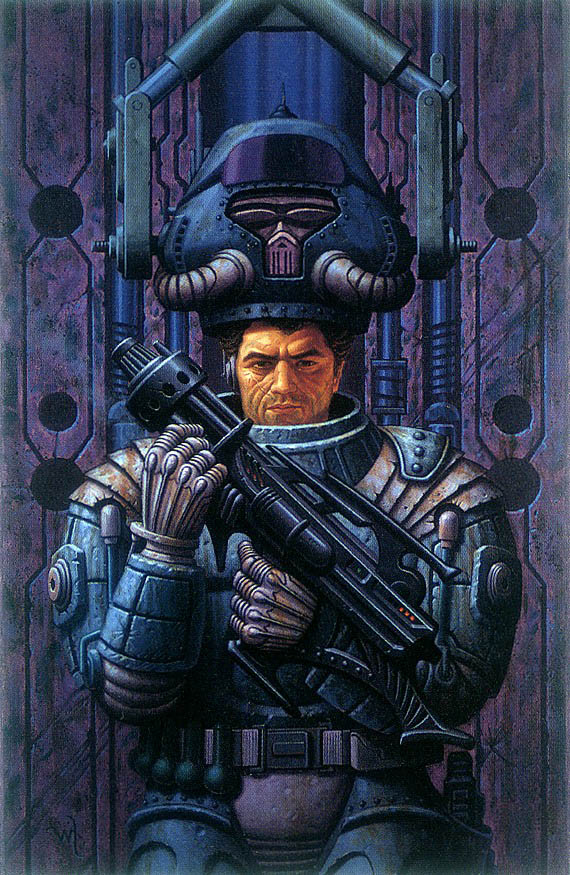
An artists vision of what Starship Trooper’s power armor looks like.
A few weeks ago I was looking over a friend’s Facebook page and noticed they had posted a list of movies and/or books that had influenced them. It was a nicely mixed list and I soon found myself considering the books that had influenced me. I have decided to share with you three separate lists of books, movies and comics that have influenced me and a little of the reasoning behind why. Today we’re going to start with books, in no particular order (well, they’re in the order in which I thought of them).
- Starship Troopers – This is one of my all-time favorite books. Robert Heinlein masterfully combines a science fiction, war story with Libertarian political views, without ever making it seem preachy. While I don’t agree with all of the political things that Heinlein has to say, they do make for interesting thoughts and debates.
- The Hobbit – Honestly, this almost goes without saying. Like many of my generation (and my parent’s generation) this was my first introduction to the fantasy genre. The Hobbit really is just that, an introduction. Tolkien gives just enough of all the various pieces to make readers want more without feeling as though they’ve been cheated. It’s also a pretty light read, which cannot be said of The Lord of the Rings.
- The Lion, The Witch, and The Wardrobe – Keeping with fantasy for a moment, this is the C.S Lewis classic. I first came across this book sometime around third or fourth grade (maybe earlier) and was so immediately enthralled that I read the entire thing in a single night. This was the first time that I have been so in love with a book that I physically could not put it down.
- Fear and Loathing in Las Vegas – Anyone who has read Hunter S. Thompson knows exactly how bizarre his work can be. Underneath the layers of drug use and general weirdness in his books There is a surprisingly accurate and thoughtful look at America. I certainly don’t share Mr. Thompson’s political views, but from time to time there are things in his work that I find myself agreeing with.
- Marvel Comics: The Untold Story – There are two things that have fueled my interest in comics history: a panel about the history of censorship in comics at the 2012 NYCC and Marvel Comics: The Untold Story, which I also got at NYCC. This book was so good that despite being in the middle of two other books, I dropped everything else I was reading and read this as much as possible. It reads more like a novel than a history and makes the reader feel like they know all the people personally. It has also had the effect of driving me to get more books on the history of comics.
- Horus Heresy: Horus Rising – I picked this book up on a whim in college and then spent every moment of the next three days that I was not in class (and probably somewhere I should have been in class) reading. This series isn’t always very good, but it has reminded me that I can enjoy purely indulgent fiction. And I’ve read TWENTY-TWO of the books, so they’ve had to have some influence.
- Complete Works of Shakespeare – This is cheating a little, I know. Shakespeare is not only one of the greatest works of literature in the world, but it has also had a considerable impact on my life. I started reading Shakespeare in fourth grade and it opened up a whole new world of ideas to me. Back in high school I was vice-president of school’s Shakespeare Society. Some of my favorite books and movies even now are adaptations of Shakespearean works.
To Be Continued…
 In a good book, the kind that sucks the reader in and completely absorbs him, the same thing happens. In most of these books, such as Tolkien’s The Hobbit (now a Major Motion Picture), the reader is never directly addressed. Characters act, interact, and react with each other for the benefit of the audience. Events are arranged for thrilling suspense. Action sequences are highlighted, and periods in between them are foreshortened.


 Therefore I Geek