Category Archives: Comics

Name That (Comic) Character: Answer

And our mystery character is…

moonknight1

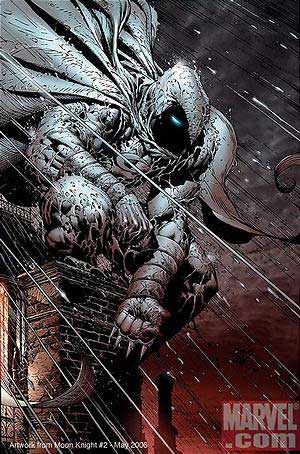
Moon Knight in a very Batman-esqe pose.

Moon Knight

1) This character was created in 1975.

Moon Knight was created by Doug Moench and Don Perlin, first appearing in Werewolf by Night #32 (August 1975).

2) S/he has been a periodic member of secondary Avengers teams.

Moon Knight has been a member of both the West Coast Avengers and Secret Avengers.

3) The character has been written by Ed Brubaker and Brian Michael Bendis and drawn by Bill Sienkiewicz and David Finch.

Brubaker wrote Secret Avengers, Bendis wrote Moon Knight, Vol. 6, Sienkiewicz pencilled Moon Knight, Vol. 1, and Finch pencilled Moon Knight, Vol. 4

4) This character has often been described by fellow characters as having psychological problems.

Adopting multiple alter egos as well as believing himself to be the avatar of the Egyptian moon god Khonshu have taken a toll on Moon Knight’s sanity and resulted in his suffering from dissociative identity disorder.

5) This sometime Avenger is Jewish.

Moon Knight is the son of a rabbi.

6) S/he has had significant military training.

Marc Spencer (aka Moon Knight) served in the US Marine Corps and worked as a mercenary.

7) Although this character is from Marvel, fans commonly consider her/him to be a knockoff of a DC character.

Moon Knight is often thought of as a Batman knockoff, though there are differences in characterization.

8) S/he has, at times, also wielded supernatural powers (but doesn’t normally have them).

Moon Knight was the Fist of Khonshu when he was possessed by the spirit of Khonshu and had temporary supernatural powers as a result.

Did you guess right? Congratulations to luna for their correct guess. Now go check out Moon Knight Vol.7, #1 out in comic books stores this week.

Leave a comment

Filed under Andrew Hales, Comics

Name That (Comic) Character

So you want to be a gumshoe?  A real, honest-to-gosh private eye?  Well, we’ve got a puzzle for you!  Today we’re introducing a new periodic feature “Name That Character”. We will provide you with a handful of hints and then, as the title suggests, your goal is to guess which comic character we are talking about. It’s just that simple.

Question_mark1) This character was created in 1975.

2) S/he has been a periodic member of secondary Avengers teams.

3) The character has been written by Ed Brubaker and Brian Michael Bendis and drawn by Bill Sienkiewicz and David Finch.

4) This character has often been described by fellow characters as having psychological problems.

5) This sometime Avenger is Jewish.

6) S/he has had significant military training.

7) Although this character is from Marvel, fans commonly consider him/her to be a knockoff of a DC character.

8) S/he has, at times, also wielded supernatural powers (but doesn’t normally have them).

Who is this character?  Think you know?  Let us know in the comments, and we will post the answer to the riddle tomorrow!

2 Comments

Filed under Andrew Hales, Comics

The Man Who Almost Killed Comics

Throughout history most forms of popular entertainment have had their moral detractors. In the 50’s Elvis was only allowed to be shot from the waist up due to his provocative hip movements. Tipper Gore went on a crusade against heavy metal music in the mid 80’s. A 2005 California law banning the sale of certain video games to minors was struck down by the U.S. Supreme Court in June of 2011.  For many industries, efforts to ban products for moral reasons have been ineffectual at best, and often when the legal system is actively discriminatory, these efforts are found to be unconstitutional. When it came to comic books however, censoring attacks were extremely successful and resulted in the near collapse of the entire industry. This near fatal blow was orchestrated in large part by one man:  Dr. Fredric Wertham.

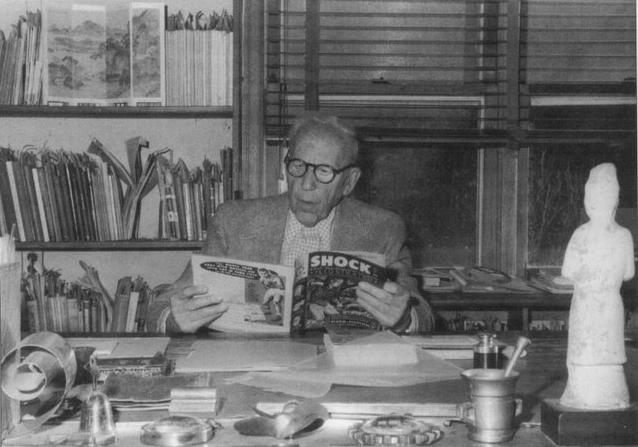
Dr. Fredric Wertham reading a comic book as part of his research.

Dr. Fredric Wertham reading a comic book as part of his research.

For the sake of fairness, Wertham cannot be wholly blamed for the attacks on the comic industry.  There were many other participating parties and several contributing factors that allowed this kind of censorship to take place.  However, Wertham’s role is the most important since he provided a scientific expertise around which the comic detractors could rally.  In the early 1950’s Wertham was a well-respected psychiatrist who often worked with the poor and juvenile delinquents.  It was his work with juvenile delinquents that actually began Wertham’s crusade for comic censorship.  As he interviewed the troubled youths, he noticed the pattern that most of the young men were regularly reading comic books.  Wertham assumed that a causal relationship existed between comics and deviant behavior, especially when it came to the more graphic horror and crime based comics. Wertham published his findings originally in a Ladies Home Journal article, and then later as book with the titillating title Seduction of the Innocent.

Wertham made many unsupported claims within the pages of Seduction of the Innocent including that Batman and Robin were homosexual lovers and that Wonder Woman was a lesbian.  He believed that these immoral influences, in addition to the violence in comics, lead to deviant behavior.  Soon Middle America was in uproar and the attack on comics was in full swing.  It was not uncommon for small towns to hold comic book burnings to rid themselves of the corrupting influence. This came to a head in 1953 with a hearing by the United States Senate Subcommittee on Juvenile Delinquency.  Over the course of three days, the Subcommittee heard testimony from Dr. Wertham, as well as EC Comics publisher William Gaines.

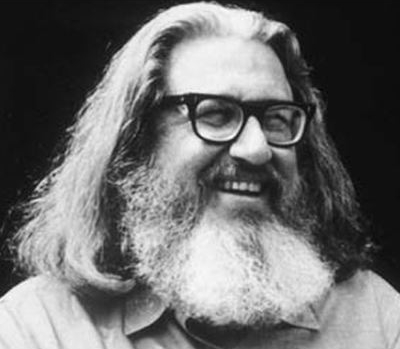
William Gaines

William Gaines

Much like the subcommittee overseeing the McCarthy hearings, which were being held during the same time period, this subcommittee came in to the hearings with less than open minds.  While Wertham was treated politely and respectfully, Gaines was questioned hostilely and treated with disdain. Gaines’ now famous exchange‡ with Chief Counsel Herbert Beaser is a prime example of how the committee members had already made up their minds before hearing all the testimony.

The infamous May issue.

The infamous May issue.

In the end the comic industry was forced to choose between imposing censorship on itself, or accepting the inevitable, and likely more restrictive government censorship that was coming their way. The new rules, called the Comics Code Authority, were loosely based on the film industry’s Hays’ Code and imposed a draconian list of limitations that crippled the comics industry. Among the most punitive measures were those banning all comics from using the words “horror” or “terror” in their titles and severely restricting the content of crime comics. These were both directed squarely at EC Comics, as punishment for Mr. Gaines testimony at the committee hearings. With these restrictions, almost of EC Comics’ books were forbidden, and EC was soon forced to cease publication. Within two years, sixty percent of all comic titles had ceased publication and those companies that remained in business were forced to slash their workforces.

The unfortunate reality surrounding these events has only just started to properly come to light. From the outset it was well known that Dr. Wertham’s methods were questionable.  A man who should have been well acquainted with the scientific method, he showed considerable disregard for it by failing to establish a control group to compare his findings.  If he had, Wertham might have realized that the overwhelming majority of kids at the time read comics.  Given that information, it would be impossible for someone to draw the causal relationship that Wertham claimed existed.  Dr. Wertham let his attempts to make a name for himself compromise his science.

Since Dr. Wertham’s notes became publically available in 2010, the full extent of his questionable methods has come to light. Prof. Carol Tilley of the University of Illinois has discovered several instances where Wertham exaggerated the findings of his interviews in order to tip the results more into his favor.

Despite all of this, Dr. Wertham is not without his redeeming qualities. Some of his other research was presented as evidence during Brown vs. Board of Education, where it provided scientific proof that racial segregation was harmful to the mental health of children, aiding in overturning fifty eight years of the “separate but equal” doctrine.

While the comics industry may have taken a dramatic hit due to Dr. Wertham’s work, it was not down for the count.  The majority of the superheroes we love—including nearly all of Marvel’s characters—were born in an era in which the Comic Code held sway. In spite of the restrictions, these characters flourished and have become deeply ingrained in our popular culture.  With the death of the Comics Code Authority in 2011, we can finally say we are rid of Wertham’s shadow, though we should remain vigilant for others who claim to protect common decency for no other reason than to attack those things they disagree with.

‡ The audio recording provides the testimony of Dr. Fredric Wertham as well as that of Mr. William Gaines. The most famous portion of Gaines’ testimony begins at 1:34:30

Further Reading:

Comic Book Legal Defense Fund – An excellent resource regarding the history of comic book censorship as well current efforts to fight censorship.

Thecomicbooks.com – Provides a full transcript of the Senate Subcommittee hearings.

4 Comments

Filed under Andrew Hales, Comics, Comics History

Science Fiction Comics

Science fiction is, of course, a staple of geek culture and always has been, as has comic books. While these two have had a long and intertwined history, up until recently there had been a rather significant lack in quality science fiction comics. Thankfully in the last two years there has been a considerable resurgence in science fiction comics. Given all of these new choices, I’ve decided to go over a few of my personal favorites and some of the newest additions to my weekly pull.
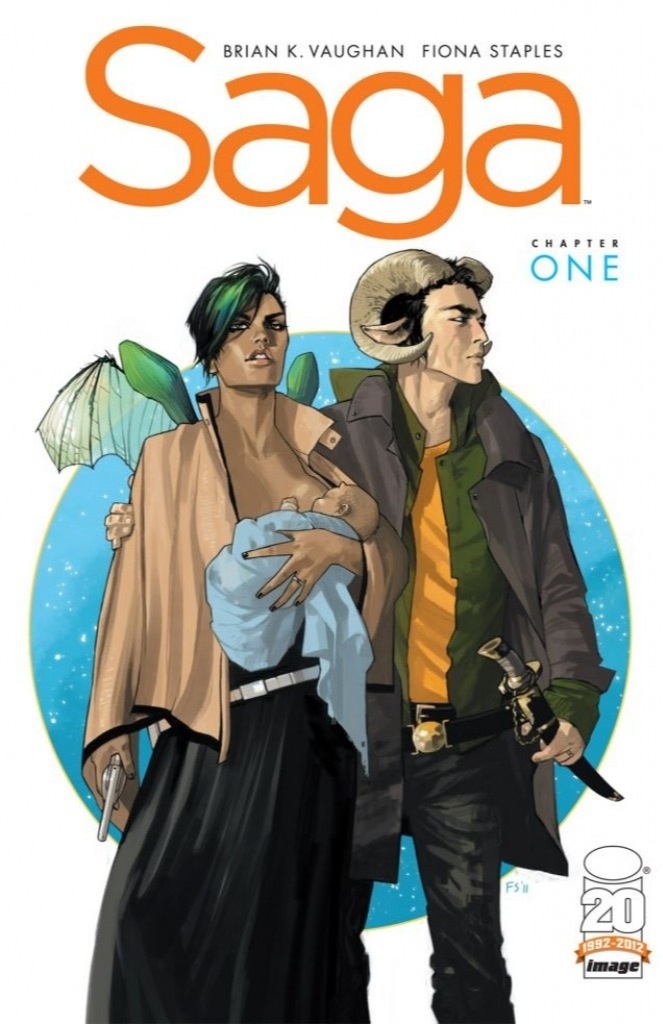
20131219-232534.jpgSaga – Brian K. Vaughan and Fiona Staples

I’ve decided to start with Saga because every week it comes out, it’s the first book I read. Saga is an amazing space epic, but unlike most epics, it is character driven instead of focused on the events that happen around the characters. It’s a sort of modern Romeo and Juliet, with two star-crossed lovers from opposite sides of a generations long war; only they don’t commit suicide, they kick ass instead. I honestly have absolutely no idea where the book is going, both on the large scale and from issue to issue, and I don’t care. I am along for the ride, no matter where it takes me. Vaughan’s writing is fantastic and when paired with art by Staples it becomes something truly unbelievable.
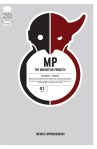
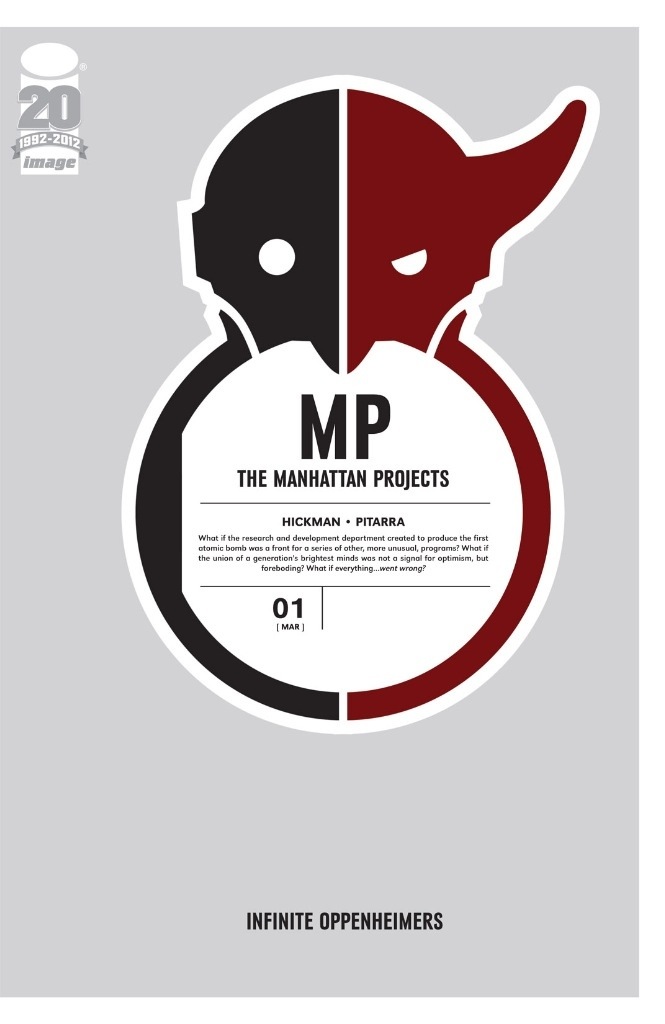
20131219-232528.jpgManhattan Projects – Johnathan Hickman and Nick Pitarra

Imagine that the super-secret Manhattan Project was itself a cover for an even more super-secret science program. That’s the basic plot of Manhattan Projects, but there is far more to it than that. Anyone who is familiar with the real life Manhattan Project will recognize the cast of characters including Robert Oppenheimer, General Leslie Groves, Richard Feynman, and Enrico Fermi among others. That’s about where the similarities end though and Hickman takes characters and events to ever increasingly insane places. There is a lot of fantastic character work and a wonderful subtlety to the art that gives this book an unexpected depth.

20131219-232523.jpgEast of West – Johnathan Hickman and Nick Dragotta

Where Manhattan Projects is crazy and filled with very weird characters, East of West is much more cerebral, in similar fashion to his current work on Avengers/New Avengers and his previous creator owned work. East of West is set in a near future, alternate reality where the United States has splintered into several different countries with competing ideologies. The political systems only provide a back drop for the larger story, one of the Biblical Four Horseman, Death, has abandoned the other three and now they have begun to hurt him down, to unknown ends. I like this book because it is similar enough to the work Hickman has done in the past, yet the plot remains novel. There have been several interesting plot twists that have made the month between issues seem very long indeed. Dragotta’s art is very clean with some hints of manga influence.
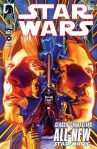
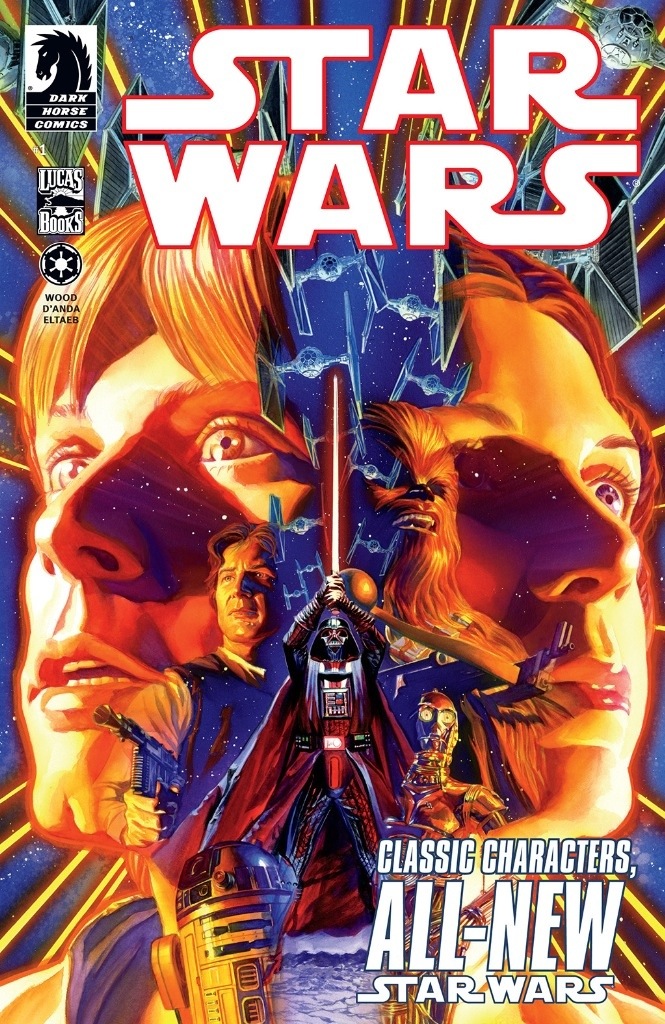
20131219-232512.jpgStar Wars – Brian Wood and Carlos D’Anda

I love Star Wars, especially the original trilogy, and this book hits my Star Wars sweet spot. Set between A New Hope and Empire Strikes Back readers follow all of the familiar heroes as they search for a new home for the Rebel Alliance. Brian Wood has a great sense of who Han, Luke, and Leia are, and it feels like a perfect continuation of the films—only with better dialogue.  D’Anda’s art is perfect for this book. Not only is he capable of clear and exciting action sequences, but he also makes the heroes look just enough like their actors that you know precisely who is whom, but not so much that it looks like he just traced pictures of them.
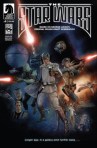
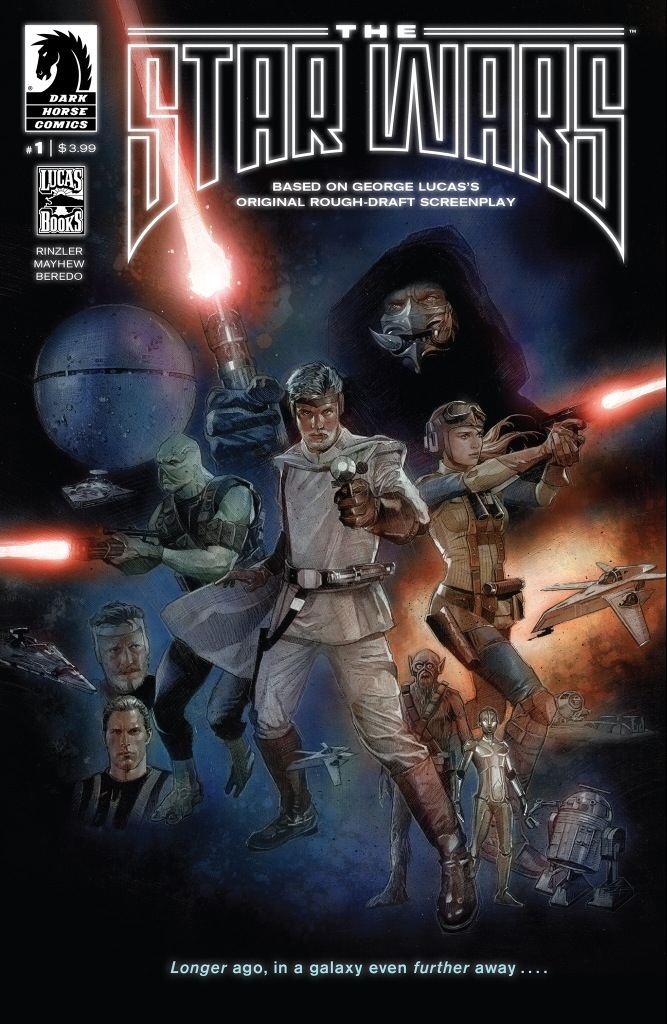
20131219-232518.jpgThe Star Wars – Johnathan Rinzler and Mike Mayhew

Yes, this is a different book than Star Wars. This book is based on George Lucas’ original draft of Star Wars and it has been quite a treat. The Star Wars is full of familiar names and places, but they all apply to different things. It’s like the entire Star Wars universe has been turned on its head and shaken around a bit. Now to be honest, I don’t want this book to last forever and I’m looking forward to seeing the conclusion to the story (though I sense it is still a ways off). What makes this book great is that I never know what part of the Star Wars I know and love is going to show up somewhere unexpected. It’s also pretty crazy to think that this is where Star Wars started.
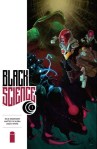
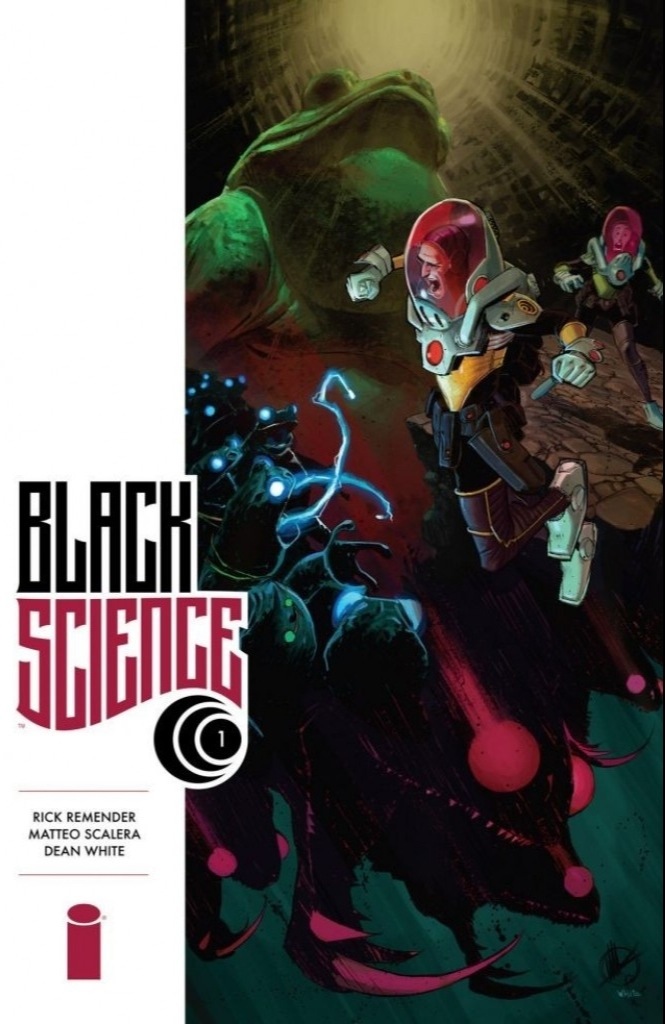
20131219-232538.jpgBlack Science – Rick Remender and Matteo Scalera

This is the newest addition to my pull list and truth be told I’m not 100% sold on it yet. Only being on issue two however, I’m not rushing to judgment just yet.  I am huge fan of Fear Agent, so I’m willing to give Remender the benefit of the doubt and stick this out at least through the first story arc. Black Science follows a group of scientists who have broken through reality into the chaos that lies beyond. Of course what they find there isn’t very nice, and just like black magic in fantasy, this black science makes things go awry. The art is strong with the exception that at times it was difficult to tell female characters apart, though once I get to know them better I suspect that problem will fade. Stay tuned for the inevitable update.

So these are the sci-fi books that I’m currently reading. They are not all the books I read with sci-fi elements and it is certainly not every book that exists (I just don’t have the money…/sad face), but they are the ones I consider pure science fiction. But enough about me, we want to hear about you. What books are you reading? Tell us about your favorites and maybe those that you’re not so fond of and of course, why.
1 Comment

Filed under Andrew Hales, Comics