Category Archives: Tracy Gronewold

Editorial | Review: Noah

***** SPOILER ALERT *****

This review will be discussing plot points which may be considered spoilers. Consider yourselves warned.

The word Ararat has a special meaning for believers of Judeo-Christian teachings.  To them it symbolizes hope, rebirth, cleansing—even the spring of a new world.  Interestingly, the word never makes an appearance in the new Hollywood film Noah, but the symbolism of Mt. Ararat, the final resting place of Noah’s Ark, is steeped into every aspect of the movie.

The first thing to mention about this movie was the acting.  Russell Crowe (Noah), Jennifer Connolly (Naameh, his wife), and Emma Watson (Ila, an orphan girl) are an all star cast, and I would expect nothing but a stellar performance from them.  They did not disappoint.  The supporting roles were filled with really excellent actors as well, with Anthony Hopkins as the surprising choice for Noah’s very elderly grandfather Methuselah, and Ray Winstone as the evil local king/tribe leader Tubal-Cain.  There was a cameo appearance by one of my all time favorite, underappreciated actors Martin Csokas, as Noah’s father Lamech.  The only supporting character that did not have an outstanding performance was Japheth, played by Leo McHugh Carroll, but this makes sense considering the lack of information about him in the source material.
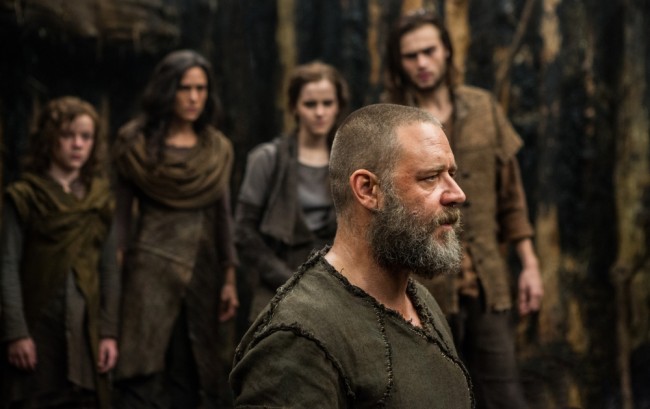
Noah's family

Noah’s family

The relationships in this movie were probably the very best, most honest portrayal of a family that I have seen from Hollywood since the great epics of the late 1950s and 1960s.  True affection and forgiveness is difficult to fake , but between the excellent script and the superb acting through the family focused scenes at the beginning and end, this movie pulled it off.  I loved seeing Naameh (Jennifer Connolly) cuddling a baby Japheth in some of the opening scenes.  It is so easy to forget that babies were just as sweet and fragile 6,000 years ago as they are today.

There was a lot more story—not just Noah’s story—crammed into this film than I was expecting.  The movie started with the story of Man, and his fall.  This was presented in stop action animation and subtitles in a font that disturbingly resembled comic sans.  Three symbols from this initial story are repeated as a motif throughout the movie that alerts the viewer that they are now watching a dream or a prophecy revealed through a trance.  The first symbol is a green snake slithering through the grass, the second is a fruit that pulses like a beating heart, and the third is the silhouette of Cain’s upraised arm and hand grasping a rock to club his brother to death.  I appreciated why the motif was used but the last image was really hard to see, and every time it was used my concentration broke while my brain tried to figure out what I was seeing.

I appreciated that the movie bothered to tell the creation story, and that it did not take sides on the issue.  The story was told by Noah as a voice over a somewhat annoying time lapse animation.  He told the original, Biblical version of creation with each part of creation taking a day to complete, but the animation that flowed with the story seemed to mimic a type of evolutionary influence.  The movie seemed to go out of its way to avoid confrontation in other ways as well, such as strictly using “the Creator” to refer to God.

It seems as though the script writers decided that destruction of the entire world by an enormous flood at the will of the supernatural being who created it all was not enough drama.  In order to add to this, they included additional stressors to the family bond.

While the Biblical account clearly states that Noah, his wife, his sons, and their wives were all aboard the ark when the door was shut, the movie takes a liberal interpretation.  Noah decides that the Creator must be destroying the world to clean up the mess that man has made, and therefore must not want any more men in the new world.  That’s completely fine, though, because Noah and his wife are past child bearing, and the only other woman on the ark—an orphan girl that they took in who is now the love interest of their oldest son Shem—is barren.  Noah refuses to find wives for his other two sons, which is not taken well by the adolescent second son, Ham.  Because Ham is angry at his father’s choice, he does not tell Noah that Tubal-Cain, the erstwhile king of the area, has stowed a ride on the ark, and actively conspires to kill Noah, and repopulate the earth with his own children.

However, Noah’s plan for a humanless planet is thwarted by his wife, who goes to Noah’s grandfather, the aged Methuselah, and asks him to intercede with the Creator for her sons, so that they can have children and be happy.  Methuselah gives his blessing to Shem’s love interest, Ila, and she gets pregnant on the ship.  Noah is angry that his wife has gone behind his back and thwarted what he feels to be the Creator’s plan, and threatens to kill the child if it is a girl, so that there will be no chance at any more human children.  This, of course, leads to quite a bit of screaming and crying on the part of every person on the ark, and an emotional climax that has almost nothing to do with the fact that they have been stranded on a floating box for months with no certainty that they will ever get off.

Another addition to Noah’s story is the Watchers.  These are fallen angels who defied the Creator in support of Adam and his race, and were cast down to Earth.  I appreciated the physics of the story that the script writers were trying to tell:  creatures of light and energy crashing to earth melted the stone, which then cooled around them.  Unfortunately, this was a visually unappealing mess.  I was also left wondering why the stone that formed around them did not erode over the thousands of years that they had been on earth—especially since they were moving a lot.
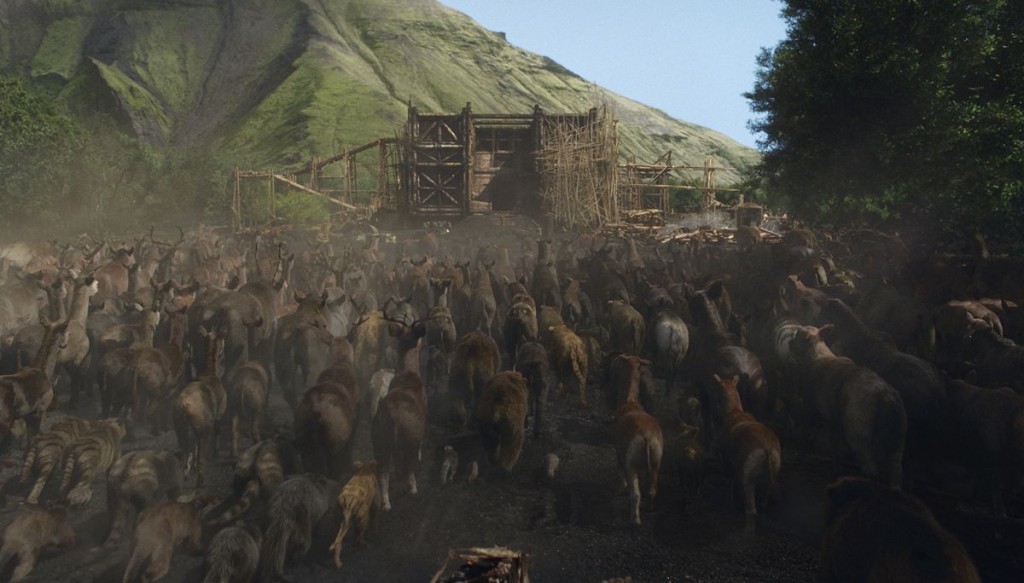
The animals arrive two by two

The animals arrive two by two

Visually this movie was shot to be beautiful, not necessarily to be accurate.  This was obvious through the use of a lot of sound stage settings, with actions designed to showcase silhouetting of characters against a setting sun.  Most of the sets felt very unearthly (Methuselah’s mountain and the black volcanic ash expanses were mostly shot in Iceland).  The visual effects are beautiful, but they do break the viewer’s concentration from time to time.

The biggest problem that I had with this movie was the ambiguity regarding why Noah and his family were told to build the ark and be saved, and the other humans were to be destroyed.  The beginning of the film showed that the murder of Abel by his brother Cain was one of the big influences for humanity veering wildly off the Creator’s track.  However, Noah shows no compunction for killing humans because they’ve killed an animal.  I was confused, and still wonder if the director/writers were trying to equate vegetarianism with being a good person.  Since this is a movie about good versus evil, I would have preferred a sharper distinction between the good and the evil.

As a moviegoer, I really enjoyed the experience that this film provided, but probably won’t add it to my DVD collection.  As an admirer of the original account of Noah and the Great Flood, I hope that despite the additions to the story, people who have not read the original will be inspired to look it up and see what is really there.  I give this movie three and half Death Stars.3.5 Death Stars
Leave a comment

Filed under Editorial, Movie Reviews, Movies, Tracy Gronewold

Editorial | Review: ACID

***** SPOILER ALERT *****

This review will be discussing plot points which may be considered spoilers. Consider yourselves warned.

I have gotten my hot little hands on a copy of Acid, the first novel from author Emma Pass.  The author is from the Midlands, UK, and her European roots come out in certain word choices and, of course, measurements.  Fortunately for Therefore I Geek readers, I have read the book and am here to lay out the good, the bad, and the ugly about it.

The Good: The main character in this book is one Jenna Strong, who is in a maximum security, male only prison at the tender age of seventeen for parricide.  The book is set in 2113, in a UK that is completely cut off from the rest of the world.  A lackadaisical government has been thrown out of power by an anti-terrorist arm of the military/police force called ACID (Agency for Crime Investigation and Defense) and a police state has been in place for about 100 years.  As far as the good of this book goes, the well designed acronym is pretty much all it has to offer.  That, and the perfect use of the subjunctive tense.

Continue reading

Leave a comment

Filed under Book Reviews, Books, Editorial, Tracy Gronewold

Editorial | Special Feature Fatigue–the death of the DVD special feature disc

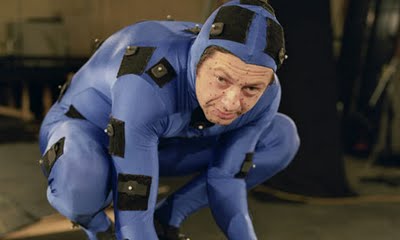
I remember the very first “behind the scenes” special feature I ever watched.  It was a video of Andy Serkis wearing a motion capture suit in a warehouse, acting out the part of Gollum.  At the time we had a 54K dialup modem, and since each of us kids were only allowed an hour of internet per day, we would all sacrifice our internet time to wait for the whole video to download so we could watch it all the way from the beginning.  I was fifteen years old, and that was the Golden Age of the special feature.

Hard to believe this method of motion capture is almost obsolete already.

Hard to believe this method of motion capture is almost obsolete already.

These days, special features are going the way of the Dodo.  I would mourn them, but to be honest, I cannot remember the last time I bothered to watch the DVD special features.  I think that this progression has been mostly organic, based on technological advances, but I also think that movie buffs are experiencing special feature fatigue.

The birth of the DVD suddenly provided extra space for producers and especially directors to show off all of the things that they do to create the amazing movies that their fans love.  At first, we were incredibly grateful!  Suddenly we fans felt as though we were right on set.  We learned about all the things that go into making one minute of Star Wars.  Then we watched as Mark Hamill got better and better at light saber choreography.

Later on, my siblings and I squirmed in anticipation as we waited for the special features from the official Lord of the Rings website to download.  (One of my favorite videos was the one entitled “Bringing Gollum to Life.”)

Another movie with great special features was Pixar’s The Incredibles.  We watched the voice actors talk into microphones (titillating stuff) and learned how Brad Bird, the director, became the official voice of Edna Mold.  I don’t know about other fans, but we watched these short videos over and over until we had almost memorized them as much as we memorized the movie from which they came.

In the early days, few DVDs came with very many special features.  A few had the music video to the credit song, and occasionally a blooper reel.  Before too long, however, every DVD had a host of special features, including the ever popular actor/director commentary—the entire movie, but being talked over by cast or crew member describing funny stories or explaining the technical reasons behind certain screen decisions.  DVDs were released in expensive two- and four-disc sets to have room for all the extras.  Even TV series were including commentaries on the DVD releases of each season.  Brian Collins of Badass Digest said it well:

“[G]uys actually had to dig out these elements and put them into the movie, not to mention create the other original content on the disc.  It probably cost almost as much to put together this DVD (including the remastering, rights acquisition, man hours spent digging up the materials, etc) as it did to make the movie in the first place.”

Since then, technology and the free market system has changed a lot about the way that fans watch movies.  Rental versions of DVD’s—once the full movie and all its features from a Blockbuster shelf—are now single discs in a paper sleeve.  Distributors wanted to encourage movie renters to purchase DVDs, so they stopped including all the special features on rental discs.  Now, many people get their movie fix by streaming videos or downloading digital versions, which come with even fewer features.  As time goes on, already fatigued viewers have gotten out of the habit of watching them.

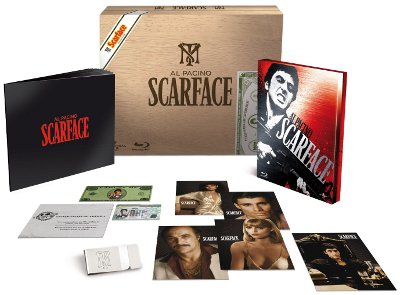
That's right, kids. DVD's used to come in sets like this.

That’s right, kids. DVDs used to come in sets like this.

I personally do not mourn the slow death of movie special effects for the most part.  Soon after The Lion, the Witch, and the Wardrobe came out on DVD, I sat down to watch the actor commentary.  It didn’t take long for me to be weary of the banal stories of actors in massive costumes tripping over their hooves, and of Georgie Henley’s (Lucy Pevensie) surprise on her first moment in the wintery world of Narnia.  While I thought of the older Director’s Cut DVD sets as something like film school at home, I also find myself experiencing special feature fatigue.

Now if you’ll excuse me, I found a video describing exactly how Peter Jackson got the runes on the doors of Khazad-Dum to glow.

2 Comments

Filed under Editorial, Movies, Tracy Gronewold

Editorial | Organizers and Explorers: Two Schools of Writing

There are two types of people in this world…  Ok, ok, there are many types of people in the world, but there are two schools of thought when it comes to writing.  Whether they write short stories, full length novels, academic research, or blog posts, most authors either are organizers or explorers.

Organizers believe in brainstorming before they begin writing.  They know the direction in which they want to take their readers before they jump into the meat of their prose.  I personally enjoy this method most—especially in more formal writing.  If I don’t have an endgame in mind, it is difficult to get my writing to move from the beginning to the end at a decent pace.  George R. R. Martin, Therefore I Geek’s man of the month as we gear up for the premier of Game of Thrones Season 4, describes these writers as architects.

“I think there are two types of writers, the architects and the explorers. The architects plan everything ahead of time, like an architect building a house. They know how many rooms are going to be in the house, what kind of roof they’re going to have, where the wires are going to run, what kind of plumbing there’s going to be. They have the whole thing designed and blueprinted out before they even nail the first board up… “

Brandon Sanderson

The benefits to organizing are obvious.  The author knows exactly where he is going.  He may start with a bare bones outline and begin to add sub-points or blocks of text.  If he gets stuck on one point, it is much easier to move on to the next point or section of the story.  I often have short bursts of inspiration that don’t fit where I currently am in my writing.  As an organizer with a penchant for outlines, I find it easy to take a break from the parts of my project that I’m in the middle of and quickly jot down the bits that have sprung into my brain.  From there it is just a matter of fitting that section under the correct bulleted heading.

Unfortunately, the downside to having a detailed plan is that the author may feel like he’s already written the story, and may get bored of his work before it is complete.  This has happened to me several times.

One famous outliner is Brandon Sanderson, author of The Way of Kings, and the brand new Words of Radiance.

The other type of writer is an explorer.  These writers follow where their personal inspiration takes them, no matter how many twists and turns that entails.  It is less that they have an endgame in mind, and more that they trust their ability to come to a conclusion when the time is right.  G. R. R. Martin describes them as gardeners, “The gardeners dig a hole, drop in a seed and water it. They kind of know what seed it is, they know if they planted a fantasy seed or mystery seed or whatever. But as the plant comes up and they water it, they don’t know how many branches it’s going to have, they find out as it grows.”

George R. R. Martin

Explorers have an easier time of writing in that they don’t feel as much pressure to know where their plot line is going and under what conditions.  This style of writing is very story driven, and can feel more natural to the writer.

Unfortunately, the exploration style of writing can also lead to stymied authors, who have run into writer’s block, and cannot take a break to write another portion of their work, because they don’t know where the work is going.

Which type of writer is George R. R. Martin?  “I’m much more a gardener than an architect,” he tells fans

4 Comments

Filed under Books, Editorial, Tracy Gronewold