A friend of mine and I were recently re-watching season one of Agents of S.H.I.E.L.D. to catch up on the episodes we had missed. A big emphasis in the second half of the first season was Coulson’s realization that what he had been told about his brief death, resuscitation, and recovery after the Battle of New York was not the entire truth. The big reveal of what exactly happened after Coulson was killed occurred in episode eleven, “The Magical Place.” As I watched Clark Gregg’s character writhing in psychological pain, I was reminded of another captain of another group that was also tortured psychologically and physically: Captain Picard, in the famous episode of Star Trek: The Next Generation called “Chain of Command, Part II.” As my friend and I concluded, I have to say that Jean-Luc Picard of the USS Enterprise is a far better leader of men than Agent Phil Coulson of S.H.I.E.L.D.
There were a lot of similarities between the torture of these two lead characters. It seems to be a formula that appears on a lot of television shows—some better and some worse—that the firm and fearless leader slowly breaks down and shows his crew a more human side. Coulson follows this formula in Agents of S.H.I.E.L.D.
In “The Magical Place” he is placed in a scanning device that is reminiscent of an MRI machine and is supposed to force him to remember what actually happened when he was revived. Of course, the nefarious group Centipede want to use this information to keep their super soldiers alive or at least allow them to bring back dead soldiers. Skye, acting outside her jurisdiction as per usual, leads S.H.I.E.L.D. to Coulson’s location and the team see him broken, bleeding and crying out to be allowed to die. Picard would never allow his crew to see him in such a state, correctly believing that such a situation would undermine their respect of him as their leader.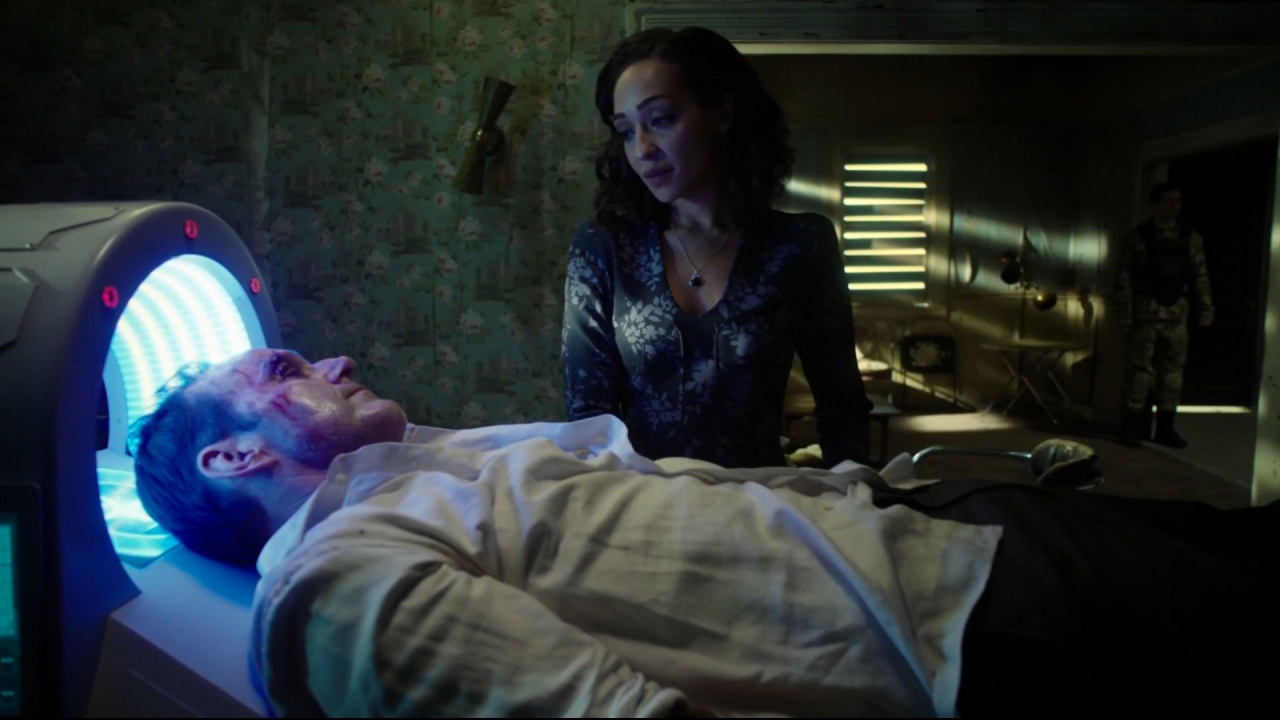
Contrast this with the poise of Picard, who remained dignified throughout his torture. Yes, Gul Madred, his Cardassian captor wracks him with pain, but as soon as it passes, Picard returns to a state of calm self-possession. He is civil to his jailer, even when Madred is not.
The way that each leader sees the men and women under his care have significant differences as well. Both are compassionate and empathetic toward their crews, but only one of them puts his own safety on the line to protect his people. Just a few episodes previously, Skye informed Coulson that Agents Ward and Fitz had been sent on a mission that did not have an extraction plan. While ignoring the insane suspension of disbelief that this plot twist would require, Coulson’s plan to rescue his team members was to simply fly an enormous jet deep into dangerous territory and haul them out.
In a devious ploy to further undermine his sanity, Picard was offered the chance to walk out of the Cardassian stronghold after days of torture. The only catch, the Cardassian military commander mentions off-handedly, was that they would have to go ahead and attempt to extract information from Dr. Crusher, the Enterprise’s medical doctor instead. Unaware that Dr. Crusher had escaped back to the Enterprise when he was captured, Picard turns around in the doorway and returns to the chair in which he had been sitting for days—more willing to take the torture himself than to see any of the people for whom he was responsible suffer.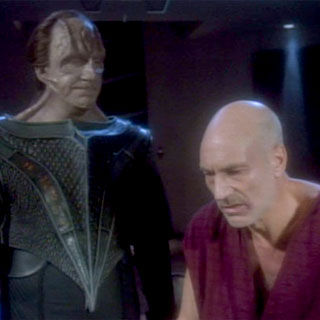
Finally after hours or perhaps days, Coulson decides that between the torture for information being too painful and his own desire to know the truth about what happened after the Battle of New York, he is willing to give up. He allows his brain to be scanned, although the audience is intended to infer that he does not plan to actually tell Centipede any of the information that their machine reveals. This is completely the opposite of Picard’s reaction to similar suffering.
The point of Picard’s ongoing torture is for the Cardassian commander to break his spirit and force him to say that he saw five lights above the commander’s head, when in reality there were only four. Although Picard admits to Counselor Troi after he has been rescued that by the end of his captivity he actually believed he did see five lights, he never broke in front of his captors.
While there is no doubt that Agent Phil Coulson is an experienced leader of what I like to call the “CIA for Super Heroes,” he does not even come close to having the courage and dignity shown by Captain Jean-Luc Picard. Modern television seems to want to show their audience leaders who are more human and who stumble or succumb to pain just like anyone else, but I would prefer to see men who retain their strength of character and refuse to bend to pressure. If I were given the option to choose the better boss–the man I would have to answer to–I would pick Picard over Coulson every time.


Picard is my “O Captain! My Captain!” 🙂 Great read!
Indeed!! And thank you! -t
Very interesting comparison, and I agree I’d prefer Captain Picard. Part of it is that I think he’s a leader on a much larger scale than Coulson, though — literally and figuratively. Literally, Coulson doesn’t have nearly as many people answering to him, nearly as much experience, and (despite the unreasonably-large “Shield academy”) he doesn’t have the kind of high-quality training we assume Starfleet officers do. Figuratively, Agents of Shield generally feels like a stiflingly small stage to me (although less so in season two.) Like the show is fundamentally on a smaller scale and not capable of portraying a leader of that gravity. Star Trek has always been just unrealistic enough to be a tiny bit larger-than-life.