Once, when I was a teenager, I wrote a story for a contest online. What made this story different from every other piece of prose I had written up to that point was that it had a 500 word limit. After months of writing, rewriting, and editing, the story was 499 words long, and there was nothing in it that didn’t advance the plot. There was no need to double up on adjectives, because each one described its noun perfectly. Ambiguous ideas were scrapped because they would require too much explanation. It was the best thing I had ever written.
Back when I first started writing novels, publishers insisted on a word/page limit of between 150 and 200 pages of Courier New font for young adult historical fiction. The 200 page (roughly 50,000 words) mark was the absolute maximum. It seems these days that those limits are no longer being enforced by publishers—especially on authors that have been well received. Unfortunately, this, combined with the phenomenon of increasing book lengths in the fantasy genre, has led even authors who have written some really fantastic stuff in the past to get sloppy.
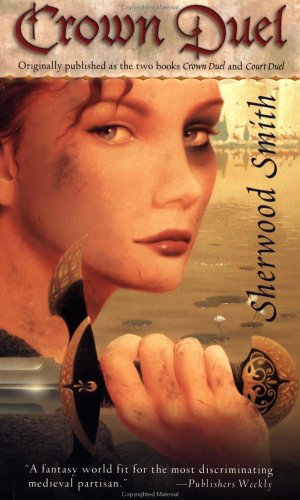 Sherwood Smith, the pen name of Christine Smith, was one of my favorite authors when I was a kid. The first books of hers that I read were Crown Duel and Court Duel, which had been written as a single book that was published as two much shorter volumes. Several years later, she published Inda, which was not quite the same quality, but still pretty good reading. Since then her books have gotten longer and the writing has gotten progressively shoddier, to my dismay.
More recent examples of how stringent word limits should be required of even established authors can be found in the works of George R. R. Martin and Brandon Sanderson. Sanderson had already published several books between 2005 and 2007, but it was his assumption of Robert Jordan’s Wheel of Time mantle after the author’s death that really projected him into fame. His Mistborn trilogy is acceptable fiction, but his books have gotten larger and larger with each succession. At the beginning of the summer, I picked up The Way of Kings, the first book in his new Stormlight Saga, and was horrified at the sheer wordiness. The first chapter alone was at least one and a half times the length it needed to be in order to set the story in motion, and the book didn’t get any better from there.
Recently, I wandered across a blog post by an aspiring author named Stephen Watkins that described this problem from the writer’s perspective, “Artistically, there’s a point at which I’m not willing to compromise. When fewer words are actually better, I’d certainly prefer to use fewer words. But so far I don’t often find that to be the case: I actually find that more words are frequently called for – both in my own work, and in the work of others.” He then goes on to list the page numbers of some of the most popular books on the market—mostly George R. R. Martin, Sanderson, Robert Jordan, J.K. Rowling, Patrick Rothfuss, and the great J.R.R. Tolkien. (Interestingly, he includes Stephanie Meyer, which makes me wonder if he is interested in quality or just marketability, which are two very different things.)
However, as I’ve pointed out before here on the blog and the podcast, quantity of words doesn’t necessarily mean quality writing. In my opinion, it’s almost the opposite. Clear, concise writing is the hallmark of a classic work. Colleen Lindsay, a former writer’s agent, summed it up perfectly, “Somewhere out there a myth developed – especially amongst science fiction and fantasy writers – that a higher word count was better. Writers see big fat fantasies on the shelf and think that they have to write a book just as hefty to get published.”
In many cases, I think that new authors are simply too inexperienced to know what parts of a story are vital to their narrative and which are not. A good writer is one who has learned to remove the fat and flab around the muscle and carve away until all that is left is the juicy, tender steak of the story. Even Watkins pauses his rant about publisher imposed word limits for a moment of self doubt, “I am not yet a professional. And perhaps there’s a reason for that. Perhaps my wordy prose is, in fact, a true sign of my amateurish lack of polished talent.” This trimming down, of course, mostly takes place during the editing process.
For established writers that continue to publish books in excess of 750-1000 pages, the problem seems to be something else. “Writing to a certain length means imposing discipline on yourself as you write, regardless of whether or not you work from some sort of outline. You have to be willing to say “I have twelve pages instead of fifteen to make this chapter work,” says David B. Coe, award winning SF&F author. A lack of discipline–especially when it comes to making sure that characters don’t decide to run away with the premise of the book–can quickly make a piece of writing much longer than it ought to be. If an author truly cannot summon the restraint necessary to keep his word count in line, there is another option.
If fantasy authors cannot get their books under control, they should at least use a trusted editor to help them do so. Lindsay again takes the words right out of my mouth:
“The longer a successful writer has been with a publishing house and the more actual dollars that author brings to the house… the more clout that author may have regarding being able to keep his or her novel intact, without taking advantage of the editorial guidance being offered. And that is never a good thing for the book. Editors exist for a damned good reason, and no author is ever such a fabulous writer that a good editor can’t find things to make better in his or her manuscript.”
The purpose of this rant is not to say that lengthy books are not good books—there are many wonderful books that are longer than 120,000 words. However, the adage holds true that there is no good writing, only good re-writing, and that usually means deep cuts to unnecessary tangents and descriptions. Word or page limits help keep an author, new or experienced, on track and force them to trim where it is necessary. Here’s hoping that publishers will start putting their feet down strongly and encouraging—even demanding—quality writing.


 Therefore I Geek
I must say, it’s an honor to be quoted, even if it’s largely in rebuttal to something I wrote.
I won’t defend my own writing nor the wordiness thereof (there would be no point since I remain, as yet, essentially unpublished), but I did want to comment on one general aspect that I think is important. And, as is my penchant, I’m afraid I’ll go on a bit long, but I hope you’ll consider that everything following is in support of my argument.
In an aside you questioned why I included Stephanie Meyer’s books in my analysis, and theorized that it might have something to do with a preference, on my part, for marketability over quality, and opined on the difference between the two.
As a general sentiment, I agree wholeheartedly that quality and marketability are not equivalent. You might take that as a given. To step away from books, for example: years ago I saw the first Michael Bay Transformers flick in theaters. It was abysmal. I have not seen another Transformers movie since and likely will not as long as these films are under the direction of Mr. Bay. And yet, these movies keep making scads and scads of money. Clearly, quality and marketability are not the same thing, here… because childhood nostalgia for transforming robot toys aside, the Transformers movies are awful, right?
If you ask me, yes. They’re pretty bad. And I’m not alone in thinking that. The latest Transformers flick has an astoundingly bad 17% rating on Rotten Tomatoes. And yet… when you look at the audience, the people who have paid to see the movie… 57% liked it – a clear majority.
But back to Stephanie Meyer. I have never read a Stephanie Meyer book, and I strongly suspect I ever will. In my personal opinion, based on what I know of them, they sound like pretty awful drivel: very poor quality.
My wife read the Twilight series. She enjoyed the books very much, and she might strongly disagree with me about their quality.
But who of us is the better, truer, more objective arbiter of quality, when it comes to Stephanie Meyer and Twilight? Am I right, or is my wife?
The truth is, it’s an impossible question to answer. There is little anyone can say that will ever persuade me to pick up Twilight. And it would be offensive and potentially abusive for me to suggest that the enjoyment my wife derived from the same was invalid.
My point is: quality is not a measurable, one-dimensional characteristic. There is no such thing as merely “higher quality” and “lower quality”. Rather, quality is a multi-dimensional bundle of characteristics that are as a practical matter impossible to disentangle – and each individual consumer of art/story/book/film/etc. has his or her own capacity to judge the quality of a work on its merits as their own unique perspective allows.
Some aspects of quality have largely and widely-agreed upon values: in books, we could talk about spelling mistakes, grammar usage, and so on. And yet, none of these, even, are inviolate as concerns a work’s quality. Try arguing that “Name Calling” by Celeste Rita Baker, recently published in Abyss & Apex, is of lower quality than it might be because it has an uncountable number of spelling and grammar errors: it’s written in dialect. I don’t think you’d get very far.
I think, therefore, that I can stand on rather firm ground and say that it is impossible to objectively and definitively tie quality to an arbitrary wordcount. Yes, sometimes shorter is better. Just as often, it may not be. I often find that, in my reading, some stories appear to leave too much out for my tastes, perhaps in deference to some arbitrary wordcount restriction or perhaps only to the whims and preferences of its author.
I like description in what I read. I like having my senses engaged. I like understanding how a character thinks in the same way that I might understand how another real person thinks: through observation of their actions, their gestures, their facial expressions, the tone in their voice. In writing… doing any of these things take words. I could simply say “She was angry. Very angry.” That’s a small handful of words. But if I were to describe the way anger radiated from her in almost visible waves the same way that heat fell from the sun, or to describe the tautness in her jaw, or how her eyes had become embers on the brink of sparking, the way she clenched and unclenched her fist, or the stiffness in her shoulders… any given one of those descriptive elements, done well (I will not count that my turn at them was well done), would take more words that to simply say “she was angry”, but would make for a substantially more satisfying read, to my eye. To another, it’s purple prose. Neither opinion is inherently right or wrong.
Marketability is another beast entirely: it is quantifiable and, to some degree, objectively measurable. Does a thing sell, and in what quantity does it sell? (Marketability is still an imperfect measure as well, because there are many traits that impact marketability: one being quality itself, and others including the title’s visibility, the effectiveness and size of the marketing campaign supporting it, etc.)
I’m so glad that you commented! First, let me say that I don’t deny that marketability is a measurable quality for a piece of writing–in fact it is one of the few objective measurements–but that doesn’t mean that quality is not measurable. Cohesion, conciseness, and coherence are all attributes of excellent writing. In this piece I’m lamenting the lack of quality writing that seems to pervade even well-received fiction recently. (While I definitely cannot recommend that you read Twilight, I can and DO recommend this blog in which a guy named Mark reads the series and reacts to it! It is fantastic.)
I believe that word limits provide a framework that allows the editing process to reduce the book to its cleanest, most precise self. The example that you give is of the difference between saying “She is angry” and describing body language that says she is angry. If I were writing within a word limit, I would just use a few, more powerful words, “She shook with fury.” This allows the reader’s experience to take over the description and create a picture in her mind, and allows the story to proceed. Of course, that is not to say that long books cannot be good books. I had almost given up on recently published authors until I ran across Scott Lynch’s first book The Lies of Locke Lamora. It clocks in at about 730 pages, but at no point did I feel the author was being verbose, as opposed to someone like Sanderson.
Again thank you for commenting, and best of luck in your pursuit of publication!
-t
Pingback: Editorial | That One Author Who Avoided the Sophomore Slump | Therefore I Geek