
So today on my desk I have the screen shots from a game called Clash of Clans. Supercell, the game’s developer, describes this as “an epic combat strategy game” and today I’ll tell you if this description is accurate.
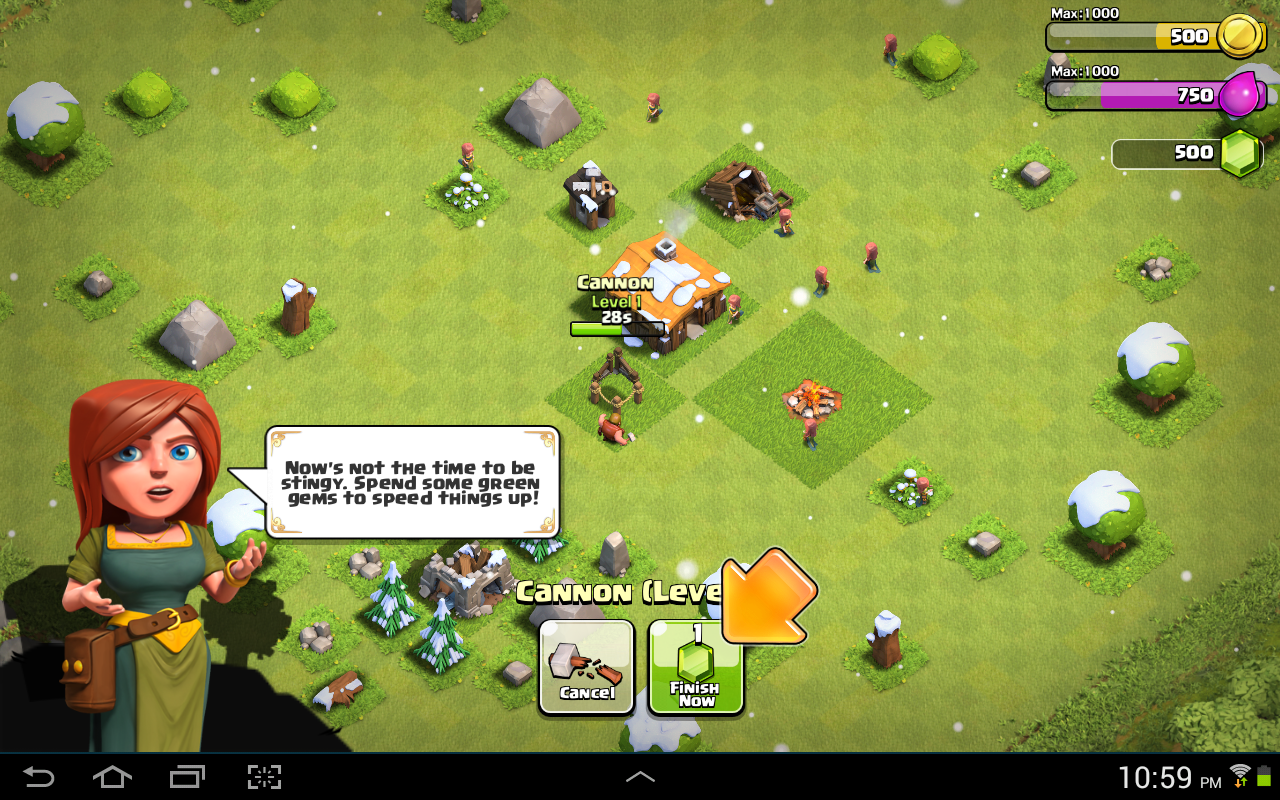
Stop trying to manipulate me, lady!
Upon downloading the game for the first time, I got the usual barrage of tutorials, which as in most games want the player to build the rudiments of their basic home-base structure, in this case a village. The game will insist that the player use gems to speed up the process of building, but these will be hard to come by later in the game without making in app purchases with real money, so I advise against using gems, and just waiting out the thirty seconds it takes to create a Builder’s Hut. Players do receive gems as a reward for completing the challenges in the Challenge Menu, but they are few and far between.
Initial setup is pretty fun. It’s nice to learn what all the different buildings do. The rules and gameplay are very generic. Gold, which the player accumulates from mines, and Elixir, which accumulates from elixir pumps, are used to purchase and build structures, defensive weapons, and warriors. Gems are used primarily to speed things up.
The first structure is the Builder’s Hut. Each hut houses one builder, and each builder can work on one project at a time. Builders are required for each new structure and to upgrade existing structures. I currently have two Builder’s Huts so I can only build or upgrade two structures at a time. (I should mention here that Builder’s Huts are the only structures that require gems for purchase—this can get annoying.)
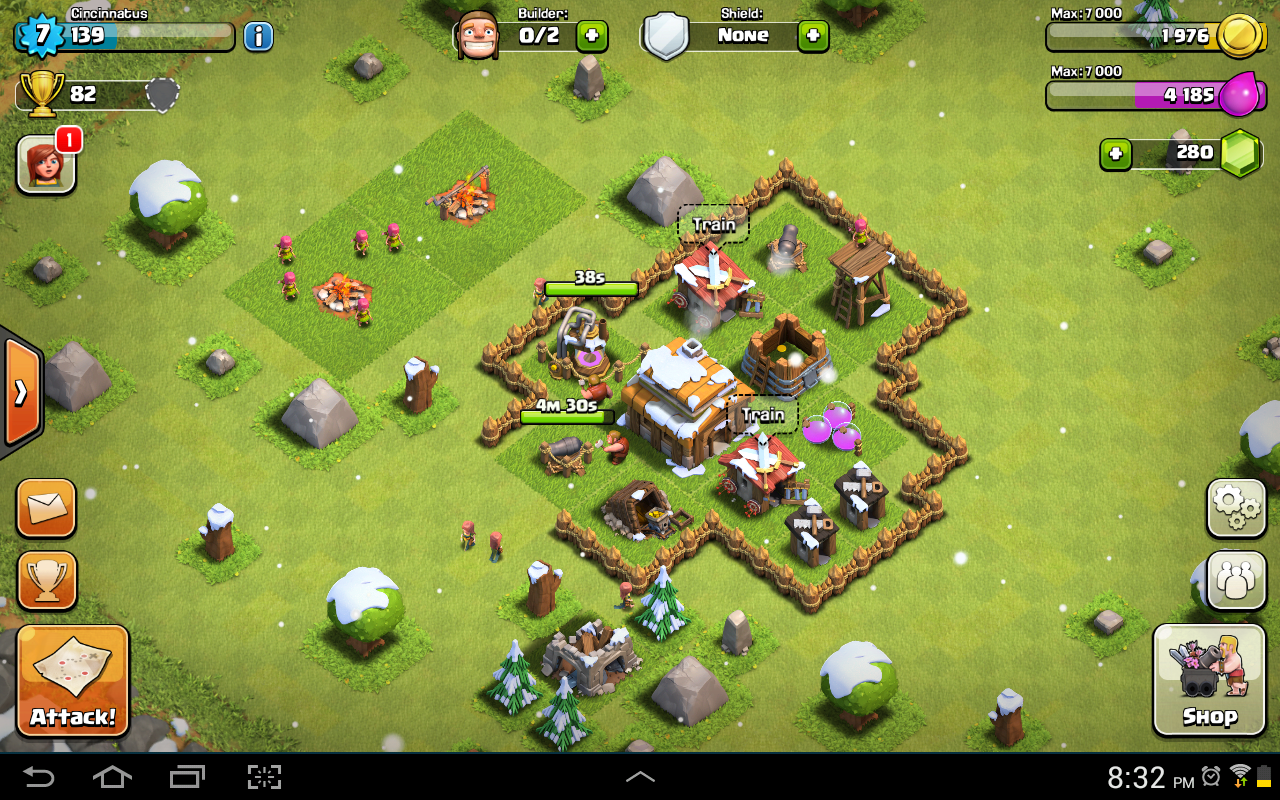
Help! Not enough wall!
Defensive weapons can be purchased for gold. At first, players only have access to a few defensive items: an archer tower, a cannon, and a few units of wall. As they level up and upgrade the Town Hall, they gain access to more types weapons and in greater numbers.
Offensive warriors are purchased with Elixir points. In order to have warriors, the player must set up barracks to train them, and army camps to house them. Leveling up the barracks unlocks new types of warriors, and leveling up the army camp allows the player to store more warriors at a time. In later levels, players can purchase the laboratory which, for a fee, will allow them to upgrade their warriors’ abilities.
Players can attack other fortresses in either of two ways. They can attack a goblin camp on the map, which results in a small gain of gold and elixir (provided their army wins). Alternatively, they may attack another player’s fortress. If I attack another player and destroy his village, he is automatically given a shield for a number of hours corresponding to the amount of damage I do to his village—up to sixteen hours for 100% destruction. While the shield is in place, no one can attack him again.
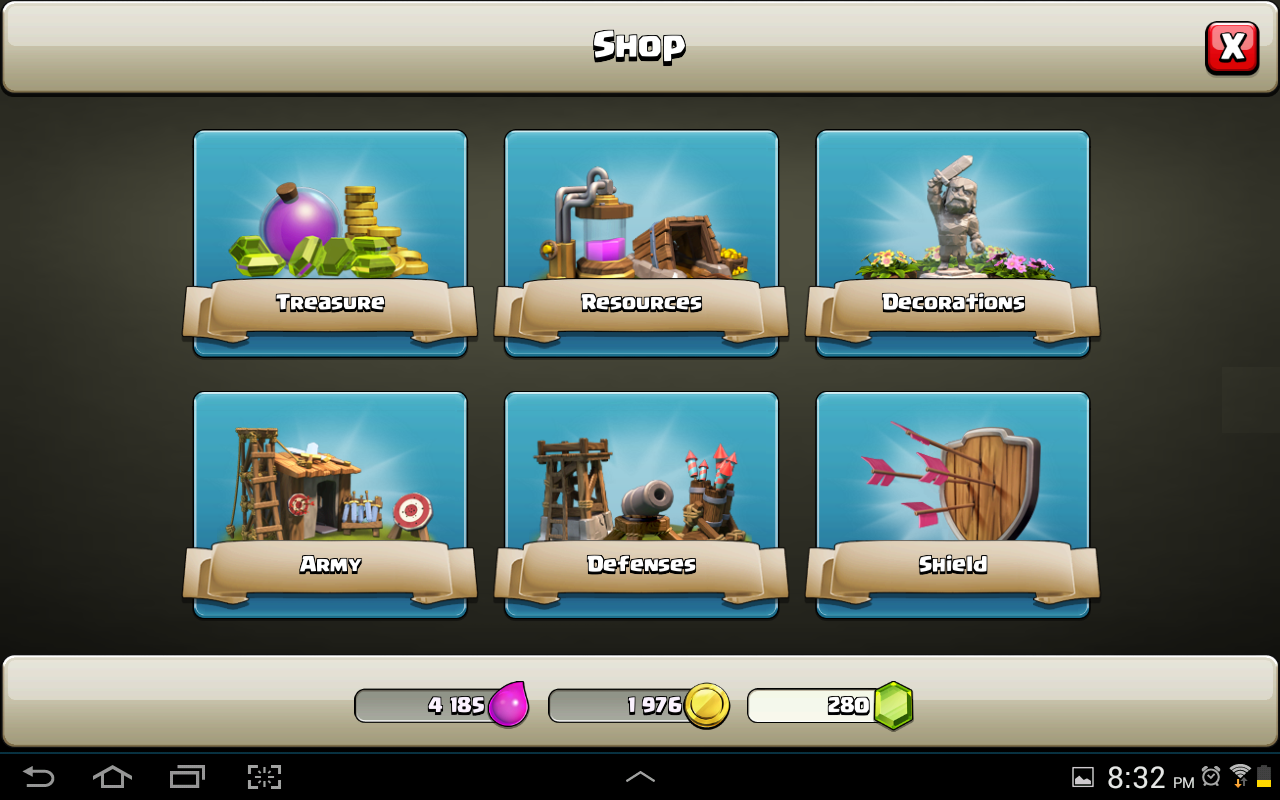
Purchase menu
After a few levels, players can save enough money to rebuild the Clan Castle, and then join a Clan or create their own. Clans tend to be groups of similar ranking players. I personally dislike the social aspect of games like this, so I don’t really like this feature. One perk of joining a clan, however, is the donation of troops to players in need.
All in all this is a fun game at first. I am playing on a tablet, and there is ample room to tap and move. Unfortunately, after level fifteen or thereabouts, I became trapped in a cycle of being beaten up by larger clans, saving up money while I had a shield in place, and still being short of the amount needed to upgrade my defenses before the shield ran out and I was attacked and my gold and elixir stolen.
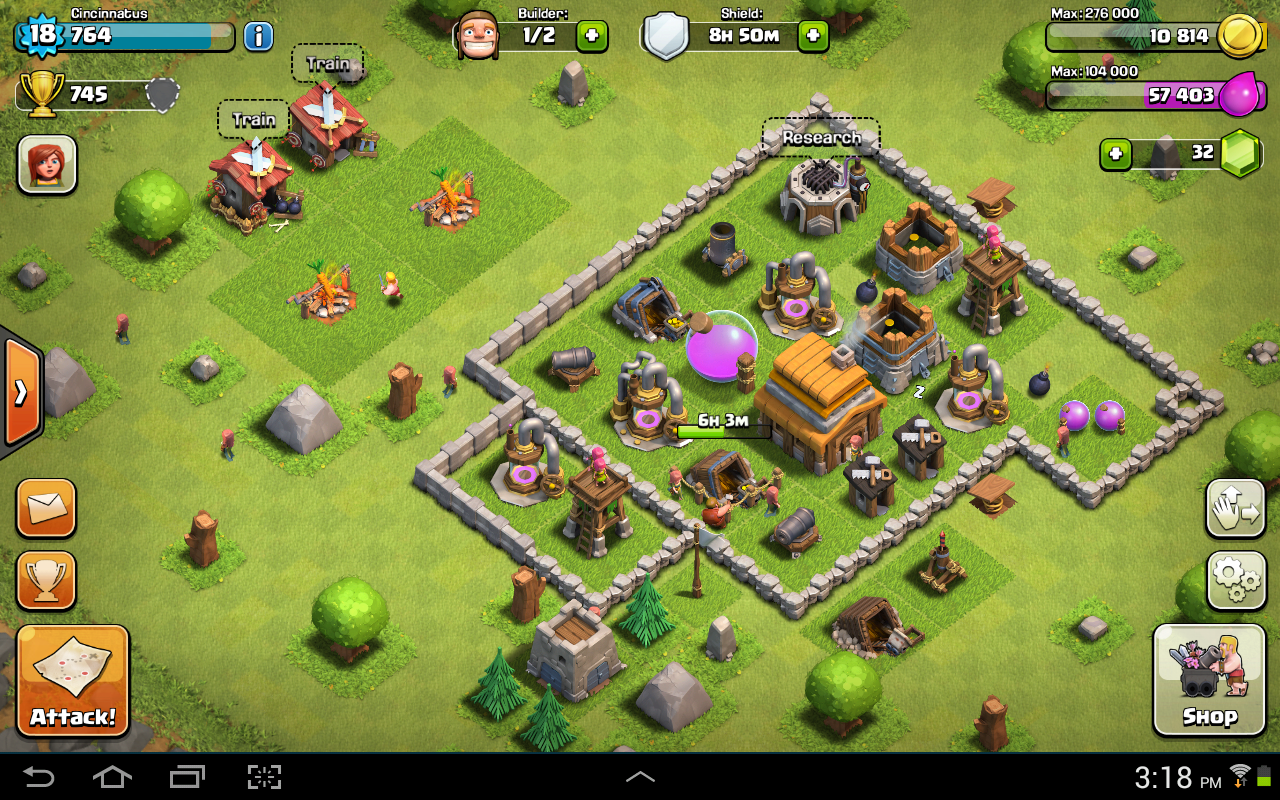
My current fortress
There are huge in-game rewards for continuing on past level nineteen, where I currently am, but I am getting bored with the game and may not continue to play at all. This game is free on iOS and Android devices. I give it three and a half Death Stars, because it couldn’t hold my attention for more than two weeks.


 Therefore I Geek
Great review, i can only say that coc is one of my favorite mobile games. Because it have everything, graphic, action, strategy, etc…
Pingback: Editorial | Follow Up Review: Clash of Clans | Therefore I Geek