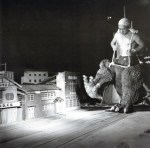
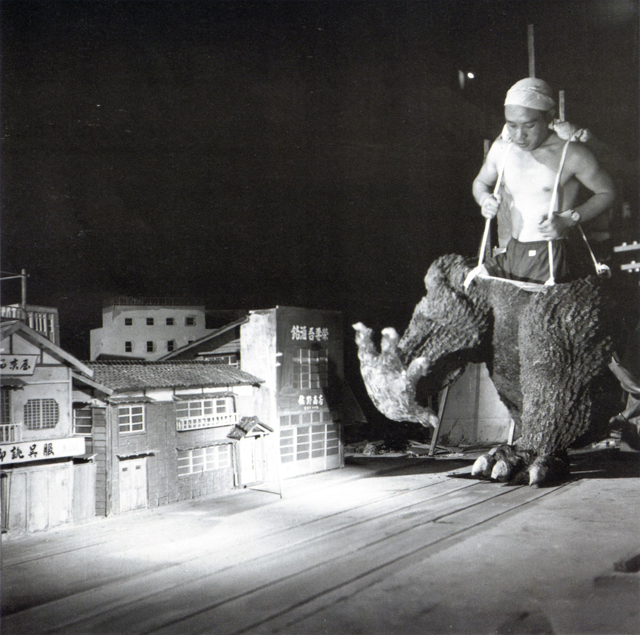
Man in foam rubber suit.
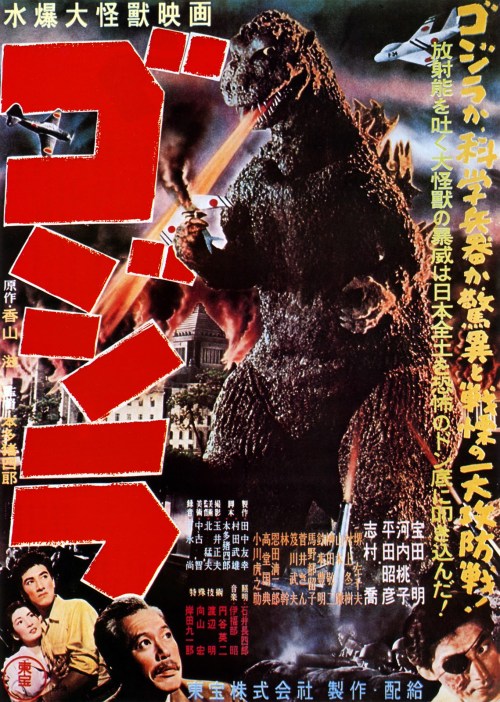
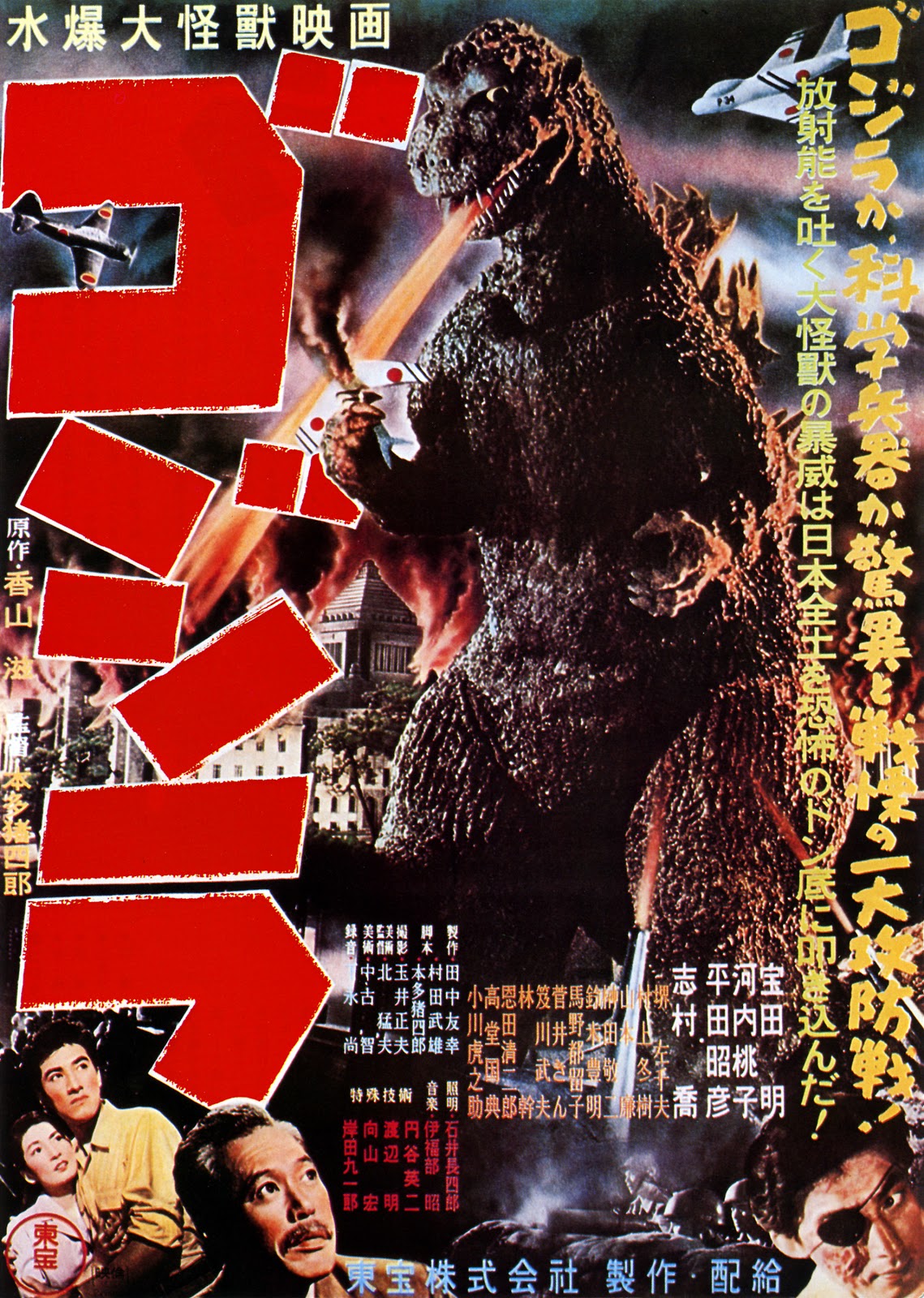
1954’s Gojira is a piece of film history. For those of you scratching your heads, Gojira is more commonly known in the United States as Godzilla—everyone’s favorite foam rubber monster. When most people think of Godzilla, they think of men in sketchy looking, foam rubber suits fighting each other in a model town, crushing everything in their process (poor Tokyo). This stereotype might be true for some of the later movies, but the original Godzilla is much more complex than that. Not only is it a classic B movie, but it also provides us with some valuable insight into post war Japanese culture.
The most important thing to realize about Godzilla is that there is a plot, despite popular belief to the contrary. In fact, not only is there a plot, but it’s a pretty good one. The film starts off with the mysterious sinking of a fishing vessel; a flash of light from under the water and the ship is engulfed in flames and sinking. Shortly thereafter another boat shows up to investigate the scene of the first sinking and it too is destroyed in spectacular fashion. While the Japanese Coast Guard investigates, a fishing village on the island of Odo is ravaged by what is first thought to be a storm, though there are reports of a giant monster that caused the damage. The Japanese government sends a scientific team to investigate, and they discover enormous, radioactive footprints throughout the village. Between the radiation and the discovery of a trilobite (a small creature thought to be extinct millions of years ago), the scientific team concludes that the creature must be from the Jurassic period. Soon after Godzilla himself is sighted on the island.
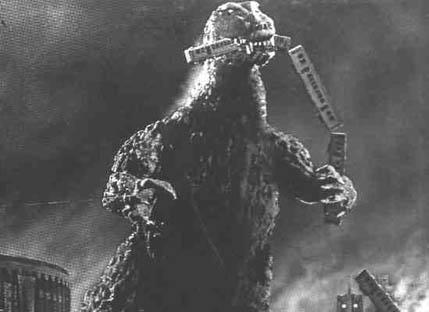
Mmmmm, train…nom nom nom.
The Japanese Coast Guard decides that Godzilla is too much of a threat and must be destroyed and attempts to do so with depth charges. Of course this goes poorly for them and only drives Godzilla to attack Tokyo harbor. Eventually Godzilla is driven off, but not before turning Tokyo into a flaming ruin. In a final act of desperation, Japanese scientists release the Oxygen Destroyer into the water of Tokyo harbor, killing all living things in the harbor, including Godzilla.
To begin, the incidents involving the fishing vessels mirror a real life incident in which the crew of a Japanese fishing vessel were exposed to extreme radiation from an American underwater Hydrogen bomb test. While film makers caught considerable flack from critics and the public for this parallel, it tapped into the Japanese cultural mindset. Godzilla was released only nine years after the end of WWII and the horrors of the nuclear bombs were still fresh in everyone’s minds. In the 1950’s, there was still a lot that was unknown about the effects of radiation, but the fear of radiation is still a very real concern for the Japanese even today.
When the senior scientist presents his results to the Japanese government he immediately blames the H-bomb tests not only for disturbing Godzilla, but also for causing his mutation in the first place. The Japanese government wants to destroy Godzilla, but the scientists want to study him, especially his resistance to high level radiation, in an implicit effort to better treat those who’d been exposed to radiation.
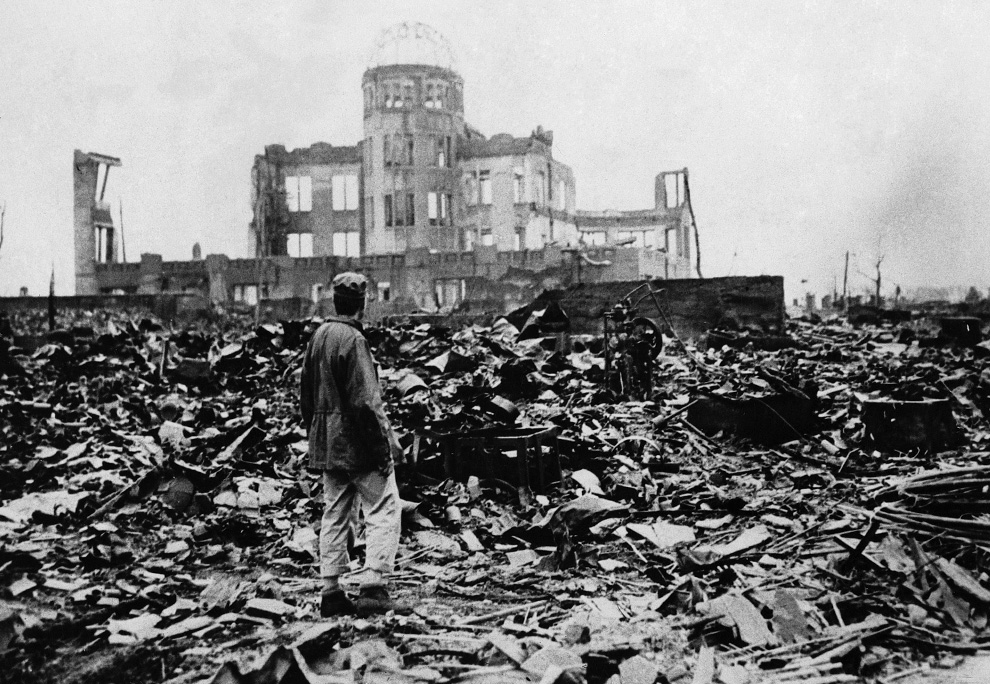
Godzilla’s attack of Tokyo harbor leaves the entire city in ruins, between his crushing things under foot and breathing fire all over the city. The scenes of a devastated city, filled with rubble and flames must have also hit home with Japanese audiences who remembered living through the firebombing of their cities. The fact that a monster movie like this can so directly tap into the pulse of Japanese society speaks volumes about its quality.
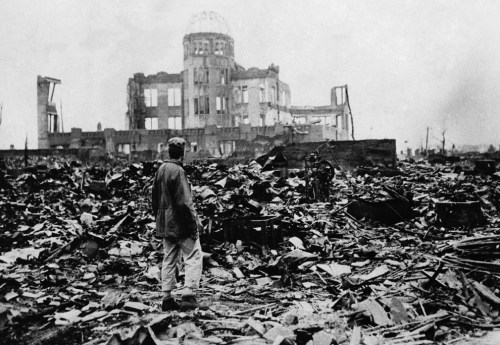
Aftermath of Hiroshima, an image still fresh in the mind of Japanese movie goers.
There are many things I love about Godzilla; chief among these is the miniature work. Well before the advent of computer generated special effects, the only options available to film makers were to film full-sized events (like Buster Keaton in The General) or use miniatures. Full sized effects are often one shot attempts, expensive and very limited in scope. Miniatures, on the other hand, allow for a world of options, can be repeated if the shot isn’t to the directors liking and are reasonably inexpensive. The real trouble with miniature work is that, done wrong, they can look terrible. Thankfully, the work in Godzilla is surprisingly good. Most of the work was masterfully done, with incredible attention to detail. There were also several occasions where the film makers blended miniature work with live actors. Several scenes of destruction showed live actors on a set which was then destroyed (in miniature) after a quick cut. It is almost impossible to tell the difference between several of these sets and their miniature counterparts. There is only one time the miniature work disappoints me and that is when jets finally chase off Godzilla. The jets themselves look like cheap models made from balsa wood and the wires attached to them and the rockets they fire are very visible.
I also thoroughly enjoyed the science aspects of the film. From the use of actual Geiger-Muller Counters, to the discovery of the trilobite in the foot print, there is factually accurate science all over the film. My favorite reference was to the discovery of Strontium-90 in the footprint, which—after a few minutes of Google searches—I discovered is actually an isotope found several weeks after the detonation of an atomic weapon.
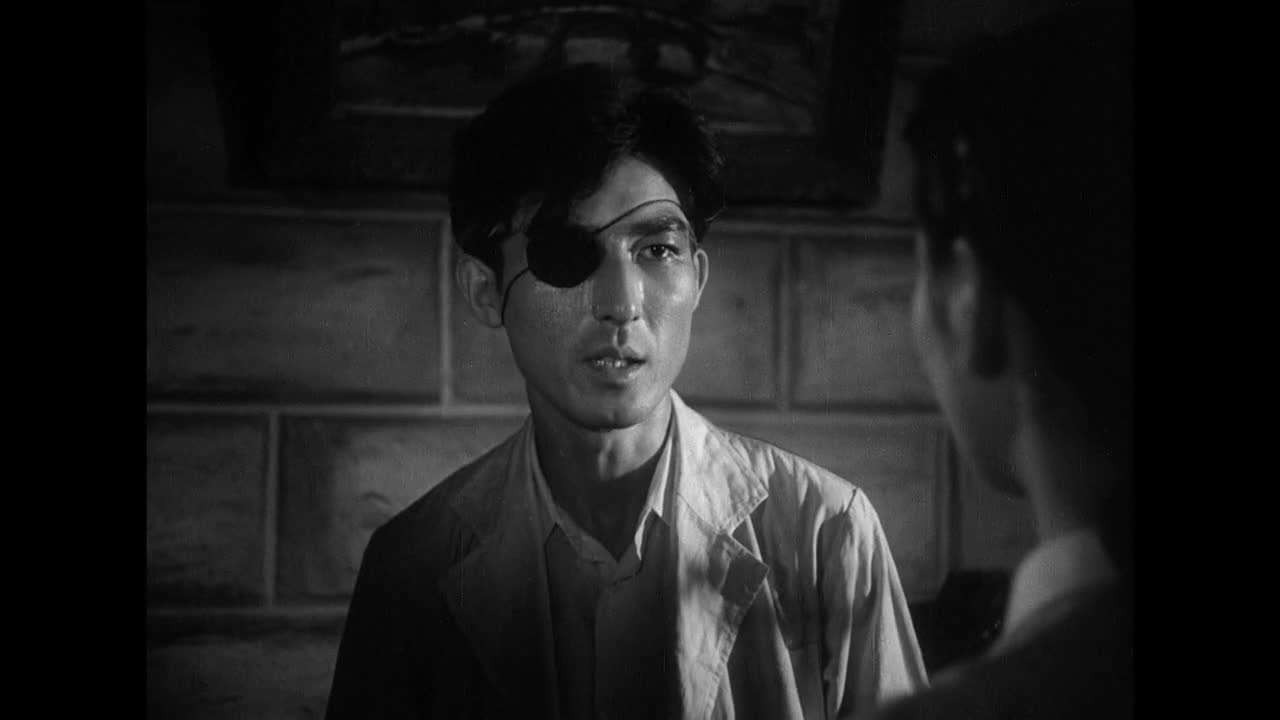
Even the ending of the movie is dependent on science, although that science is unfortunately utter garbage. The idea of an Oxygen Destroyer is completely ridiculous though it does serve a purpose, aside from ridding th0e world of Godzilla. The Oxygen Destroyer is a weapon that is even more dangerous than the atomic bomb and it isn’t used until there are no other options left and even then the creator dies with his creation to ensure that it can never be used again. Given what they experienced as a culture, it’s no surprise that the Japanese have this feeling towards a weapon of mass destruction and the willingness of a scientist to sacrifice himself in order to prevent it from being used by anyone ever again.
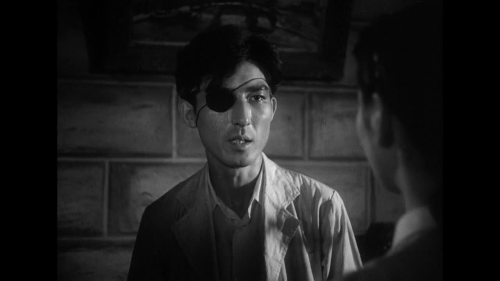
This man was willing to die to prevent another Hiroshima.
Even though it is a monster movie, Godzilla is definitely worth checking out. If you need more proof of this movie’s excellence, just look to the fact that the year it was released if won the Japanese Movie Association award for Best Special Effects and was nominated for Best Picture, losing to Kurasawa’s Seven Samurai. Without a doubt this film warrants five Death Stars.







 Therefore I Geek