Tag Archives: Editorial

Editorial | Review: ACID

***** SPOILER ALERT *****

This review will be discussing plot points which may be considered spoilers. Consider yourselves warned.

I have gotten my hot little hands on a copy of Acid, the first novel from author Emma Pass.  The author is from the Midlands, UK, and her European roots come out in certain word choices and, of course, measurements.  Fortunately for Therefore I Geek readers, I have read the book and am here to lay out the good, the bad, and the ugly about it.

The Good: The main character in this book is one Jenna Strong, who is in a maximum security, male only prison at the tender age of seventeen for parricide.  The book is set in 2113, in a UK that is completely cut off from the rest of the world.  A lackadaisical government has been thrown out of power by an anti-terrorist arm of the military/police force called ACID (Agency for Crime Investigation and Defense) and a police state has been in place for about 100 years.  As far as the good of this book goes, the well designed acronym is pretty much all it has to offer.  That, and the perfect use of the subjunctive tense.

Continue reading

Leave a comment

Filed under Book Reviews, Books, Editorial, Tracy Gronewold

Editorial | Organizers and Explorers: Two Schools of Writing

There are two types of people in this world…  Ok, ok, there are many types of people in the world, but there are two schools of thought when it comes to writing.  Whether they write short stories, full length novels, academic research, or blog posts, most authors either are organizers or explorers.

Organizers believe in brainstorming before they begin writing.  They know the direction in which they want to take their readers before they jump into the meat of their prose.  I personally enjoy this method most—especially in more formal writing.  If I don’t have an endgame in mind, it is difficult to get my writing to move from the beginning to the end at a decent pace.  George R. R. Martin, Therefore I Geek’s man of the month as we gear up for the premier of Game of Thrones Season 4, describes these writers as architects.

“I think there are two types of writers, the architects and the explorers. The architects plan everything ahead of time, like an architect building a house. They know how many rooms are going to be in the house, what kind of roof they’re going to have, where the wires are going to run, what kind of plumbing there’s going to be. They have the whole thing designed and blueprinted out before they even nail the first board up… “

Brandon Sanderson

The benefits to organizing are obvious.  The author knows exactly where he is going.  He may start with a bare bones outline and begin to add sub-points or blocks of text.  If he gets stuck on one point, it is much easier to move on to the next point or section of the story.  I often have short bursts of inspiration that don’t fit where I currently am in my writing.  As an organizer with a penchant for outlines, I find it easy to take a break from the parts of my project that I’m in the middle of and quickly jot down the bits that have sprung into my brain.  From there it is just a matter of fitting that section under the correct bulleted heading.

Unfortunately, the downside to having a detailed plan is that the author may feel like he’s already written the story, and may get bored of his work before it is complete.  This has happened to me several times.

One famous outliner is Brandon Sanderson, author of The Way of Kings, and the brand new Words of Radiance.

The other type of writer is an explorer.  These writers follow where their personal inspiration takes them, no matter how many twists and turns that entails.  It is less that they have an endgame in mind, and more that they trust their ability to come to a conclusion when the time is right.  G. R. R. Martin describes them as gardeners, “The gardeners dig a hole, drop in a seed and water it. They kind of know what seed it is, they know if they planted a fantasy seed or mystery seed or whatever. But as the plant comes up and they water it, they don’t know how many branches it’s going to have, they find out as it grows.”

George R. R. Martin

Explorers have an easier time of writing in that they don’t feel as much pressure to know where their plot line is going and under what conditions.  This style of writing is very story driven, and can feel more natural to the writer.

Unfortunately, the exploration style of writing can also lead to stymied authors, who have run into writer’s block, and cannot take a break to write another portion of their work, because they don’t know where the work is going.

Which type of writer is George R. R. Martin?  “I’m much more a gardener than an architect,” he tells fans

4 Comments

Filed under Books, Editorial, Tracy Gronewold

Editorial | Review: Clash of Clans

So today on my desk I have the screen shots from a game called Clash of Clans.  Supercell, the game’s developer, describes this as “an epic combat strategy game” and today I’ll tell you if this description is accurate.
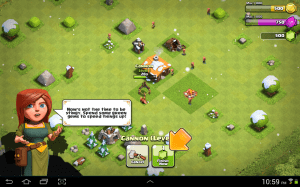
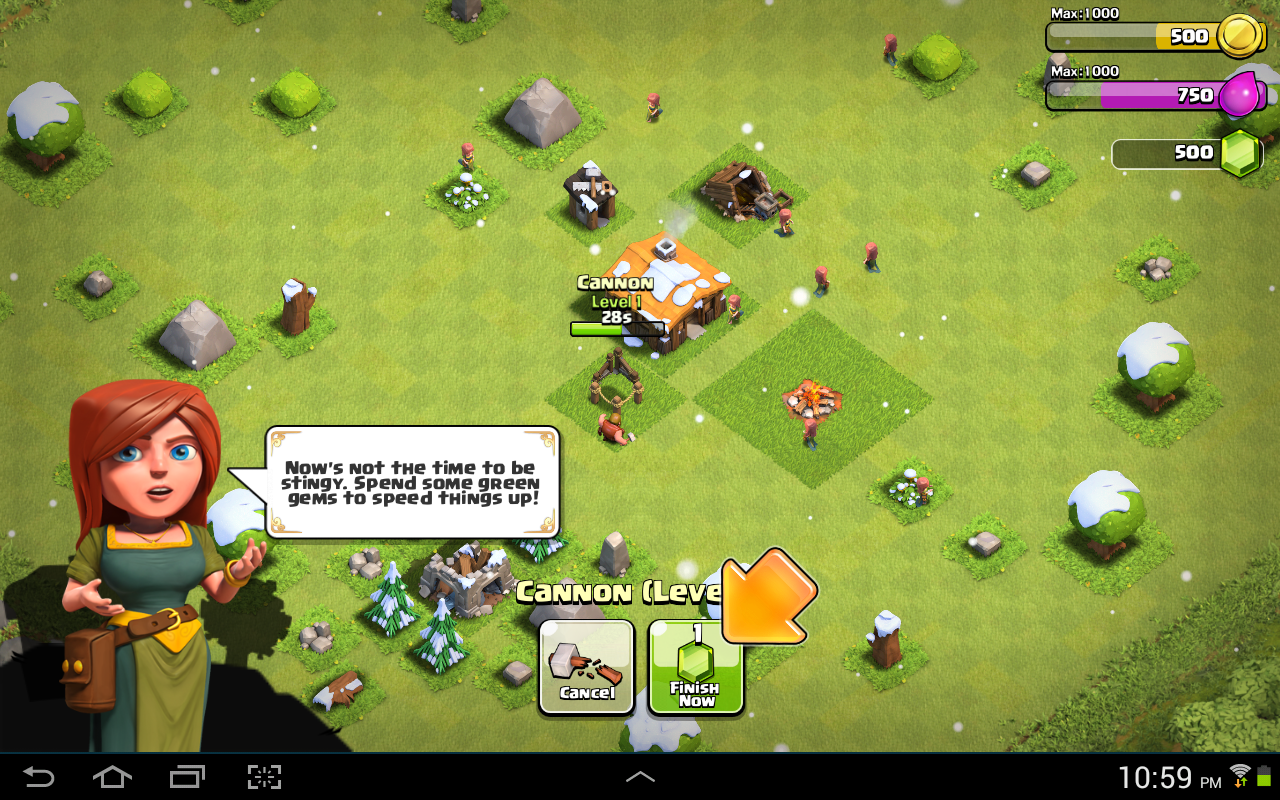
Stop trying to manipulate me, lady!

Stop trying to manipulate me, lady!

Upon downloading the game for the first time, I got the usual barrage of tutorials, which as in most games want the player to build the rudiments of their basic home-base structure, in this case a village.  The game will insist that the player use gems to speed up the process of building, but these will be hard to come by later in the game without making in app purchases with real money, so I advise against using gems, and just waiting out the thirty seconds it takes to create a Builder’s Hut.  Players do receive gems as a reward for completing the challenges in the Challenge Menu, but they are few and far between.

Initial setup is pretty fun.  It’s nice to learn what all the different buildings do.  The rules and gameplay are very generic.  Gold, which the player accumulates from mines, and Elixir, which accumulates from elixir pumps, are used to purchase and build structures, defensive weapons, and warriors.  Gems are used primarily to speed things up.

The first structure is the Builder’s Hut.  Each hut houses one builder, and each builder can work on one project at a time.  Builders are required for each new structure and to upgrade existing structures.  I currently have two Builder’s Huts so I can only build or upgrade two structures at a time.  (I should mention here that Builder’s Huts are the only structures that require gems for purchase—this can get annoying.)
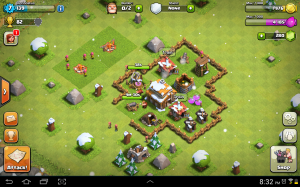
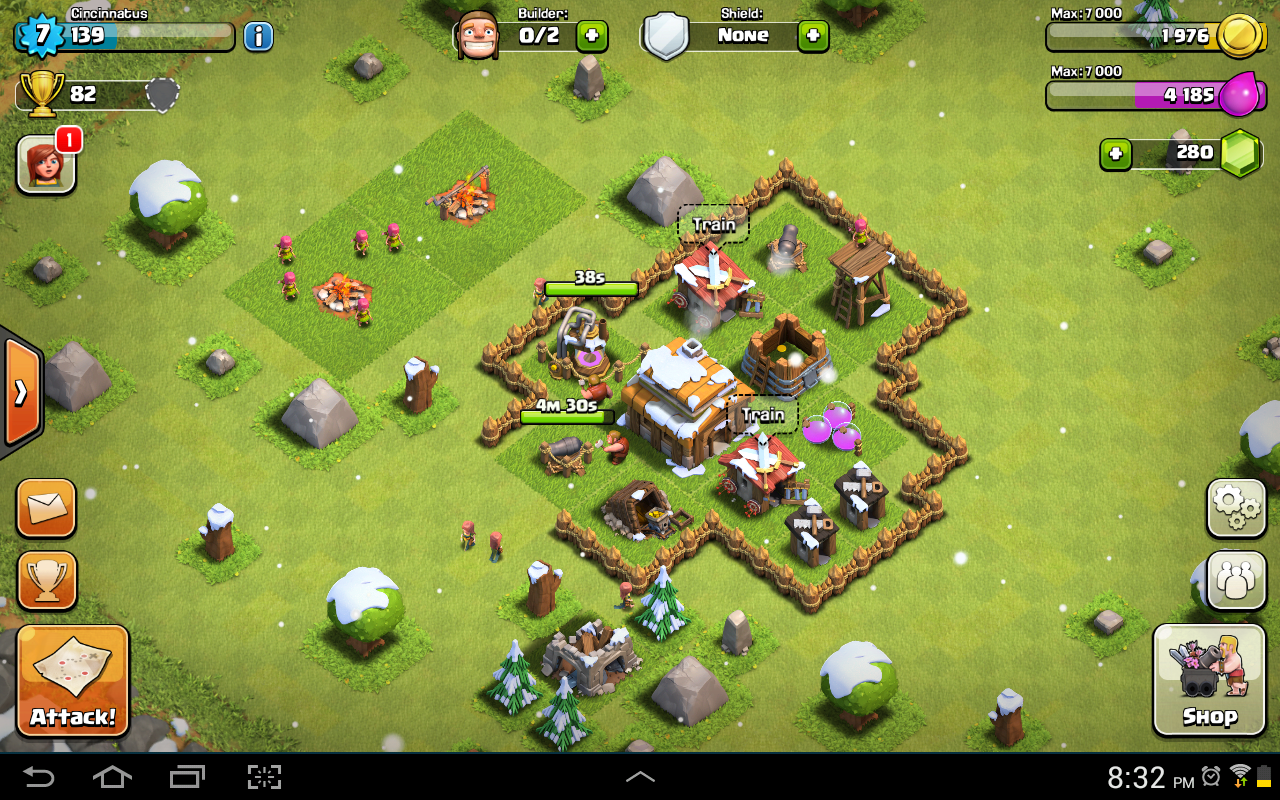
Help! Not enough wall!

Help! Not enough wall!

Defensive weapons can be purchased for gold.  At first, players only have access to a few defensive items:  an archer tower, a cannon, and a few units of wall.  As they level up and upgrade the Town Hall, they gain access to more types weapons and in greater numbers.

Offensive warriors are purchased with Elixir points.  In order to have warriors, the player must set up barracks to train them, and army camps to house them.  Leveling up the barracks unlocks new types of warriors, and leveling up the army camp allows the player to store more warriors at a time.  In later levels, players can purchase the laboratory which, for a fee, will allow them to upgrade their warriors’ abilities.

Players can attack other fortresses in either of two ways.  They can attack a goblin camp on the map, which results in a small gain of gold and elixir (provided their army wins).  Alternatively, they may attack another player’s fortress.  If I attack another player and destroy his village, he is automatically given a shield for a number of hours corresponding to the amount of damage I do to his village—up to sixteen hours for 100% destruction.  While the shield is in place, no one can attack him again.
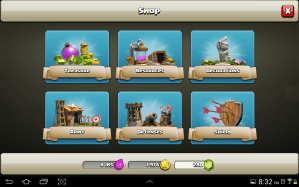
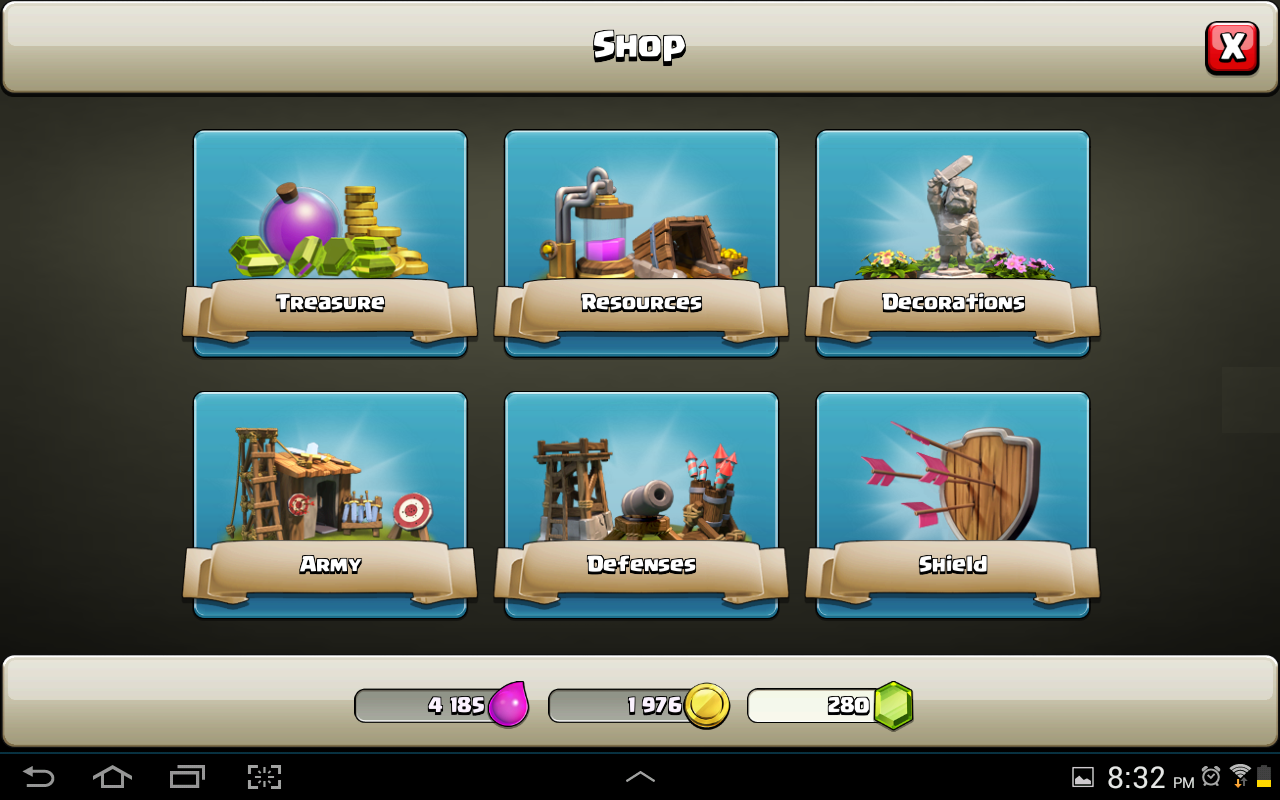
Purchase menu

Purchase menu

After a few levels, players can save enough money to rebuild the Clan Castle, and then join a Clan or create their own.  Clans tend to be groups of similar ranking players.  I personally dislike the social aspect of games like this, so I don’t really like this feature.  One perk of joining a clan, however, is the donation of troops to players in need.

All in all this is a fun game at first.  I am playing on a tablet, and there is ample room to tap and move.  Unfortunately, after level fifteen or thereabouts, I became trapped in a cycle of being beaten up by larger clans, saving up money while I had a shield in place, and still being short of the amount needed to upgrade my defenses before the shield ran out and I was attacked and my gold and elixir stolen.
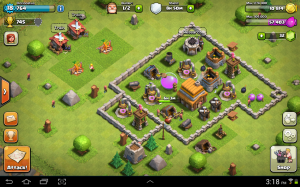
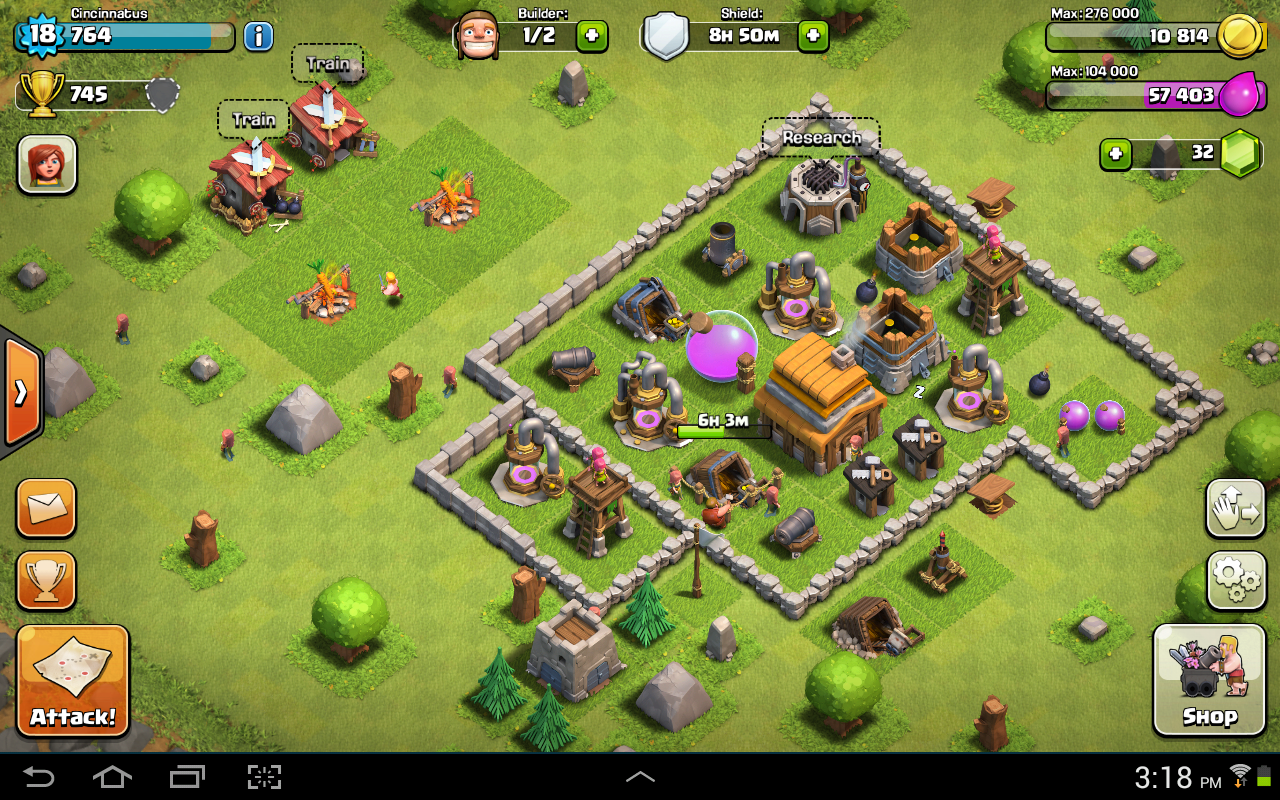
My current fortress

My current fortress

There are huge in-game rewards for continuing on past level nineteen, where I currently am, but I am getting bored with the game and may not continue to play at all.  This game is free on iOS and Android devices.  I give it three and a half Death Stars, because it couldn’t hold my attention for more than two weeks.3.5 Death Stars

2 Comments

Filed under Editorial, Game Reviews, Gaming, Tracy Gronewold

Editorial | Review: Fates

While I was at New York ComicCon, I was fortunate enough to be able to snag several advance copies of some really interesting books.  I am really pleased to be able to review these books before they are available for sale.  Today’s review is Fates, which will go on sale next month.

The cover image and tagline for Lanie Bross’s book were definitely not encouraging.  “There will be no miracles today,” the front cover proclaims.  I opened the book thinking that I was going to read another fairly trite piece of young adult fantasy.  (This is called foreshadowing, and in this case it indicates that the content of the book changed my mind.)

The first couple of chapters were told mostly from the point of view of typical, modern, high school students.  The dialogue is atrocious, and my heart sank.  I was prepared to put the book down.  Then the story seemed to come into its own, and I really started to enjoy it.

Corinthe, the main character, was a Fate, once upon a time.  She made a mistake while doing her job one day, and her punishment was to leave her Eden-esque home in Pyralis (in an alternate dimension) and walk the earth.  She is now an Executor, tasked with carrying out assignments to make sure that humans’ fates proceed according to plan.

The other protagonist, Lucas Kaller, is a human who has been forced to grow up too soon.  His home life fell apart after his mother left the family, and his dad retreated inside himself.  His sister turned to drugs, and Luc was left to keep the pair of them alive, if not functional.

In opposition to the orderliness of the Fates and the current system, a group that call themselves Free Radicals roam between worlds and attempt to bring chaos to all dimensions.

The plotline of Fates is fairly straightforward, with few surprises for the experienced reader.  The heroes go on a quest, feel a strange attraction for one another, and fall in love.  However, the quest itself has some unique twists—Corinthe seeks redemption, while Lucas seeks something else entirely—and the final act of this book is not at all what I expected from fluffy YA fiction.

The setting of this world was well created.  Most of the scenes set on Earth feel like a depiction of a yuppy, California city.  The secondary characters aren’t quite as fleshed out as I would like, but the primary characters are very bright and lifelike.  It is easy to empathize with them.  The prose is simple; the vocabulary is light and pleasing.  I appreciated that the dialogue matured quite a bit once I got through the first few scenes of high schoolers interacting.

Fates caught me by surprise and made me change my initial judgment.  I liked Corinthe a lot by the end.  It certainly is not a classic piece of fiction, but it is very enjoyable, light reading.

This book goes on sale on February 11, and will be available in hardback and e-book form.  I would say that it is worth buying at the e-book price.  Therefore I Geek’s rating is three and a half out of five Death Stars.3.5 Death Stars

Leave a comment

Filed under Book Reviews, Books, Editorial, Tracy Gronewold