Category Archives: Comics History

The Man Who Almost Killed Comics

Throughout history most forms of popular entertainment have had their moral detractors. In the 50’s Elvis was only allowed to be shot from the waist up due to his provocative hip movements. Tipper Gore went on a crusade against heavy metal music in the mid 80’s. A 2005 California law banning the sale of certain video games to minors was struck down by the U.S. Supreme Court in June of 2011.  For many industries, efforts to ban products for moral reasons have been ineffectual at best, and often when the legal system is actively discriminatory, these efforts are found to be unconstitutional. When it came to comic books however, censoring attacks were extremely successful and resulted in the near collapse of the entire industry. This near fatal blow was orchestrated in large part by one man:  Dr. Fredric Wertham.
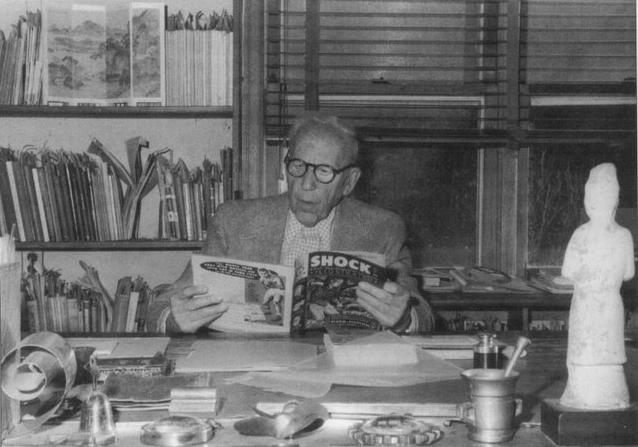
Dr. Fredric Wertham reading a comic book as part of his research.

Dr. Fredric Wertham reading a comic book as part of his research.

For the sake of fairness, Wertham cannot be wholly blamed for the attacks on the comic industry.  There were many other participating parties and several contributing factors that allowed this kind of censorship to take place.  However, Wertham’s role is the most important since he provided a scientific expertise around which the comic detractors could rally.  In the early 1950’s Wertham was a well-respected psychiatrist who often worked with the poor and juvenile delinquents.  It was his work with juvenile delinquents that actually began Wertham’s crusade for comic censorship.  As he interviewed the troubled youths, he noticed the pattern that most of the young men were regularly reading comic books.  Wertham assumed that a causal relationship existed between comics and deviant behavior, especially when it came to the more graphic horror and crime based comics. Wertham published his findings originally in a Ladies Home Journal article, and then later as book with the titillating title Seduction of the Innocent.

Wertham made many unsupported claims within the pages of Seduction of the Innocent including that Batman and Robin were homosexual lovers and that Wonder Woman was a lesbian.  He believed that these immoral influences, in addition to the violence in comics, lead to deviant behavior.  Soon Middle America was in uproar and the attack on comics was in full swing.  It was not uncommon for small towns to hold comic book burnings to rid themselves of the corrupting influence. This came to a head in 1953 with a hearing by the United States Senate Subcommittee on Juvenile Delinquency.  Over the course of three days, the Subcommittee heard testimony from Dr. Wertham, as well as EC Comics publisher William Gaines.
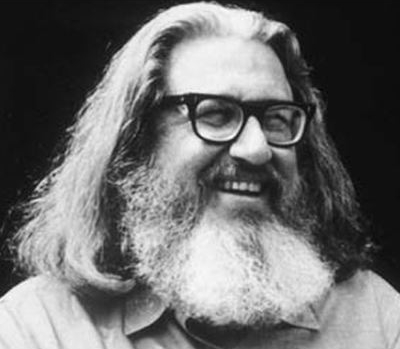
William Gaines

William Gaines

Much like the subcommittee overseeing the McCarthy hearings, which were being held during the same time period, this subcommittee came in to the hearings with less than open minds.  While Wertham was treated politely and respectfully, Gaines was questioned hostilely and treated with disdain. Gaines’ now famous exchange‡ with Chief Counsel Herbert Beaser is a prime example of how the committee members had already made up their minds before hearing all the testimony.

The infamous May issue.

The infamous May issue.

In the end the comic industry was forced to choose between imposing censorship on itself, or accepting the inevitable, and likely more restrictive government censorship that was coming their way. The new rules, called the Comics Code Authority, were loosely based on the film industry’s Hays’ Code and imposed a draconian list of limitations that crippled the comics industry. Among the most punitive measures were those banning all comics from using the words “horror” or “terror” in their titles and severely restricting the content of crime comics. These were both directed squarely at EC Comics, as punishment for Mr. Gaines testimony at the committee hearings. With these restrictions, almost of EC Comics’ books were forbidden, and EC was soon forced to cease publication. Within two years, sixty percent of all comic titles had ceased publication and those companies that remained in business were forced to slash their workforces.

The unfortunate reality surrounding these events has only just started to properly come to light. From the outset it was well known that Dr. Wertham’s methods were questionable.  A man who should have been well acquainted with the scientific method, he showed considerable disregard for it by failing to establish a control group to compare his findings.  If he had, Wertham might have realized that the overwhelming majority of kids at the time read comics.  Given that information, it would be impossible for someone to draw the causal relationship that Wertham claimed existed.  Dr. Wertham let his attempts to make a name for himself compromise his science.

Since Dr. Wertham’s notes became publically available in 2010, the full extent of his questionable methods has come to light. Prof. Carol Tilley of the University of Illinois has discovered several instances where Wertham exaggerated the findings of his interviews in order to tip the results more into his favor.

Despite all of this, Dr. Wertham is not without his redeeming qualities. Some of his other research was presented as evidence during Brown vs. Board of Education, where it provided scientific proof that racial segregation was harmful to the mental health of children, aiding in overturning fifty eight years of the “separate but equal” doctrine.

While the comics industry may have taken a dramatic hit due to Dr. Wertham’s work, it was not down for the count.  The majority of the superheroes we love—including nearly all of Marvel’s characters—were born in an era in which the Comic Code held sway. In spite of the restrictions, these characters flourished and have become deeply ingrained in our popular culture.  With the death of the Comics Code Authority in 2011, we can finally say we are rid of Wertham’s shadow, though we should remain vigilant for others who claim to protect common decency for no other reason than to attack those things they disagree with.

‡ The audio recording provides the testimony of Dr. Fredric Wertham as well as that of Mr. William Gaines. The most famous portion of Gaines’ testimony begins at 1:34:30

Further Reading:

Comic Book Legal Defense Fund – An excellent resource regarding the history of comic book censorship as well current efforts to fight censorship.

Thecomicbooks.com – Provides a full transcript of the Senate Subcommittee hearings.
4 Comments

Filed under Andrew Hales, Comics, Comics History

Stan and Jack

Aside from those of its beloved characters, Marvel itself has an amazing origin story.  In November of 1961 Stan Lee and Jack Kirby released the first issue of Fantastic Four. Soon the two had several more titles under their belts such as Iron Man, The Incredible Hulk, The Avengers and The X-Men.  All the while the two men worked together using the Marvel method of writing comics, which was born more out of necessity than anything else. The Marvel method consists of a writer giving a brief outline of the issue to the artist, the artist plotting out the story, and the writer coming back and adding in all the dialogue to match both the art and plot summary.  In the 50’s Stan was Editor-in-Chief and writing nearly all of Marvel’s comics, which required him to cut corners, hence the plot summaries—some of which were only a paragraph or two long. This has unfortunately lead to a rather ugly fight between Stan and Jack (and now Jack’s estate).

The underlying problem is that the Marvel method leaves quite a bit of room when it comes to determining who really gave these characters their shape. On one hand it is possible that Stan provided Jack with fairly clear details and descriptions for these characters in his summaries and that while Jack certainly added something to them, it was mostly based on what Stan had provided him.  It is also just as likely that Stan was somewhat vague on the details, as was often the case, and that it was Jack that filled in the missing parts in order to really flesh out the characters. With the exact details of events lost to history, it’s pure speculation at this point as to what actually happened.

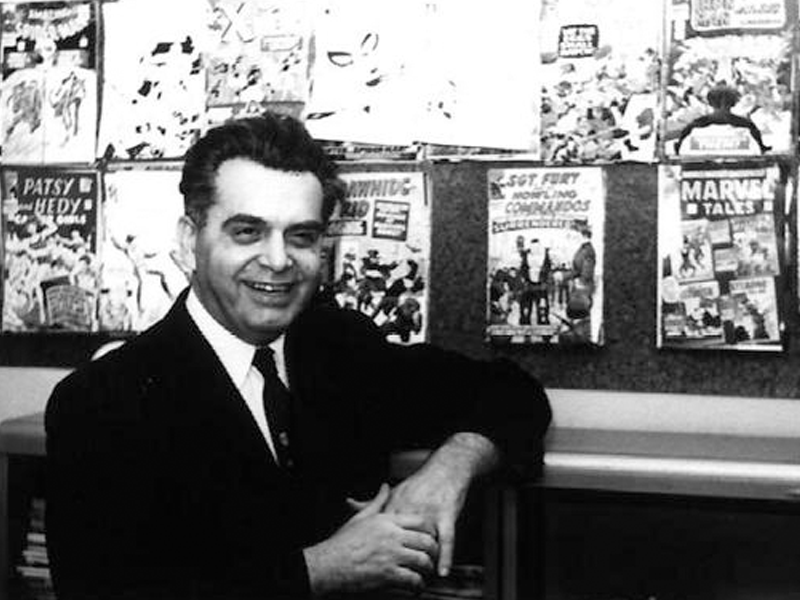
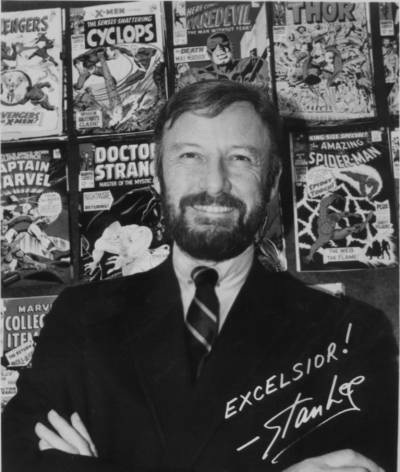
Stan 68 bw

Over the last few decades the tension between the two has led to a growing schism among fans of classic Marvel comics, with fans picking sides between Jack and Stan (Teams Edward and Jacob can suck it!). For a very long time there was a general public consensus that Stan was responsible for most of Marvel’s characters in large part because Stan was both the public face of Marvel and was much more personable than Jack. Newspaper interviews would go on and on about how wonderful Stan was while dedicating only a paragraph or so to Jack, often describing him in unflattering and sometimes insulting terms. It’s much easier to give credit to someone who is amiable and intentionally doesn’t correct people when credit is given erroneously. I can’t imagine that in the beginning Stan went out of his way to discredit Jack, though it is apparent that he made little, if no attempt to correct people.

jack-kirby-museum

Of course Jack is not wholly without blame in this circumstance. There is some evidence that makes me believe that Jack was never a big fan of Stan’s. This stems from years earlier when Jack was fired from Timely Comics (the predecessor of Marvel) because he and Joe Simon were going to a hotel during their lunch breaks to do work for DC. The publisher of Timely (Stan’s cousin) found out about their deal shortly after a very young Stan began tagging along for their lunch time sessions, and Jack and Joe both blamed Stan for this discovery. Years later, both Joe and Jack would be working for Stan, a position, I’m sure, in which neither was thrilled to be.  Towards the end of his life Jack also made grandiose claims that he was solely responsible for the creation most of the Marvel characters created during the 60’s.

When it comes to actual ownership rights, I must admit I fall into the crowd that says Marvel has the rights.  Certainly I am no legal expert, but given the circumstances under which the work was done, it seems that Jack was hired to do specific work for Marvel and that at the time Marvel had expectations that they would own the work. No one ever expected comics to become the industry they are today, with multi-million dollar blockbuster movies and these characters plastered on thousands of products. Even though they are masterfully crafted, these were still just stories for kids. It seems more than a little revisionist to look back from today and say that these men should have known better and that contacts should have been made clearer with rights explicitly delineated.  There was just no way of knowing.

Although I believe Marvel owns the rights, there is still the matter of doing the right thing. There is no excuse for the way Marvel, as a corporation, treated Jack; and as the head of Marvel, Stan had an ethical responsibility to put a stop to it, and he didn’t.  From the rejection of requests to return old original pages, to the blatant refusal to grant any credit to Kirby, Marvel did the wrong thing every chance they got.

This is too often the case when it comes to older creators who never expected their work to amount to anything other than an immediate paycheck.  Both Marvel and DC have made considerable sums off the characters and have shown very little compassion and respect to the men who created them.  The whole situation is made worse by the fact that Jack Kirby is not alone in this situation.

In the end, I think Stan began to believe his own hype and Jack became overly bitter.  During a radio interview on his birthday, Jack Kirby received a phone call from Stan, calling to wish him a happy 70th birthday on the air.  To me this shows that somewhere inside, Stan had an affection and respect for Jack and the work they did together and that maybe if Stan had stopped with the birthday greeting, it might have been the first step towards mending fences. But Stan, always the self-promoter, couldn’t stop there, and once again had to throw some barbs at Jack. It is a great shame that even by the time that Kirby died, these two men couldn’t come close to seeing eye to eye.

I believe that Stan and Jack are both right and both wrong. Given the unique method in which the Marvel method works, it had to have taken a collaborative effort to make these wonderful comics. Stan provided some great ideas which Jack improved upon with some of his own ideas and both men shaped the final product. While both men have had some level of success separately, neither has come close to the magic they achieved together.


Links:

Interview with Jack Kirdy on his 70th birthday – Stan enters the conversation at minute 19, and throws barbs at minute 33:30.

Marvel Comics: The Untold Story – Provides even more details about how Marvel worked behind the scenes. Highest possible recommendation.

Jack Kirby Museum – Working to create a permanent museum dedicated to the work of Jack Kirby.

4 Comments

Filed under Andrew Hales, Comics, Comics History